Column: 'Homer In Silicon': QTE Land
April 13, 2010 12:00 AM |
['Homer in Silicon' is a biweekly GameSetWatch-exclusive column by Emily Short. It looks at storytelling and narrative in games of all flavors, including the casual, indie, and obscurely hobbyist. This week she looks at Quantic Dream's PlayStation 3 exclusive Heavy Rain, with significant story spoilers included as part of the analysis.]
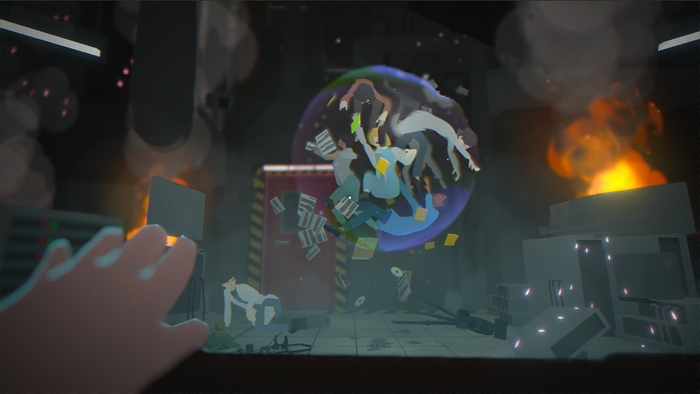
Plenty has already been written about Heavy Rain's defects as a game: the tiresomeness of the Quick Time Events, the fact that characters often walk back and forth in front of their own refrigerators in confusion, the inconsistent controls. All too often I felt like I was handling a character with a degenerative nerve disorder, nobly struggling with the quotidian trials of brushing teeth and drinking orange juice.
Personally, though, I would have been happy to forgive Heavy Rain its defects as a game in deference to its strengths as story and interactive movie. The movie aspect does work brilliantly. The cinematic aspects are beautiful, the split screen moments much more effective than I would ever have expected, the graphics superb.
It's too bad, then, that the story just isn't very good.
Heavy Rain does daringly strike out from the range of genres that video games typically cover: instead of space warfare or car racing or fantasy heroism, we have a thriller about a serial killer. But there it draws on a large pool of existing clichés. The killer who cannot resist laying out puzzles for his victims' families. The heavily-foreshadowed car accident. The broken marriage.
They're stock bits, and the fact that they come from the vocabulary of movies rather than the vocabulary of games does not make them any less predictable. The plot that results, moreover, depends on many characters acting against their own self-interest. It's oddly paced and full of holes.
Predictable genre elements do not have to be a killer in games. I've seen the argument -- made fairly persuasively by several of the articles in Second Person, for instance -- that having a familiar genre to work with helps players of story-oriented games form a clear understanding of their range of action.
But if the plot itself is not going to carry the work, it helps if there is something else going on to form the core of interest instead. In "Heavy Rain", that something else cannot be the gameplay; and, unfortunately, both theme and characterization fall short.
To get into why, the rest of the discussion will have significant spoilers. I recommend not reading on unless you've already played through Heavy Rain.
Problems of theme. At the core of this story there is supposed to be a thematic question. "How far," the game asks, "would you go to save someone you love?"
It's a valid question, an interesting one. Other games have explored it occasionally. The ending of Fable II touches on it, though in a timid and ineffective way. Victor Gijsbers' Fate deals with it much more extensively. It is, moreover, the kind of question that can fruitfully be posed in an interactive context, because after each choice the player can be challenged with a new decision that refines on the previous one, pushed to refine the terms of his own morality.
The problem is, the interactive aspects of Heavy Rain aren't mostly about this question at all. Norman and Madison are motivated more by curiosity and professional obligation than by love; Shelby bumbles through trying to find the right touchstones to get people to share their secrets with him.
Where we do explore the question of love and sacrifice, the results are mixed. Yes, there are a handful of relevant trials set out for Ethan Mars to experience: the risky drive the wrong way down the freeway, the interminable suffering of getting through the broken-glass-and-electricity maze, the choice of whether to shoot the drug dealer. But these choices are desperately contrived. In real life, our choices are never so melodramatic, so ridiculous. Consequently, it's hard to take them seriously, even though they are supposedly contrived by a killer who has reason to be interested in the problem of paternal love.
Moreover, though these sequences are narratively about choice, interactively they are framed as challenges. While story-Ethan may want to stick with the electricity maze and suffer through to the end, game-Ethan will quit if the player screws up the finger-Twister of Quick Time Events. What the protagonist would do is mapped against what the player can do, often to distancing effect.
That's not to say that a gameplay challenge can never represent the protagonist's choice. I've written before about how challenge in some games is an effective way to measure the protagonist's devotion to a cause. Arguably the electricity-maze sequence, at least, is an appropriate place to use this kind of challenge. The problem is that challenge-as-measure-of-determination works best if the player is willing (and encouraged) to replay a scene over and over until it comes out right. Heavy Rain spends most of its time discouraging the player from approaching it in that mode. So while I did restart the electricity maze a couple of times in order to win, I felt like that was a jarring break from the way the game otherwise worked, rather than an effective use of interactivity to merge the protagonist's experience with the player's.
In other places the disparity between player's challenge and protagonist's choice is even more problematic. I felt that story-Ethan would not be willing to shoot someone in cold blood -- that that was a bridge too far for him -- but the framing of the game forced me into a scene of visiting his potential victim's apartment and getting into an altercation with him. My failure at the QTE of the fight scene was then understood by the game as a decision not to take the man's life, but I would preferred to have expressed that decision earlier on, without ever going to the apartment at all.
Problems of characterization. I took Heavy Rain at its word that even failures should be played through and should produce meaningful stories. So while I did start a few scenes over when I had made the wrong choice because I simply misunderstood the controls (e.g., Jayden shooting the crucifix-obsessed man in the face), I did not go back and replay the more challenge-oriented action sequences. Both Jayden and Madison were dead by the time I got to the final stages of the game, and Shaun never got rescued.
When Madison and Jayden died, though, I didn't mind too much. I felt the strongest interest in Scott Shelby, who from the outset conveyed more personality than the others. Ethan, Madison, and Jayden all struck me as more or less blank slates. We get very little information about any of them other than their weaknesses, at the outset: we learn about Madison's insomnia and fear, Norman's addiction, Ethan's family tragedy, but little about their strengths, their likes, their social networks. (Possessing a magic evidence-finding glove does not count as a personality note.) Shelby alone gives much evidence of having pre-existing friends.
Then there was the acting and visualization. Shelby's body language and face expressed a patient world-weariness, and his willingness to keep fighting in the face of his own handicaps -- asthma, weight, age, world-weariness -- made me sympathize with the guy.
The interactivity supports that view. Shelby gets a more nuanced range of choices than the other characters. Where Ethan faces purely contrived serial-killer challenges and Madison has to puzzle over such doozies as "should I administer first aid to this severely wounded man?", Shelby gets to negotiate his way through a tense hold-up situation, empathize with grieving parents, patch up a suicidal woman and look after her baby.
Though a few of his options are a bit plot-contrived (do you give the life-saving pills to the man who suddenly has a convenient heart attack?), for the most part they seem plausible. I replayed the sinking-car scene until he succeeded in rescuing Lauren (a wrong guess about the controls had me save only Shelby the first time around) because it seemed inconceivable to me that this character, the character I'd developed in tandem with the game's authors, would ever leave a woman to drown.
He even gets the most expressive range of body-language actions, with scenes in which he can lean indifferently against a wall or sit sympathetically next to his interlocutor. Those options are sometimes open to other characters as well, but are most systematically implemented for Shelby.
Shelby, in other words, is the most humane of the protagonists, and the one for whom I felt my choices were the most genuinely defining. I was okay with the other characters being killed off -- even arbitrarily, even senselessly -- if my favorite hero remained alive.
If you've played the game, you know where this is going. The twist ending, the discovery that Shelby is the Origami Killer -- that felt like a betrayal.
Not because it was unexpected, not because I'd been successfully gulled into caring about Shelby -- I could live with that, and movies play those tricks all the time -- but because that twist negated the meaning of every truly interesting choice I'd made in the game up to that point. All that time I thought I was at least getting to craft one character, I was being played.
There are ways to make that work. I've played games before where it turned out that the protagonist was not the hero, or where the player's agency was much less than it originally appeared. But it doesn't work in Heavy Rain, where so much of the story and gameplay are built around the concept that choices do matter.
I strongly agree with all the articles and reviews that call Heavy Rain a must-play for people interested in narrative games. I'm delighted it was made, and I'd happily play more games that attempted some of the same things. While I didn't always have fun, I was almost always interested, and the times when I was bored were the spots, such as that horrendous electrified maze, when it was most gamelike. I would like to play more works where every moment of the game was in some way contributing to the narrative, and while Heavy Rain occasionally falls short of that (especially during the dull, draggy prologue), it does a better job than the vast majority of commercial games out there.
But I also feel that the real deficiency of Heavy Rain lies not in the limitations of its gameplay but in the nature of its story -- the clichés, the weak characterization, and, most of all, the makers' failure to recognize what would be interesting about making this particular story interactive.
(Disclosure: I played a copy of this work that was purchased at full price. I have had no commercial affiliations with the publisher at the time of writing.)
[Emily Short is an interactive fiction author and part of the team behind Inform 7, a language for IF creation. She also maintains a blog on interactive fiction and related topics. She also contracts for story and design work with game developers from time to time, and will disclose conflicts with story subjects if any exist. She can be reached at emshort AT mindspring DOT com.]
Categories: Column: Homer In Silicon


10 Comments
I can see why the average movie and game has tons of money poured into visuals, sound, game engine, etc. and almost no thought into plot, dialogue, etc. The truth is, people will buy it anyway, so why bother? And good story is hard, no doubt.
But why do narrative-based games still end up like this? I'm halfway through _Fahrenheit_ and it sucks. Cardboard characters, flat dialogue, one minute pouring champagne step-by-step, the next dodging angels and hanging from helicopters. The choices don't affect the story materially, the stats just get in the way, and the quicktime crap is ridiculous and keeps you from watching the sequences themselves.
_Fahrenheit_ should have been Quantic Dream's time to learn from their mistakes, but it appears they didn't, and introduced plenty more. I don't have a PS3, so will probably never play _Heavy Rain_, but if this is all the farther interactive fiction on consoles has gotten (several people have held it out as a shining example), then I'm going into hibernation for another 5 years.
Anyway, back to my question: yes, it's hard to write well, but why didn't a company willing to spend this kind of money and time on a story game invest more in the story itself and make sure they got it right?
Horace Torys | April 13, 2010 8:18 AM
My impression is that Cage believes he's already cracked the story problem with his deathless prose, and the rest is just down to more photorealistic graphics to make the game properly commercial.
Or, a cynical take is that the undemanding story is calibrated to flatter a naive player into believing they're having a quasi-art-house experience. If it had required any more challenging engagement it probably wouldn't have sold a million copies. I don't really believe that, although I suppose someone at QD or Sony probably made that calculation at some point.
I strongly agree it's still a step forward in terms of intention and in some respects even execution, but it's very depressing to see most of the serious gaming press enthuse in the undiscriminating terms they have. It means QD can just keep on turning out more Fahrenheits and Heavy Rains and the industry might just move from violent adolescence to earnest adolescence.
Alexis Kennedy | April 13, 2010 8:46 AM
@Horace Torys:
Well, I don't know the details of production, obviously, but I would guess at least part of the answer is that this is not a problem that's solvable by throwing money at it. Hiring people on from Hollywood doesn't guarantee that you get writers who understand interactive stories at all. What you need is someone who really understands what the gameplay is going to allow the player to express, and how that dovetails with the themes of the story -- and that's hard, because it transcends both writing and game design, and because you can never be quite sure how something is going to play until it's implemented, so you have to be able to come back to the project and adjust.
This stuff isn't easy, and I don't want to suggest I think it is-- I've got lots of respect for what QD was trying to do. (Well, mostly. The way the game handles the character of Madison annoyed me -- I felt I was being invited to participate in exploitation during the scenes where she's attacked and sexually threatened -- but that would be a whole other article.)
Emily Short | April 13, 2010 9:21 AM
@Emily
"...this is not a problem that's solvable by throwing money at it."
Granted, but the numbing earnestness of the dialogue, the bewildering ricketiness of the plot, the glassy characterisation, all the cliches you identify above - these are, surely, solved problems. The relative vitality of the Shelby scenes - just the sense of personality and the relatively competent acting you describe - is an effective signpost towards what it could have been.
Alexis Kennedy | April 13, 2010 9:54 AM
@Horace: Actually they did learn a lot of lessons from Indigo Prophecy/Fahrenheit. The story is full of holes, but it's more grounded and if you don't actually try to think anything through it almost makes sense. It was an objectively better story than, say, Transformers 2, which is more than I can say for Fahrenheit. They made QTEs feel decently good with branches, alternate outcomes, and acceptance of failure. I mean, they're QTEs. But they're the best QTEs I've ever seen by a wide margin, and the first time I've genuinely enjoyed them since Shenmue. QD didn't solve every problem from Fahrenheit, and their solutions sometimes introduced new problems, but it's not like they didn't learn anything.
I sidestepped the problem with Shelby because of the ending I happened to get. Madison and Jayden died, and Ethan succeeded in every trial. This meant that my Shelby was satisfied and left Ethan to save his son in the end. It made him fairly believable as both the Mr. Glass-like searching murderer and the sympathetic character he played as pre-reveal. One of the problems with having relatively fluid endings is that some of them are just not going to be as poetic as others, and some of them are going to fall apart completely.
Julian | April 13, 2010 10:24 AM
@Horace: Why do narrative-based games still end up like this? I think there are two answers.
Alexis mentioned the first. In this particular case, Cage simply thinks he is a lot better than he actually is.
The second answer is a bit more discouraging. I think the second reason is simply that people are willing to accept and even praise the quality that they currently get. Indigo Prophecy appeared to receive plenty of critical praise despite all of its glaring flaws. Heavy Rain has been praised as if it is the greatest gift ever given to videogames, blazing a new path. Amazing in its story (compared to the stereotypical action game fare). Unbelievable in how everything you do matters (even though it doesn't really). Even people who see some of the flaws still praise it for what it tried to do, no matter how far short it fell.
I think Heavy Rain is more an attempted progress at Myst-style games, and shines brighter for people who like that genre. For them, it is a light of hope rather than a bundle of failures. From the more action gamer-oriented view, you just have a bad story with bad gameplay and some bad design.
Billy Bissette | April 13, 2010 7:21 PM
What IF title would best showcase an interactive storyline with interesting, rounded characters?
Are there better examples of interactive console/PC titles in Japan or other countries? Last I checked, they were mostly date-sim-type visual novel thingies.
Horace Torys | April 13, 2010 9:40 PM
@HoraceTorys: There are quite a few one might recommend, but to pick just a couple:
Jon Ingold's "Make It Good" (http://ifdb.tads.org/viewgame?id=jdrbw1htq4ah8q57) is also a mystery story, with a lot of noir elements and a heavy emphasis on manipulating and interrogating characters rather than doing physical violence. It's a very difficult game, because you have to manipulate the non-player characters in some complicated ways, but it has a tight story with many many possible outcomes before you reach a favorable one. (And the word "favorable" is debatable here.)
Jim Munroe's "Everybody Dies" (http://ifdb.tads.org/viewgame?id=lyblvftb8xtlo0a1) does a lot of great work with character voice (and is also a lot shorter and easier than "Make It Good", though less branchy). Its protagonists really emerge as distinct people, and again, the interaction forces the player to engage actively with them as characters and understand their different strengths.
Emily Short | April 14, 2010 3:50 AM
@Billy:
I don't think Heavy Rain is "Mystlike" at all: Myst is predominantly about exploration, with a lot of pixel-hunting and trying to work out what's possible. HR is relatively rarely about exploration; it's more expressive.
I agree the gameplay is flawed (I hesitate to say simply bad, because there were moments when it succeeded for me very well); I'd also argue that trying to make Heavy Rain more like an action game would be a complete mistake. That's not to say you can't tell a good story with an action game -- I really liked Arkham Asylum, for instance -- but the focus on combat and physical performance in general seriously restricts the kind of interactive story that can be told. If you get heavily metaphorical, you can just about pull of something like Braid, which is to say, a platformer about relationships (sorta), but if you want a more literal kind of storytelling, and you want to explore more nuanced character interactions, you've got to be open to handling things like conversation, gesture, and internal monologue.
At its best, Heavy Rain did well with those; as I mentioned, I really liked being able to assign Shelby an emotional stance towards the person he was talking to by having him choose where in the room to sit/stand while having a conversation (for instance).
This kind of play seems to me closer to improv acting than anything else, and it's fun because it invites the player to participate with the author in developing a take on the character he's playing.
Emily Short | April 14, 2010 4:20 AM
Sorry, I mean Myst-like as a genre, as opposed to action games. While there is certainly crossover amongst the audiences, there are people who play Myst and other story games who have little to no interest in more action-focused titles. I think Heavy Rain looks more positive to that crowd.
I also don't mean to say that Heavy Rain would be better if it were more action-like. Action games have their own weaknesses when it comes to storytelling, anyway. I think Heavy Rain would be better if it had a better story, a better interface, and better general design.
Overall, I think Heavy Rain gets more praise than it deserves, by people who either don't see its flaws or are willing to ignore them. I'm not saying people should hate the title either. It is certainly possible to like a title that you find flawed. I see flaws in plenty of action games as well.
Billy Bissette | April 14, 2010 4:38 PM