COLUMN: @Play - 'Much About Monstania'
October 21, 2008 8:00 AM |
['@ Play' is a monthly column by John Harris which discusses the history, present and future of the Roguelike dungeon exploring genre.]
It's incorrect to think that the Mystery Dungeon games are the first exposure to Japan of roguelike gameplay. It wouldn't have made sense for Compile Heart to release Rogue Hearts Dungeon (a remake and expansion of Rogue itself) in Japan if (a few) people hadn't been familiar with the original game. The Mystery Dungeon games do appear to be Japan's primary exposure to the genre, however, and have been a surprising influence.
Besides the many many games ChunSoft's made in the series, one occasionally finds other games that seek to duplicate its successes (and failures, too). The Izuna games are an example of this. And while it's hard to be sure, it's possible that the Super Famicom game Monstania is another. This is a look at that game, or more accurately a look at the English version, produced by famed translation group Aeon Genesis.
Monstania is an anime-inspired, character-centered soft of game, along the lines of Grandia but a bit less developed. The story is nothing to really write home about, but no matter. We're interested solely on its essentially-roguelike tactical gameplay, so I won't waste another word on it.
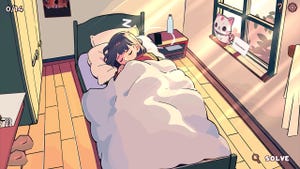
They discarded just about everything random about Rogue other than to-hit rolls. It's all painfully static: areas are designed instead of random, all monster encounters are set, there is no exploration, there's no money or shops, and there's very little loot-finding within an area. The characters don't even earn experience points. Instead, they just gain a level at the end of every area.
There are a couple of places where you can pick from one of two routes to take depending on how you answer conversations, but it's still rather little variety for such a chaotic genre. One of the best things about roguelikes is that you can have fun with them even after you win; here, other than seeing the other story paths (which can be done in one additional playthrough, and isn't even worth it), there's really no reason to play it more than once. Monstania is, sad to say, pretty disposable.
The game may not seem awfully roguelike at first, because its interface is kind of weird. Instead of moving directly, you use left and right to turn, and forward and back to move. (There is an option for direct movement on the options screen, but since the game doesn't use a diagonal constraint button like Mystery Dungeon does, it can be difficult to move where you want.)
By the way, this is an isometric game, and while you can move on diagonals, you can't move or attack straight u/d/l/r. You usually control two characters at once in this game, but only one can act per turn; the other will simply sit there, or follow the other. You can switch between them at will, and your main character can also sort of tie the other one to him to follow behind.
Ultimately, the two-character thing provides most of the game's interest. If the characters are split-up then it takes a turn to connect them, but once joined they can be moved at once. Every turn a character doesn't act he regains one Ability Point (AP), but if he's the follower when the two are joined then he can both move and regain AP at the same time. Understanding this is important to playing the game well, due to the fact that characters don't heal naturally as they do in most roguelikes.
A character must use a healing move, which consumes both a turn and some AP, to get hit points back. Every character has an ability called Recover that restores about half his hit points, and some characters can also heal the partner, but restoring AP usually relies on using an item (which are in very short supply) or relying on resting. Joining characters allow one to both rest and flee from monsters at the same time, which is quite useful.
The other interesting strategic aspect of the play is in the special ways the monsters move. Several of them have special movement quirks, including a good number that move at half-speed, which is less unbalancing here than in other games because a character needs to spend extra turns doing nothing to regain AP, and thus, HP. One particularly interesting monster type hops around as a chess knight. In the two areas I've seen them appear, it's easy to get swarmed if one doesn't recognize their movement strategy (which is quite rapid), but once their trick is determined it's relatively easy to shut them down.
But despite how cool these things may seem, it's difficult to really recommend Monstania. One fairly severe flaw in the game is that most of the time, the monsters are idiots. It's not uncommon for them to take paths other than the most direct way to the players. Indeed, the game is designed around this, often throwing enough monsters at the player that he'd be in hot water if they were to all suddenly realize the shortest path between points is a straight line. The AP system means that, at most, the player needs six turns without doing anything to heal for half his maximum HP.
Getting enough breathing room to heal up is often just a matter of running away for a few turns. And in those areas where you have a missile-using character helping you, making short work of even bosses can be simple, a matter of shooting until he gets close, running until he loses the scent, and repeating. I believe that bad AI doesn't necessarily harm a game if it's designed around it, but compared with Shiren's simple-yet-effective monster algorithms, it does seem inexcusable that Monstania's developers couldn't implement smarter opponents.
Difficulty is a mixed bag. Many areas are remarkably, even laughably easy, but every so often the game will throw in a devilishly difficult area. The first of these puts the player's two characters against two strong golems in a confined area where the AI doesn't have much chance to screw up. These places are where the game is most interesting. At its best, the AP rules, the joined character movement and difficult adversaries make it feel almost like a puzzle game. Actually, since all the areas are pre-made scenarios, levels are handed out after each level, and nearly all equipment is handed out at the end of battles so there's no opportunity to vary a level's opening state, that's perhaps the best description for Monstania.
What I'm about to say is perhaps needlessly reductive, but I think it's true in the general case: the big thing about the Japanese game industry is how they're willing to take a game concept further into the abstract, making the game less realistic in order to fit in a new play mechanic. This is just way Monstania abstracts roguelike games down further than Shiren (which already abstracted them a bit).
But roguelikes aren't typically abstract games, because they lean on the conceit that they're simulations, that they're presenting a Gygaxian playing-out of the possibilities of a situation. When you allow only one character in the party to act in a turn, when you allow the players to tie them together arbitrarily, when simple movement may or may not restore energy based on whoever's leading, and when monsters bumble around instead of relentlessly chase the player, that takes away from the simulationist aspect of the game.
JRPGs these days push ever further into unrealistic, abstract concepts. It seems like every one of them has its own new flavor of points to introduce to the world. (What on earth are "job points" supposed to measure?) At the best, this results in interesting play unburdened by concerns of realism. At the worst, the game becomes disconnected from the real world, and it's difficult to relate to it. Monstania demonstrates why roguelikes aren't helped by this approach.
[@Play celebrated its second birthday in August. Since it started, its update schedule has wavered between once every two weeks and monthly. There are still a good number of games to cover, but it's getting harder to write about them.
Because of this issues, and to assuage the massive guilt I feel whenever a column is late, @Play is officially moving to a monthly schedule for a while. To make up for it, I'm beginning a new column here on GameSetWatch, beginning in approximately two weeks. See you then.]
Categories: Column: At Play


15 Comments
You could write an @Play article about artificial intelligence, or other programming-related issues.
Nate879 | October 21, 2008 9:18 AM
Actually, I probably shouldn't have announced the new column yet, because the dev/null tournament starts November 1.
John H. | October 21, 2008 3:47 PM
I just wanted to mention that @Play is probably my favourite GSW column, and the primary reason I bought Shiren DS when it came out here in Australia.
Thank you very much!
Screwtape | October 21, 2008 7:08 PM
If you're looking for suggestions on column subjects, I'm sure the community can drum up a few!
Mike | October 22, 2008 5:51 AM
Just to add another note of support: @Play is the one and only reason I keep an eye on GSW.
DJH | October 22, 2008 6:40 AM
Hmm, a comment of mine seems to have vanished....
Thanks for the support guys. It's not that I lack for column topics; what with 7DRL, the remaining output of the Roguelike Restoration Project, and some of the more obsessive minutiae of Crawl, ADOM and Angband yet to cover, there's still a good bit to go through. After that, who knows, maybe Nethack 4 will finally be out.
(Feel free to suggest topics though.)
The problem is less stuff to cover and more the time it takes to research these things. The other column is something I've been naturally exploring a lot lately, so it makes sense to try to write something on it. It looks like it won't be starting for another couple of weeks anyway, as I'm now pretty sure I'm doing an @Play on the devnull tournament at the end of this month.
John H. | October 22, 2008 8:37 AM
You can still cover Incursion :)
Andrew | October 25, 2008 10:04 AM
Yes, I second the Incursion suggestion.
Turgid | October 25, 2008 4:35 PM
Glad to hear you will be continuing the column, whether weekly or monthly. Your column is a big part of what got me back into playing Roguelikes after 20+ years. Have you considered writing about other non-tradititional games with Roguelike element? It's a bit far afield, but here's an example: "The Awful Green Things from Outer Space" was an old TSR board game (now in print by Steve Jackson Games) which had random item effects requiring trial IDing in a Roguelike manner in order to fight off an alien invasion controlled by the second player.
The Eidolon | October 29, 2008 7:34 AM
Might be worth a shot, if I can find a copy that is.
John H. | November 19, 2008 2:28 PM
Hardly important, but since you asked, for the most part, job points basically serve to, at some level, seperate character level from class level more than, say, multiclassing in D&D does.
...Since they're typically gained in the same way as experience points (thank god, I dread to think what the inevitable minigames for gaining jp for the various classes would be otherwise), however, this seperation is mainly only really noticable if you're allowed to mix and match class abilities, or
Further on your comment about how Japanese game design tends to be willing to abstract to hell if it generates game mechanics compared to Western which seems to, at the moment at least, be heading towards a more simulationist approach, would you say this is similar at all to the distinction between the 'American wargame' and the 'Eurogame' genres of boardgame? (Actually, hm, I was thinking in terms of realism vs abstraction, but it could probably apply in terms of just how much randomness is involved as well. And in the same direction.)
Gizensha | December 6, 2008 10:48 PM
It's true that European board games are more abstract than their U.S. counterparts, but from a design perspective they tend to blow most U.S. and Japanese video games out of the water. A good board game can't rely so much on flash and action-movie aesthetics to impress audiences, so to do well they really do have to be good games.
Even so, there's still usually a stronger connection between play and theme in a Euro board game than, say, the typical modern JRPG, which get quite arcane at times.
John H. | February 4, 2009 12:38 AM
While I greatly enjoy your columns, I think this one is a bit off the mark. Monstania should be played more as though it's somewhere between a puzzle game and a simplistic SRPG. While the poor AI greatly hampers the game- and it is painfully easy for the most part- it's otherwise an excellent game.
Also, try playing without ever upgrading equipment to make many of the stages much more challenging! I did it once- and some of the later stages, I needed much more breathing room since I had to heal much more often- and THEN it becomes much more of a challenge.
And before anyone asks- I have beaten this game start to finish at least five times.
Me here | May 28, 2009 5:53 PM
Yes, but not upgrading equipment falls under the category of a personal challenge, such as playing a pacifist in Nethack.
You could make nearly any game challenging if you restricted yourself in the right way, but unless the game provides some way of suggesting and rewarding that restriction, it cannot be rightly called part of the game.
John H. | May 31, 2009 3:45 AM
Agreed about no equipment not being part of the game proper. Still, it feels like one of the less artificial such challenges- it makes the difficulty curve steeper with a comparable balance.
Me Here | June 5, 2009 7:06 PM