« GameSetLinks: On Blizzcon, Mirror's Edge, Scrabulous | Main | Exclusive: Behind The Scenes of Metanet's N+ »

Tuesday, September 30, 2008

Column: 'Homer in Silicon': The Courage to End It

['Homer in Silicon' is a biweekly GameSetWatch column by Emily Short. It looks at storytelling and narrative in games of all flavors, including the casual, indie, and obscurely hobbyist. The latest column examines a Flash-based RPG for lessons on story.]

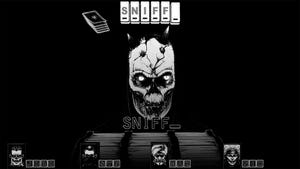
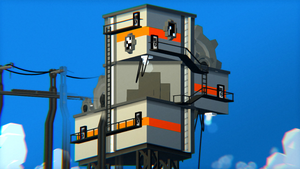
Krinlabs' Sonny is a Flash RPG which consists of a lot of tactical battles interspersed with chances to level up. It's like Monster's Den: the Book of Dread, only with a more eclectic setting and smaller parties.
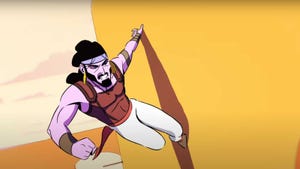
Sonny is clearly the result of a lot of love and attention. The animations are sweet and smooth. The interface is easy to use. There are some occasional spelling errors, which irk me (maybe hire a proofreader next time?), but they're relatively infrequent. There's even some decent voice acting and the beginnings of a story about illicit government experimentation gone horribly wrong.

Only the beginnings, though -- and here is where Sonny turns seriously disappointing. The first few scenes set up relationships between the characters and hint at narrative revelations to come -- but they don't. Instead of explanations and discoveries, the end of the game turns into a long, grueling, stats-oriented fight against four special boss levels. The ending of the story never arrives -- and in fact before we reach the bosses, there's a helpful note which explains that "the next part is not part of the story".

Now, from the forums over at Krinlabs, it's clear that the makers of the game intend to create a Sonny 2, which will pick up the dropped narrative strands from earlier in the game. But there's nothing in the original game that hints that it's really episode 1 of a longer series. The story just stops going forward, jilting the player, who came along in hope of hearing the end.

Maybe it's wrong to feel quite so annoyed by this, but I see the beginning of a story as a promise. If you hook me in with a mystery, then I'm trusting you to tell me the truth if I play the rest of the game. That's the deal.

I get the strong impression, in the case of Sonny, that the designers just ran out of time or energy for the story aspects of the game, and put off the rest for the sequel, without signalling that very well in the finished piece.

But I bring it up because I see the broken promise to the player as an example (admittedly extreme) of a slightly more widespread trend in game narrative development. Ken Levine, talking about Bioshock, urges authors to "trust the mystery" and not answer every question that a story raises.

I understand where the impulse comes from: we've all seen horror movies where the horrific thing was disappointingly lame after a great build-up (I'm looking at you, M. Night Shyamalan); played games where the big boss was not nearly as bad-ass as we'd been led to expect; seen TV shows end with attempted explanations that totally fail to handle the loose ends up to that point (hey, X-Files). In fact, Levine says this explicitly: ""Think of 'Lost'? What is their entire stock in trade? It's asking questions they don't answer," Levine said."

So maybe it's better just not to answer the questions raised. A non-answer has got to be better than a bad answer, right?

No. Not necessarily. Not even most of the time. Not if you've gotten the player to play this far on the premise that truths are going to be revealed. Certainly not if you leave the player thinking that maybe you didn't have an answer planned at all.

There are a small handful of stories that have the form of a mystery but get away with not answering the question. Usually it's because, along the way, they've convinced the reader that the truth is not the important thing, or is too subjective to identify, or that a state of uncertainty is actually better. This is not an easy trick to pull off.

What's more, most of the ones I can think of, from the classic "Lady or the Tiger" story to John Sayles' movie "Limbo", leave the reader/viewer/player with a specific set of options for the ending. This thing happens, or that one does. The domain of uncertainty is not large. This is completely different from leaving the reader with no idea why key things in the story happened.

No, what makes the end of a mystery story good is not that the answer gets left off. It's that the answer is interesting. Maybe it makes you feel differently about the characters. Maybe it makes you question some of the moral decisions that led up to that point.

Maybe it makes you wonder about the applicability of the story in your own life. Most of the best mystery authors in static fiction have already caught on to this one (and authors of related genres, such as science fiction with a strong mystery element). Discovering who did what in Gaudy Night, or what's really going on in Mote in God's Eye, isn't disappointing. On the contrary, it's meaningful for the characters and challenging for the reader.

I see nothing inherent about this kind of story-telling that puts it beyond the reach of games. It does require the storyteller to have some sense of the themes of his work, some awareness of the issues it might raise, and the willingness to explore those. But why would that be a bad thing?

[Emily Short is an interactive fiction author and part of the team behind Inform 7, a language for IF creation. She also maintains a blog on interactive fiction and related topics. She can be reached at emshort AT mindspring DOT com.]

Comments

Hi Emily,

I've got to say, I'm getting a bit depressed reading the Homer in Silicon column. I often agree with and enjoy the conclusions you draw in your columns, but every time the subject piece is abysmal from a narrative standpoint.

The conclusion that your column leads me to make about these types of casual games is that their authors consistently fail to compose or complete a decent story, whether from incompetence, lack of time, or indifference. It's just getting depressing, is all. Can we see something a bit more inspiring? _Is_ there anything more inspiring? :)

every time the subject piece is abysmal from a narrative standpoint.

I wouldn't say that -- "Miss Management" and "Treasures of a Slaver's Kingdom" are genuinely good; "Ciao Bella" and the Tradewinds games have some successful aspects. And then sometimes I'm looking at the narrative spinoff potential of something that wasn't reallly trying to do narrative in the first place (as in my last column).

That said, I have a couple of games in my recently-played or in-progress stack that are scheduled for a more positive write-up. Stay tuned.

I ran into something very similar with _Dreamfall: The Longest Journey_. The previous game had been self contained; it opened with mysteries and problems and the majority were resolved by the end. The second game superficially appeared to also be self contained. So when I got to the end to discover that five of the six plotlines were left dangling and unresolved I was infuriated. http://www.highprogrammer.com/alan/rants/reviews/video_games/dreamfall/index.html Part of the problem is expectations. If I had been told up front, "Part 1 of 2" I wouldn't have been angry. If it had said "Part 1 of as many as we can make before we run out of money,*" I would have given the game a pass.

* http://www.joystiq.com/2007/03/01/dreamfall-the-longest-journey-to-continue-in-episodic-format/

As for "But it worked for _Lost_." Did it really? It has worked for a while, but it does so by promising that reveal and closure... just later. I'm told that Lost's major story arcs are not pre-written, that they're essentially winging it. What's the likelyhood that they'll actually be able to deliver? Will it end with that final reveal and closure that leaves viewers satisfied and earn it the ongoing respect of, say, M.A.S.H.? Or will it end with a whimper and be forgotten to history?

"As for "But it worked for _Lost_." Did it really? It has worked for a while, but it does so by promising that reveal and closure... just later."

Yes, I agree with you. But then I at one time or another followed all of "X-Files", "Lost", and "Alias" -- all of which worked on this ongoing promise of future resolution -- and in each case I got frustrated, lost faith in the writers, and gave up on the show before the end.

By contrast, I did watch all of "Babylon Five", despite the often cringe-worthy dialogue writing and highly variable acting, because it managed to look like it knew where it was going, and because it provided satisfying partial resolutions along the way.

If you want to play amateur made rpgs you should play neverwinter nights 1-2 mods. There is a lot of talent there.

I like david lynch style creepy stories that don't quite make sense. What you are talking about is more like lost or anime style stories that never really have satisfying answers to plots. I don't like that sort of storyingtelling either.

It isn't that common in games though. Most games have braindead action movie plots.

I just found this, several months later... Anyway, Sonny 2 is out and has lots more plot. I had pretty much the same reaction to the first Sonny, "Dudes! Finish the story!" And then with Sonny 2 -- well, there's lots more story, lots of cut scenes, new characters, and explanation of what's going on with the plot, lots of messing around with the tape you have, and the occasional fake battle (I mean, you take one or two turns, and then it goes to a cut scene). And... well, my reaction was that I was glad to see the story explained, but I didn't actually find the battle play as engaging this time around. (It could be because I'm in a different place in my gaming right now.) And truth be told this isn't really a story-driven game, I don't think. The long, grueling stats-oriented battle is the highlight in some ways; and there are some goofy intrusions that wouldn't really fit in with the story ("Rockstar" in Sonny, some others in Sonny 2).

Actually I think there's a hint of something more interesting; one of the characters does some stuff which I'm not entirely comfortable with (the end of the official plot of Sonny). Maybe he'll turn out to be an enemy in Sonny 3? And if the narrative is in the end a little perfunctory when you find out about it (it is government experimentation gone wrong! who knew?), there's some really nice atmosphere, as there was in the first one -- in two of the areas of Sonny 2 you fight to the end of a ghost train and then down an abandoned tunnel, which I found effective.

So... well, the moral is that at least the Sonny folks did write the sequel and bring the plot to a (possibly temporary) resolution. But it's still mostly about the fighting.

(A search for "Sonny 2" will get you the game.)

Post a comment


If you enjoy reading GameSetWatch.com, you might also want to check out these CMP Game Group sites:

Gamasutra (the 'art and business of games'.)

Game Career Guide (for student game developers.)

Indie Games (for independent game players/developers.)

Finger Gaming (news, reviews, and analysis on iPhone and iPod Touch games.)

GamerBytes (for the latest console digital download news.)

Worlds In Motion (discussing the business of online worlds.)


GameSetWatch [Twitter / RSS feed] is an alt.video game weblog from the people who run:


Copyright © 2009 Think Services