COLUMN: Design Diversions : 'Bad Monster, No Biscuit'
[‘Design Diversions’ is a biweekly new GameSetWatch-exclusive column by Andrew Vanden Bossche. It looks at the unexpected moments when games take us behind the scenes, and the details of how game design engages us.]
When people ask if video games teach us anything, the answer is yes: they teach us how to be better at playing video games. But games also teach us, sometimes subtly, sometimes accidentally, about game design. The choices of design aren’t usually obvious.
Most of the time, it’s enough that a game is fun, or scary, or dramatic, and it’s better to focus the player on the experience rather than how the experience was created. Sometimes, though, an unusual choice of design breaks this rhythm and makes us suddenly conscious of the conventions we take for granted.
One game that unintentionally shares this information (to its determent, unfortunately) is SaGa, a game marketed in the states as The Final Fantasy Legend. The SaGa series is perhaps best known for becoming progressively more obtuse and bizarre with each iteration. Its beginning on the Game Boy, however, was fairly standard for RPGs of its time, asking the player recruits a party of four to do normal RPG things like kill monsters and find treasure.
But this game gives particular insight into enemy design and its incompatibility with player design through an interesting, though flawed, option for players: it lets you play as nearly any enemy in the game.
SaGa is unusual when it comes to the advancement of the game’s three races. Humans grow by buying HP and stats from stores, and mutants grow in random ways after every fight. Monsters, however, advance by turning into different monsters, allowing them to transform into an exact copy of nearly any enemy in the game.
Don’t Eat the Meat
In theory, it sounds very interesting, but because these monsters are designed with the challenges of enemy design in mind, the fundamentally different design requirements that go into creating players and enemies makes the monsters an extremely weak choice to play as. What becomes apparent through play is that their weaknesses as a tool for a player are a result of their strengths as a challenge for the player to overcome.
So what makes monsters so bad? For one thing, monsters tend to do much less damage than anyone else, and they can’t be customized, whereas the humanoid races can be set up with an appropriate breadth of abilities. Monsters can quickly run out of useful skills and then sit around uselessly until you have a chance to rest. They have more HP than anything else, but that doesn’t carry much of an advantage when the other playable races can do so much more damage that there won’t be enough enemies left to damage them.
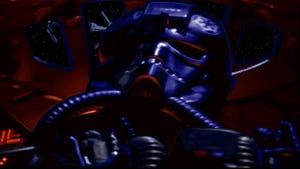
It doesn’t take a lot of playing to figure out that monsters just don’t feel made for fighting.
The characters the player controls need to be designed to live through dozens and dozens of battles, kill a boss, buy stuff, advance the plot, and still have some wiggle room left over. A monster, on the other hand, is designed to outlast the looping of the battle music. In the seconds of an enemy’s lifespan, it needs to be challenging enough to interest the player but then either die immediately in a satisfying manner or kill players that are doing something wrong.
The Life of a Monster: Nasty, Brutish, and Short
Because of this, a monster is designed with only a brief lifespan in mind. Designers don’t have to worry about the monster before it encounters the party (because it doesn’t exist) or after (because either the player or the monster is dead). Trying to keep one of these things in your party is like trying to get a mayfly to live long enough to earn a PHD from a major research institution.
At first this might seem backwards since monsters have high HP and frustrating immunities, which theoretically would let them survive longer than the races designed specifically for players. But because a monster has relatively weak attacks, they will actually take much more damage than any of the other races because their weak attacks ensure that combat will last longer.
Monsters also aren’t typically equipped with the resources necessary for multiple battles. The other races have the ability to stock up on weapons and attacks, and although they run out eventually, monsters are stuck with what they have. For their tiny lifespan, it’s luxurious, but the game full expects the player to be able to survive extensive periods without rest, and what’s plenty for one battle is nowhere near enough for dozens.
The Making of a Hero
Player HP is low not to make the heroes weak, but to create tension and drama. If the players lose health, they have to be cautious or find ways to recover it. Monsters won’t outlast the fight, so their HP has to come up front. When HP is given to player characters in short increments, the player has a lot more moments of OH MY GOD I’M GONNA DIE. This engages players.
HP is the benchmark of challenge. Monsters must have more and more HP in order to present more of a challenge. HP is less a way for monsters to survive and more a tangible goal for the players to accomplish. The core of RPG gameplay (or really, any game that involves fighting) is to hit this allotted goal of damage before you run out of resources. Challenge and tension depend on this sort of distinctive enemy design.
Conclusions
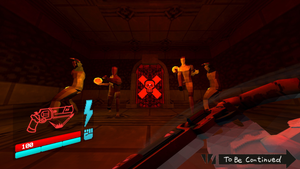
These principles are by no means limited to RPGs. What if I invented a first person shooter in which you ran from inn to inn shooting waves of monsters? Then I would be sued, because I would have invented Doom. While Doom’s monsters aren’t very resilient, they more than make up for this in numbers that easily overwhelm the total health of the player. In both games, there’s a goal of minimum damage required before you can move on.
In the more “realistic” modern fps, the only change to the fundamental mechanic is even lower player health, a design choice that is as much for dramatic reasons as it is for realism. Nearly every game that involves shooting and killing something controlled by the computer follows this school of design.
This is because enemies aren’t supposed to be lethal. They exist to generate the tension of almost dying, and force the player to find ways to overcome them. SaGa teaches its unsuspecting players that enemies are designed to pose challenges, not overcome them.
[Andrew Vanden Bossche is a freelance writer and student. He has a blog called Mammon Machine, which discusses videogames and helps mayflies acquire master's degrees, and can be reached at AndrewVandenB@gmail.com]


Comments
I loved the FFL series, but I never did get the point of the meat/parts systems for the reasons described (mainly that monster playable characters were weaker than non-monster PCs). It was a novel idea in FFL1, but completely extraneous in FFL3.
What I found really interesting about FFL1 was that it provided such a variety of playable character progression mechanics, as if Square was using it as a testing ground for future games. Specifically, humans could be upgraded via potions purchased from vendors, mutants would randomly gain/lose abilities and stats over time, and monsters could be changed into other monsters by eating meat the meat of their foes. FFL2 expanded this variety with the robot class/race, whose stats scaled directly from whatever items (weapons, armor, etc.) they had equipped.
FFL3 used a much more mainstream experience/level system, and gave you a predetermined party. For some reason, Square decided to retain the meat system - even expanding it with a mirrored "parts" system that combined together to present a spectrum of 5 class/race types into which you could convert your characters (something like robot, cyborg, human/mutant [the default], beast, monster) depending on how many times you fed them meat or installed parts. It sounded cool, but in the end it really just converted your characters into analogues of the monster class from FFL1, with all of its limitations. I can't help but feel that they left the system in for consistency with the previous games in the series and little else.
Posted by: HunterZ | June 25, 2009 9:35 AM
Yeah, once I figured it out, I always went with a party of mutants in FFL1. A human, while starting with more HP, was a waste of money since you'd expect random stat growths after any battle. The game was totally flawed, but I still loved it. A female mutant seemed to be the best character. Low health initially, but you could wake up with a 20 HP boost making them instantly better. Rapier being a speed weapon, they always seemed to hit first. I mixed and matched male/female just so my party wouldn't look boring. Avoided monsters for exact reasons mentioned in article
FFL2 at least introduced stat growth to Humans as well, so I'd mix and match those. Again, avoided monsters/robots. There was a cool extra/cheat in the game where depending on what floor you were on, the items garbage can would give you free stat bonuses. It eventually would max out, but I couldn't not use it. ;)
Posted by: PoV | June 25, 2009 10:27 AM
The FFL's are amazing games... the first is awesome and a whole lot of fun, but by the third, they got to the level of immersion you (at that point) would expect from a major console it (i.e. SNES).
Those are great games... if you consider 'great' to mean immersive at the cost of sanity. I adore the FFL's and hope to play at least 1 and 3 again (2's levelling was... well, crap).
Posted by: phu | June 26, 2009 12:43 AM