« May 3, 2009 - May 9, 2009 | Main | May 17, 2009 - May 23, 2009 »

May 16, 2009

Gamasutra Expert Blogs: From Poetry To Doom Lessons

[In highlights from big sister site Gamasutra's Expert Blogs, industry veterans write poetry about the awkward dance between gameplay and story, and how modern shooters can learn from Doom.]

In our weekly Best of Expert Blogs column, we showcase notable pieces of writing from members of the game development community who maintain Expert Blogs on Gamasutra.

Member Blogs -- also highlighted weekly -- can be maintained by any registered Gamasutra user, while the invitation-only Expert Blogs are written by development professionals with a wealth of experience to share.

We hope that both sections can provide useful and interesting viewpoints on our industry. For more information about the blogs, check out the official posting guidelines.

This Week's Standout Expert Blogs

The Gaming Renaissance Movement
(Wanda Meloni)

Wanda Meloni, market analyst with M2 Research, delivers a sobering statistic: 8,450 -- that's the number of games industry professionals laid off since July 2008, with 75 percent of that number originating in North America. But the silver lining is that many of the recently jobless have gone on to establish small, agile and creative independent studios, leading to what Meloni calls "The Gaming Renaissance Movement".

Doomed To Invent Our Mistakes
(Adam Saltsman)

Designer Adam Saltsman recently revisited the original Doom, and he thinks that modern FPSes could learn a thing or two from the game, released way back in 1993. He details the problems that he has with modern FPS conventions such as hiding, reloading, A.I. and aiming mechanics. Are FPSes getting better, or worse?

Gameplay and Story: An Ode To The American Junior High School Dance
(Matthew Allmer)

Design veteran Matthew Allmer exercises his creative writing chops with "Gameplay and Story: An Ode To The American Junior High School Dance", a brilliant 38-stanza poem describing video games' awkward tango between gameplay and story. The ballad breaks its ABCB rhyme scheme in just one instance, when Story demands of Gameplay: “You step this way, / that way, then switch. / You jostle me around / As if I’m your…slave".

Toward Better Readability In Adventure Games
(Nels Anderson)

There are a few adventure game design traditions that should be deep-sixed, according to Nels Anderson, gameplay programmer with Penny Arcade Adventures developer Hothead Games, but linearity should be the first to go. "Why must adventure game puzzles only have one solution? Why must every one of them be solved to continue?" he asks.

Going Commando
(Adam Saltsman)

Saltsman has been busy on the Gamasutra blogs, posting yet more read-worthy material with some important tips about freelancing in the games industry. One of the most important skills is trusting your gut: If your gut tells you a potential client is a jerk, Saltsman says, "They are, in all likelihood, a slimey douchebag that you should avoid at all costs."

Sound Current: 'Mega Ran, Hip Hop & 8-Bit Democracy'

[Continuing with the GameSetWatch-exclusive game audio interviews, courtesy of Jeriaska's 'Sound Current' series, he sits down with a pair of musicians who take Mega Man themes and run with it, in ways that may be... surprising to the ear?]

When Capcom first announced its intentions to return the Blue Bomber to his 8-bit roots, many questioned whether the stage music of Mega Man 9 would prove as influential as the NES originals.

Following our Rockman 9 Arranged Soundtrack interview in Tokyo, we hear from two musicians working to keep the love of classic Mega Man alive through the genres of hip hop and '70s funk rock.

Random is a Phoenix, Arizona based artist hailing from Philadelphia. In 2007 Mega Ran debuted: a collection of Mega Man-themed rap music. After years of receiving requests for a sequel to the album, Random released Mega Ran 9 in March, a reimagining of the tunes of last year's downloadable retro-themed title.

Also featured on the album is Mutherpluckin' B of Uppsala, Sweden. With three albums of NES-covers on his discography, he channels Led Zeppelin, Jimi Hendrix, and Yuukichan's Papa in turn.

Often depicted on album covers in bell-bottoms, shades and packing a zapper, Mutherpluckin' B first began arranging Mega Man in 2004 with Sex, Drugs N' Nintendo. His latest album, released this week, is called 8-Bit Democracy.

For Mega Ran 9, Random and Mutherpluckin' B offer a remix of Jewel Man's theme in which the diamond-mining robot and the game's protagonist spar with beats and rhymes. In this interview we hear from the two artists on their latest game-inspired musical creations.


Random and Mutherpluckin' B

Random, was there a primary motivation you could point to for embarking upon the first collection of Mega Ran songs?

Random: Simply put, a love for Mega Man. I had come across some mp3s of the old school tunes and got so nostalgic that I came up with the plan of comprising my own variations. I knew it had been done before through rock and dance music variations, but I had never seen it done with hip-hop, and so much of the hip-hop generation are '80s babies who remember the good ol' days of Super Mario and Street Fighter II.

Following your album debut, when you were invited to Capcom's booth at Comic-Con, was this a very different environment from the venues you had been used to performing at previously?

It was unbelievable. I sat and signed autographs for about an hour, and it never really sunk in. I'd read about Comic-Con, but never dreamed of being a part of it. Performing is performing, whether it's in front of 5 or 5000, but I have to admit I was taken aback but the sheer size of everything there. It was different than a dark, smoky club.


You have stated that you had no intentions of making a sequel to the album prior to the release of Mega Man 9. What changed?

On top of the music for Mega Man 9 being phenomenal, my song "Grow Up" played in the Second Skin movie. This was what helped to get the Capcom licensing deal rolling. The second thing was Nerdapalooza. I had never experienced the kind of love and support that I had when I performed there.

As momentum picked up, people were asking me constantly: "When is Mega Ran 2 coming out?" I had a fear of being pigeonholed as the "Mega Man rapper," but I can honestly say that there's a possibility that as a side project between albums, I could see myself working on a Mega Ran album every year or two. They're just so much fun to do.

What extra content is on the album for those who purchase the Mega Ran 9 album through iTunes and Amazon?

There are three additional tracks on the full version: "Endless," "The Outro" and an acoustic remix of "Splash Woman." Also on the album are cutscenes from the Mega Man videogames and cartoons that will add a bit more life, clarity and fun to the storyline.

Among the many supporting musicians that collaborated on Mega Ran 9, DN3, Storyville and Samik appear to have played a prominent role. Can you describe your working relationship with these three artists?

Random: DN3 is my road DJ, as well as main producer and engineer, so we know each other's styles very well. He was like the right tackle on this album, making the key blocks to make sure it got done. Samik is a hard-working producer who helps me to create "the hit," so he was like the star running back. Storyville was the quarterback. He put his stamp on every single track, mixed the entire album, produced one and was featured on three. I was the guy blessed to be in their presence with a good idea. It was truly a team effort.


Mega Ran's song about his run-in with the armed and dangerous fembot "Splash Woman."

Mutherpluckin' B, on your two previous albums there are a number of '70s audio and visual references. Is there a particular film soundtrack from this era that has inspired you?

Mutherpluckin' B: Curtis Mayfield's Superfly album is amazing. Since all NES music is a variety of soundtrack, it was relatively easy to adapt the songs to a '70s funk-rock style.

On "Sky Diver Inside Her" you have taken a poppier approach to your Mega Man covers. Can you describe the style of the song?

I started out being inspired by artists like Van Halen and the Sensational Alex Harvey Band, and I wanted to do something more "rock 'n' roll". The drum loop I picked forced me to change the rhythm and the melody, which gave it a bit of a "pop" sound with the vibraphone and ska-like guitars.

How did it come about that you became involved in the Mega Ran 9 album?

Random posted a thread on the OverClocked ReMix forum in which he asked if anyone was interested in doing a rock-rap collaboration for his hip hop album. I loved his stuff, both the previous Mega Ran album and his non-videogame music.

I was surprised that no one else had replied, especially since his last Mega Man covers had been so successful that Capcom chose to promote him. I already had my Jewel Man remix nearly finished, and Random dug it, so we went with that song right away. I'd love to be involved in more collaborations in the future.

What is it about the Jewel Man stage music that appeals to you?

The melody is great and the rhythms caught my ears immediately with their heavy progressive rock feel. It made me think of Led Zeppelin's Presence-era stuff that I love so much. The song would sound wicked with John Bonham on drums! I love most of the Mega Man 9 soundtrack, but no one else seemed to care about Jewel Man, so I wanted to be the first to cover it.

What factors would you say account for the tremendous amount of time and effort that go into each of your albums of Nintendo covers?

My new album has taken so much time to create that I'm calling it "8-Bit Democracy," as a nod to Guns 'n' Roses' last record. There are several reasons, though. I'm playing all the instruments myself, I'm a near-perfectionist and I arrange the songs as I record them, which makes for a lot of re-recording, cutting, editing, etc.

Previously I only used looped drum samples from other songs, but now I'm playing drum soundfonts myself on the keyboard, which gives a lot more variation but also takes ages to nail. 8-Bit Democracy includes stuff from Commodore 64 ("SID") games, lesser known game music, and tons of stuff inspired by Led Zeppelin, Jimi Hendrix and Yes. There's hopefully enough Mega Man and Super Mario Bros to please most NES fans.


Mutherpluckin' B's homemade Sky Diver Inside Her music video

On previous albums you have had audio clips from ‘70s movies. On this one you have a clip of someone saying, “You work a typewriter, you work an Atari game, but you don't work a guitar. You play it.”

The source is an interview with David Lee Roth of Van Halen. He is talking about how many businessmen there are on stage "nowadays." There is another part with him in track number 11, and it’s even better because he is talking about how you steal things to make new music. That’s kind of a political stance.

Is this quote relevant to you in terms of your creating rock covers of NES games? You don’t go into a dark room and wait for a flash of inspiration?

When I make my songs, it’s basically how he says. I’m the kind of guy that loves to listen to records and play the music of my idols. I've never thought of myself as a songwriter, so my way of music involves some “stealing,” or “borrowing,” "covering" or whatever you want to call it. You mix it with something else, and in the process you come up with something of your own.

The free download version of your album is dubbed the "Socialist Edition.” How many additional songs are on the $7 Capitalist one?

Two additional songs are on the Capitalist Edition. "Napalm on the Dancefloor" is Napalm Man of Mega Man 5, plus a bit of DuckTales and Castlevania. Then there's the Godzilla tune "Godzilla's Head Soup".

You’re including a cover of the Godzilla ending theme? That’s a great song. Is someone working with you on the photo shoots this time around?

For Nintendosploitation I was taking all the photos myself. I had a timer on a camera and a stand, so I dressed up and went out, posing in different places. It was never really consciously a concept. Rather it was more of a spontaneous idea.

This time I’ve got a friend helping me by taking photos. There are these old photos of a classy Swedish hotel from 1943 that I found in a magazine. We took some photos and put myself in these pictures and there’s an NES on the floor. The pictures I'm working with are from several decades, from the '40s to the '70s, but mainly the 1960's.

It’s similarly anachronistic to have songs that were created in the ‘80s, and these NES sound effects that crop up in the album, appear as if they were first played in the ‘60s and ‘70s.

Yeah, exactly. There's this Led Zeppelin album called “Presence” from 1976 that has this phallic symbol in all the pictures on the sleeve. There’s a family at a table and then you see this phallic sculpture there with them. There’s a woman sitting by a pool, and the sculpture is in the pool. There's two guys in a factory, a woman in a field of flowers, a captain steering a boat... It all looks really old-fashioned, and I was inspired by that. My idea is to do kind of the same thing, but I put an NES console in all the pictures.


Random tells the story of Mega Ran 9

GameSetLinks: Game (And Set) And Watch!

[GameSetLinks is GameSetWatch's daily link round-up post, culling from hundreds of weblogs and outlets to compile the most interesting longform writing, links, and criticism on the art and culture of video games.]

As we move rapidly towards the weekend, it's time to check out the latest set of GameSetLinks, headed by another excellent NowGamer.com UK mag-reprinted profile -- this time of the history of Game & Watch, something that's dear to our heart, and vaguely connected to the name of this blog.

Also in here - Guitar Hero research, the latest GameTunnel indie game review round-ups, a discussion of who put the A in MDA (or thoughts to that effect!) and lots more besides.

Import export:

ThenGamer: Game & Watch | NowGamer
'According to legend, Nintendo engineer Gunpei Yokoi came up with the concept after observing a bored Japanese salary man absent-mindedly fingering his pocket calculator while travelling to work.'

Original Sound Version » Blog Archive » Tales of Knighthood: Sonic and the Black Knight Original Soundtrax (Review)
Interesting idea to mix Western notables like Jacques and Tallarico with Japanese composers.

guitar hero: a research blog: Schizophonic Performance article
The full article - we've run a few of Kiri's research extracts on GSW before.

April 2009 Indie Game Round-Up by Game Tunnel
'This month at Game Tunnel we had some amazing titles! A tiny off the beaten path game, Caster, took our vote for Game of the Month.'

GAMBIT: Updates: Have Adventure Games Forgotten the A in MDA?
'Hearing people talk about the lack of new adventure games, they frequently say they miss the complex stories, the humor, the interesting situations. Who misses the actual interactions?'

Fullbright: Single-A games
'Hopefully games like Zeno Clash and The Path (and Gravity Bone, and Flower, and so on,) are early glimmers of the successful intersection of immersive 3D and the indie mindset. And hopefully they're to be followed [by] many, many more.'

May 15, 2009

Scarier Than Pyramid Head: Silent Hill Nurse Cosplay

I've seen cosplay outfits for Silent Hill's nurses before, but nothing as accurately menacing as this. This looks even creepier than the Silent Hill movie poster with the nurses!

Certainly, the performer's contributions -- putting together the grungy uniform/mask, painting veins all over herself, posing awkwardly -- made this Anime Central 2009 photo shoot stand out from other similar costumes, but photographer Judith Stephens should also be applauded for capturing the feel of these video game enemies approaching you, scalpels in hand (or a straight razor in this case).

You can see a couple more nurse photos below, and the rest from the set (including shots of Pyramid Head cosplay) on Stephens' Flickr set:

Interview: Welcome To The Id Experience

[Perhaps a little borderline on whether this is primarily GSW or Gamasutra-appropriate, but our own Chris Remo recently sat down with Id's Todd Hollenshead. And let's face it - who doesn't want to hear about what id is up to? Here we go...]

Seminal Texas-based Doom and Quake creator id Software has diversified a great deal over the years, with AAA titles like Rage and Doom 4 in internal development, plus iPhone and mobile remakes of titles like Wolfenstein 3D.

The company now works with different publishers, rivals Electronic Arts (publishing Rage via EA Partners) and Activision (which is making a Wolfenstein update at its Raven studio), after a long history of working only with the latter. And alongside all this, says CEO Todd Hollenshead, the company still manages to stay lean.

In this in-depth interview, which adds to his recent comments to Gamasutra about the studio remaining "games first, licenses second" on id Tech 5, Hollenshead explains the state of his company.

Topics discussed include plans for Rage and Doom 4, Quake Live's debut, the company's mobile/iPhone game initiatives, working with EA Partners and Activision at the same time, and how the company so deftly juggles so much at once:

How much have you grown the company in the last several years?

At the end of 2007, we had 46 people. By the end of 2008, we had 86 people and had hired, through turnover and things like that, 45 additional people. And now we're at 97 or something like that.

For me, there -- John [Carmack] talks about this, too, but certainly it has become more and more evident to me -- are now people at the company that I don't know. And I started when I was, like, employee 13 or something like that. It's a vastly different world.

It does seem that like for a company making two AAA games, that has their hands in all these other places, you're not bloated.

I would say we're actually quite small. Our average team size... We're around the 35 range on the Rage and Doom teams, exclusive of our animation department, which is like seven to nine guys. The Quake Live team is only a dozen guys or so. And Wolf mobile is like five or six people. Our numbers might not add up there because I internalize them a little differently.

You're talking a handful of level designers on each project, a lot of artists relative to programmers and designers. We do have to rely on management structure to keep everything going.

Do you deal much with outsourcing or contractors, or do you keep it mostly in-house?

Mostly in-house. We'd like to outsource more stuff, because that would allow us to reduce some of our time to market. There's stuff that you have to do inside, your key art, your characters, and things like that that you can't outsource. But, you know, trees and dirt? Do you really need that to be a gating factor on shipping a game?

In a perfect world, every little pixel would be completely perfect in a game, but in the real world, it doesn't happen like that. In the real world, if it did happen like that, games would never ship because art is one of those things that's arbitrary in terms of when it's done.

id's Major Internal Projects

So you're not likely to ship an internal product until 2010, right?

Right. Wolfenstein is When-It's-Done, but I think there'll be an expectation that's going to be created pretty soon about when that range of date and time is going to be.

Rage is not this year, and Doom is obviously not this year, since we started it up last year. In addition to work on all these things, we did a significant amount of work on Enemy Territory: Quake Wars internally at the company, in addition to Quake 4.

We did a lot of work, actually, on the multiplayer for Quake 4 when it came out. After Doom 3 shipped, we did a whole lot of work with Vicarious Visions on the Xbox version. We've been quite busy on all these projects, and getting Rage done.

How focused are you guys on engine licensing this time around with id Tech 5?

Well, our philosophy really hasn't changed from what it's always been, which is games first, licenses second. And so, working on Rage, and working on Doom 4, which are both id Tech 5 games, are certainly our top priorities.

We have seeded tech out to a few licensees. We're kind of not in the mind that we need to go and talk about in press releases who all is using our tech, so we'll leave that up to those people for when they're ready to make those announcements.

We are continuing those efforts, but our philosophy on that has been that we'd rather have a small number of good fit, high-quality developer licensees than a bunch that aren't really good fits or that may not be that bright of a licensee anyway. Because we think that the licensees, for us, given that that's our strategy, are going to have an impact on how the technology is perceived. And so we'd rather have those be really good fits.

That's presumably pretty similar to when you work with Raven and Activision, for example?

Similar to that, yeah. very similar.

Publishers: Activision Vs. EA

You guys worked with Activision for years, and you're now simultaneously working with EA [which is publishing Rage] simultaneously. How has that situation been after years of a one-publisher arrangement?

And the Doom stuff is still up in the air. We haven't chosen anybody about that. In fact, we haven't even shown the game to prospective publishers. We'll probably be doing that later on this year.

But it's been good. The EA guys are good to work with. A number of the EA guys that we work with used to be at Activision at one point, or we worked with them in some capacity in one form or another.

We have a lot of respect for those guys, but at the same time, I've got a ton of respect for the Activision guys... I mean, the Raven guys are obviously enthusiastic about their own project, but even the guys at the Activision level, not at the Raven Studio level, they're like, "Hey, we want to get Doom. We want more id games."

In all honesty, there was a little friction at first, but at this point, we don't have any animosity towards Activision. They've been a great partner over the years. They've sold tons of games for us. I think we've made them lots of money. So, okay, we're doing one game with EA. We're independent. That's kind of our prerogative. They don't own us, so that's sort of their risk, too.

I imagine from an independent perspective, there is probably a utility to having those two publishers feel like there is some element of competition for further titles. That probably is something that benefits you to an extent.

Yeah. One of the downsides of being independent is you may not necessarily know where your next check is coming from, and there's sort of some element of risk there. But the upside is that you really want to be able to maximize your opportunities, and the key to that is getting competitive marketing deals.

And so you do think that there is an element of, "If you never go out and test the market, you're never going to know what it is."

EA Partners seems more actively interested in independent development partnerships than any of the other major publishers right now -- I've got to assume that was a pretty big factor for you guys.

Yeah, it was. They really are a separate operating division within EA, so -- at least, the idea is -- the reason why EA Partners is set up separately from their internal stuff is that they can actually service external developers, independent developers like ourselves, like Valve, et cetera, as if they don't have the rest of the internal competition for resources because they are separate.

And that way, you kind of stand on your own merits in that regard. Because they're separate, because they have their own P and L, the responsibility, they fight for that stuff just like they're an independent company, but they're able to leverage the power of the organization.

Now, when we did the deal with EA, that was prior to... Or kind of concurrent with the sort of Activision Blizzard merger coming down... and Activision Blizzard wasn't actually bigger than EA like they are now. There was some also consideration that EA has a superior worldwide distribution network than Activision. They gave us some compelling arguments on that, and we figured we'd let them give a try to find out ourselves.

So Rage and Doom are made by you, an independent studio, whereas Wolfenstein, although the IP is owned by you, is published and funded by Activision and developed by an internal Activision studio. I imagine that by default leads to more control on their part.

Exactly. And we take a smaller share because they're paying the bills, and it's their studio, and all that.

id And Mobile, iPhone Games

What's going on for you right now in the mobile arena?

Todd Hollenshead: I think there's been maybe a little bit of confusion, and I can understand it, too, but we have two Wolfenstein mobile games -- and then of course the big Wolfenstein game. So, there's actually three separate things going on.

So, there's Wolfenstein, which is a separate project, and Wolfenstein RPG, which was initially released on handsets last month. But then, that's also coming to the iPhone.

I'm not exactly sure where the status of that project -- is because I was a little confused myself -- but John [Carmack] did the primary work on bringing the handset version over to the iPhone, and I think EA has to do some functionality polishing and things like that.

That, I understand, is coming soon. And I guess just yesterday, somebody had some program that was going through our web servers or whatever we had, something that was left up, which was actually the source code... I think somebody posted: 'Oh, you can get it for free if you jailbreak your iPhone.'

But all you're getting is the source, because John used some GPL code in the Wolf 3D port to iPhone, so he actually sort of staged the source to be uploaded as soon as the App store went on. And I guess somebody just found it, and everybody's like, 'Ohhh.'

I'm kind of surprised it... I mean, I thought it would be good, but I didn't think the controls were going to be that good -- just because I was kind of skeptical about it.

But John really did a pretty awesome job. Good compliment on that, which shouldn't surprise anyone. He was the one that came up with the controls, WASD and all that stuff for the keyboard and mouse anyway. It works pretty slick. It takes a little bit getting used to, but once you get it down, it feels quite natural. And there are a lot of different ways you can customize it, too, so it's pretty cool.

It sounds like you’re going all out for the iPhone. You've got Wolfenstein 3D, you've got Wolfenstein RPG, and when I talked to John last month, he hinted at the possibility of Quake 3 on the iPhone.

Yeah, I think there's still probably some networking stuff that needs to be worked out on that. John really likes the iPhone... he's a graphics aficionado and a technophile and all that stuff, and the problem with making mobile handset games is you really have to go for wide market penetration, which does limit what you can do from an innovation standpoint, especially in terms of graphics.

We do four versions, a low-end Java, a high-end Java, a low-end Brew, and high-end Brew, but they all have to basically use the same assets, whereas the iPhone is more like kind of a high-end console to program for, where it can really take stuff.

I can't remember what his analogy was, but it was something like, 'the iPhone is more powerful than the PCs we were using X number of years ago', so it's a cool thing for him because he can absolutely max out.

The State Of Quake Live

It does seem like id is really going just headfirst into different revenue streams. I traditionally think of id as a company that produces a big game every few years -- but now with all of this iPhone work, and Quake Live it's relatively new for the company, isn't it?

Yeah. John has been working on the mobile stuff going all the way back to... Let's see, we first released Doom RPG in 2005, so he was working on it probably in 2004, so kind of after Doom 3 came out, then he was working on that stuff.

Wolf RPG kind of took several months of development, but Wolf 3D for iPhone, John basically did with the help of a few people over the course of a couple of weeks. So, it just worked really well. And Quake Live, we've been working on that for over a year. That was a strategy -- to take the risk with a smaller game, and try to do something different there.

So far, Quake Live has worked out. Our problem has been too many people, which is the good problem to have.

How successful has it been for you? Can you give any indication?

Well, we don't want to get into hard numbers yet, but I can say that we had some projections that we thought would make it a huge success for our first month -- just literally, the one-month anniversary was yesterday -- when I left the office on Monday, we were 50 percent ahead of what our target was for the first month.

We have the people we need. The economy being as it is, it's a tough market for advertising and things like that, and there's a bit of a chicken-and-egg situation with advertising and games, as we've learned, which is that advertisers are reluctant to put up money until they know what the demographics are and what the reach is.

And so now we have data that we can give them. It's really probably primarily male, 18 to 34 years old. The thing that's been surprising for us is that probably only about 30 percent of the players are from the U.S., and the top four markets are U.S., Germany, UK, and Poland. And in the top 25... I mean, did we sell a copy of Quake 3 in Poland? Not that I know of.

And in the top 25, that includes, in addition to Poland, Russia, China, and Japan... I don't think we sold a copy of Quake 3 in Russia or China. We maybe sold a few thousand in Japan, or something.

As for Russia, you'd think realistically, someone probably pirated that thing over there, but at some point...

Yes. Somebody sold lots of copies. [laughs] I said we didn't sell it.

Japan is interesting, because frequently that's tough for PC developers. That's not a region that has as much historical familiarity with the PC as a hardcore gaming device.

Yeah. We've done no localization either, for Asian characters or anything like that. And there are no servers over there, so these guys are playing on either American servers or Western European servers. Now, the roll-out plan is that Mac and Linux are priorities, and they should come out at about the same time, sometime soon. I don't have a date on that... but it's not too far off in the distant future.

I think that what's inside the package is really good. And people responded to it, too, and liked it a lot. That was really what we wanted to see from getting the beta out there. The queue is good, and we queued the stats, and we still don't have leaderboards turned on and things like that just because we're not actually capturing all the data because it would choke the game down.

We know we have some chokepoints that we have to work on, but those are things that I know we can accomplish... it's just a matter of leaning on it, scrubbing it down a little bit.

Do you think you might try Wolfenstein: Enemy Territory after this, as some people have speculated?

I probably can't underscore this enough, people always want to know, "What's next? What's next?" And yeah, to me personally, Wolf ET would be something that's cool. But our priority now is to finish Quake Live, really get it to where all the stuff is working like the way we want it to work, make sure that that works out, and then kind of figure out what we're going to do next there.

But from a proof of concept point -- does this work and will people show up? -- I have little doubt that that would work for Wolf ET. It's more work than what we anticipated it would be when we started off on Quake Live, but we've learned so much now, applying those lessons would be a lot easier the second time around.

From a studio perspective, you've had the Wolf stuff going on for a few years, you've got Quake Live now -- I would imagine that this allows you to really broaden the areas in which id is investing without losing your overhead the way you would by adding another team for an AAA game. Is that the case?

Yeah -- That's exactly the strategy. I mean, we do have the other team that's working on Doom, but we are trying to be conservative about how we grow the studio and be smart about it, because especially in times like these, a lot of things are uncertain and unpredictable.

Videogame Nation: The Rise of the British Gaming

Manchester's Urbis center is currently running Videogame Nation, an exhibit following the evolution of British games, from the 1970s to today, presented through themed areas like a darkened arcade, a child's bedroom, and even a bus stop where visitors can play handhelds.

The show will run from May 14th to September 20th, with several special events planned for the coming months. Here's the organizers' description for the exhibit:

"From the British-made ZX Spectrum to the Nintendo DSi, discover and play old favourites and forgotten gems such as Jet Set Willy, Manic Miner and Sensible World of Soccer. Explore Lara Croft's worlds in Tomb Raider and understand why Grand Theft Auto has become one of entertainment's biggest British exports. Explore different gaming environments from the arcade game and sporting arena to interconnected multi-player games and virtual worlds.

The exhibition also examines the cultural impact of gaming, from its cleverly designed graphics and contemporary soundtracks as well as its darker side -- violent content and gaming addiction. With a high level of interactivity and strong historical narrative about the story of gaming, this exhibition is suitable for pros and novices alike."

Photos from the exhibit after the post break!

Game factoids, statistics ("38.2% of the UK population is an active computer gamer"), and quotes like these are scattered all over the exhibit's walls:

In one of the themed rooms, stadium seats placed over fake grass surround a monitor with a playable copy of Sensible Soccer:

My favorite portions of the show (from what I've seen in posted photos) are the walls that invite contributions, like this one featuring game covers drawn by attendees:

On this "Memory Wall", visitors can write down their video gaming memories on cards shaped like Pac-Man, Sonic the Hedgehog's head, Adventure's dragon, and other characters, sticking them onto their favorite consoles:

[Photos via Heather Corcoran and Negative Gamer]

Round-Up: Gamasutra Network Jobs, Week Of May 15

In this round-up, we highlight some of the notable jobs posted in big sister site Gamasutra's industry-leading game jobs section this week, including positions from Blizzard, Blue Castle, Ubisoft and more.

Each position posted by employers will appear on the main Gamasutra job board, and appear in the site's daily and weekly newsletters, reaching our readers directly.

It will also be cross-posted for free across its network of submarket sites, which includes content sites focused on online worlds, cellphone games, 'serious games', independent games and more.

Some of the notable jobs posted in each market area this week include:

Gamasutra.com - Game Industry Jobs

Blizzard Entertainment: Software Engineer, Gameplay
"Blizzard Entertainment is seeking an experienced gameplay engineer to focus on game rules systems for an unannounced title. This is your chance to get in on the ground floor of a dynamic and focused team working on a brand new project. Blizzard Entertainment offers a fun, creative, and technically challenging environment with excellent compensation and a full range of benefits."

Blue Castle Games: Lead Environment Artist
"We have an amazing opportunity to lead the charge on one of the industry’s most highly anticipated titles – Capcom’s Dead Rising 2. If you’re an experienced Lead Environment Artist with a proven track record of hands-on open world environment art leadership we want to talk to you. The Lead Environment Artist reports to the Art Director, oversees a team environment artists and is responsible for setting and maintaining the world’s aesthetic and technical quality bar."

Ubisoft San Francisco: Lead Programmer
"Ubisoft Entertainment, a global leader in the video games and entertainment software industry, is currently seeking a full-time Lead Programmer to drive the development of a multi-platform next generation title at our San Francisco studio."

Warner Bros. Games: Executive Producer
"The Executive Producer is responsible for overseeing all phases of development for one or more projects from the concept phase through release. The position identifies and communicates goals and risks, on an ongoing basis, to both internal and external stakeholders in the project(s). The Executive Producer has final authority (subject to the approval of the Studio Manager and General Manager) to represent the needs of the studio on any and all project-related issues. On a day-to-day basis, the Executive Producer manages Senior Producers, Producers, Associate Producers and other assigned project team members to monitor tasks and ensure that their projects are tracking in accord with the specified product plan."

WorldsInMotion - Online Games

Carbine Studios: Sr. Game Systems Programmer
"This individual will be primarily responsible for designing, building, testing and documenting major game systems and will need to communicate effectively with artists and designers. Problem solving skills and independent thinking are the hallmark of the ideal candidate."

38 Studios: Graphic Design Artist
"The Graphic Design Artist is responsible for creating artwork for a broad spectrum of needs, from in-game content and interface layout, to website imagery, marketing, and creative promotional projects. This is a full-time time position with competitive salary, full benefits and 401k, and the chance to be part of online gaming history!"

Serious Games Source - Serious Games

IPKeys Technologies: Game Programmer - Software Engineer
"IPKeys' I-GAME team supports the mission of IPKeys in delivering world-class modeling and simulation and interactive gaming technology. We are looking for experienced game programmers to join our rapidly expanding I-GAME Modeling and Simulation team."

To browse hundreds of similar jobs, and for more information on searching, responding to, or posting game industry-relevant jobs to the top source for jobs in the business, please visit Gamasutra's job board now.

Bogost Releases Guru Meditation to iPhone, Atari 2600

Legend has it, Amiga's developers became so frustrated while programming the Amiga computer operating system, as a relaxation technique, they practiced sitting absolutely still on the company's Atari Joyboard peripheral (a Balance Board-like controller used for games like Mogul Maniac) -- and from that came Amiga's Guru Meditation fatal error messages.

Paying homage to that Amiga lore, Persuasive Games designer Ian Bogost created Guru Meditation, a relaxation game for Atari VCS that has players sitting cross-legged on a Joyboard. So long as the player sits still, an on-screen yogi character will levitate as on-screen clouds wander by.

Neat as it is, the Joyboard isn't required: "In joystick mode, the end result is the same, but the player indicates his zen by pressing up on the first joystick controller." The Atari VCS game is only available in a signed, numbered limited edition set of 10, which includes the game, a console, and accessories.

Bogost also released an iPhone port with the original's graphics, sounds, and gameplay, using the handset's "similar (but more sophisticated) accelerometer, touch, and sound controls to encourage focus and inactivity." Says Bogost:

"The iPhone offers a unique opportunity for a true relaxation game, since it makes such constant demands on our attention—telephone, email, text messages, Twitter, etc. Guru Meditation for iPhone literally makes it impossible to pursue other activities while playing. As such, it offers a convenient secondary commentary on the often overwhelming values of "connection" that today's portable communication devices embrace."

You can download Guru Meditation's iPhone edition from the iTunes App Store.

Houkago Play: Romance Over Video Games in Four Panels

Smitten with Kevin Gifford's translated chapters of Japanese serial novel The Phantom of Akihabara: GAME OVER, I've kept an eye out for more Japanese publications with a video game theme (but not with a video game setting) lately, which is how I came across Kurosaki Rendou's Hougako Play, or After School Play.

It's a romantic comedy manga series, each scene split into four panels, featuring a young couple -- a video game otaku and his tsundere girlfriend with a habit of kicking her partner -- who meet after school to play and argue over games, both too shy to kiss each other.

The two don't just talk about whatever titles they happen to be playing, like Monster Hunter and Mystery Dungeon (I'm pretty sure no American comic has ever name-dropped Shiren!), but also about lewd mousepad pack-ins for game magazines, and about how PS2 releases hardly get any shelf space at game shops anymore.

Though there are no plans to release Houkago Play in the States, you can find translated scans for the manga online (just ignore that raunchy fourth page).

COLUMN: Game Time With Mr. Raroo: 'Love Stung: My Affair With Hudson Soft'

Game Time With Mister Raroo logo[In a GameSetWatch-exclusive article, Mister Raroo catches up with one of his first gaming loves, Hudson Soft. Hudson have had an interesting presence in the game industry over the years, and Mister Raroo explores not only Hudson Soft's history, but how his personal experiences and feelings have intertwined with the company's software.]

First Kiss, First Love

Two things happened during my eighth grade class’s trip to the East Coast in 1990: I awkwardly kissed a girl for the first time, and I fell in love. However, other than the fact that both happened while I was in New York, the two events are not related to one another. The kiss, in all its embarrassing whoops-our-teeth-just-knocked-together glory happened during a makeshift game of Spin the Bottle while on a late evening bus trip. The falling-in-love, however, occurred one afternoon at FAO Schwartz toy store.

Alien CrushFresh off its cameo in the Tom Hanks flick Big, FAO Schwartz was a destination that excited many of us eighth graders, if only because we wanted to visit the store we had seen in the movie. Thankfully, we were not disappointed, and our senses were almost overwhelmed with the many dazzling sights and sounds that surrounded us. But for me, my attention was focused on a wall of television screens working in unison to display an incredible sight: Alien Crush for the Turbografx-16.

I was not unfamiliar with the Turbografx-16, and in fact I had brought along a number of video game magazines jam-packed with information about the system on the trip with me, but this was the first I had seen any of the system’s games in motion. Put simply, I was blown away. Alien Crush sported a level of graphical detail the likes of which I’d never seen outside of an arcade, and I declared then and there that I’d do whatever it took to own a Turbografx-16. Unfortunately, this was easier said than done.

With an allowance of five dollars per week, it would take a ridiculously long period of time to save up for a Turbografx-16, not to mention a game or two to play. To my mom, a video game system was a video game system, and she didn’t understand why in the world I needed another game system when I had a perfectly good Atari 7800 at home. It took months of effort on my part to even get her to the point of considering the prospect of buying me a Turbograx-16, and it wasn’t until my birthday in 1991 that I finally got my mitts on the system.

One of a Kind

As far as I knew, I was the only person at my high school who owned a Turbografx-16. Everyone else who was into video games was either a diehard Nintendo or Sega aficionado, and nobody seemed to care about the strange little system I was so enthralled by. In some ways, the fact that I was the only person who seemed to understand how great the system was made the Turbografx-16 seem even more special to me, but looking back it was also an indication the lack of mainstream success it would have in the United States.

In fact, by the time I was able to get my own Turbografx-16, the poor console seemed to already be on its way out. Many of the local stores had already stopped carrying the system, and my mom resorted to ordering it for me through our trusty Sears catalog. It took a few weeks for my Turbografx-16 to arrive for pick-up at our local Sears, and the wait was grueling. But when the day actually arrived, it was pure magic.

Turbografx-16The pack-in game, Keith Courage in Alpha Zones, wasn’t particularly impressive, but its visuals and sound were head and shoulders above the best of the bunch on the Atari 7800, and I couldn’t believe I had something so amazing in my own home. I had purchased Splatterhouse with money I’d received for my birthday, and while admittedly it was easy enough that I beat it the first night I played it, I thought the game was so neat I revisited it countless times after that.

Soon I began saving up every last penny to put all my money towards buying new games and before long my collection began to grow. Not only did I reunite with Alien Crush at long last, but I became a big fan of the likes of the Ninja Spirit, Legendary Axe, Final Lap Twin, Soldier Blade, Air Zonk, and one of my all-time favorites, Bonk’s Revenge. I spent so much time playing my Turbografx-16 that my parents actually had to hold a mini-intervention of sorts to encourage me to partake in other activities!

Over the next couple years I expanded the Turbografx-16 itself, adding the ahead-of-its-time CD-ROM drive so I could play games like Ys Book I & II and Valis III. And, in the twilight of the Turbografx-16’s run in the U.S., I upgraded my system with the incredible SuperCD Card, allowing me to play titles like Gate of Thunder, Loom, and Lords of Thunder. In my heart I knew that the Turbografx-16 was having its last hurrah, but it sure felt like a heck of a great way to go, and I was happy to be a part of it.

Discovering Hudson

Despite being a manic video game player during the Turbografx-16 era, I knew little about its Japanese counterpart, the PC-Engine. To be honest, the few times I saw any information about the PC-Engine in game magazines, I thought it was a different system altogether! Soon, however, I learned that the Turbografx-16 was actually the Americanized version of the PC-Engine, and furthermore I was rather shocked to learn how much more successful the system was in Japan than in the United States.

Beyond seeing their name on many of the games I played, I also didn’t realize Hudson Soft had actually worked with NEC to develop the PC-Engine. It wasn’t until the Turbografx-16’s last days, when NEC and Hudson formed a joint venture in the U.S. called Turbo Technologies Inc., that I began to understand that Hudson Soft had much more to do with the Turbografx-16 than I had previously known. It was at this point that I began to not simply care about the games—I started caring more about the companies behind them.

Formed in 1973 by Yuji and Hiroshi Kudo and reportedly named after the Hudson trains the brothers liked so much, Hudson’s beginnings was as a store in Sapporo, Japan. Within five years Hudson transitioned from being a vendor for electronics such as the CQ Radio Transmitter to developing and selling its own software. This move eventually led to Hudson Soft creating games for Nintendo's Famicom game console.

Hudson Soft was the first third-party company to release games on the Famicom, starting with the mid-1984 releases of Lode Runner and Nuts and Milk. Additionally, Hudson worked with Nintendo and Sharp to co-develop the Family BASIC, which was both a software language and Famicom peripheral that allowed users to program software. And, of course, a few years after their Famicom debut Hudson would go on to work with NEC on the creation of the PC-Engine. All the while, Hudson’s warm relationship with Nintendo continued, and despite their strong ties to NEC, Hudson never stopped creating games for Nintendo’s system.

Hudson Soft LogoOne of the mysteries I had always wondered about was how Hudson Soft chose to have a bee in its logo. According to Hudson Soft’s Director of Marketing, Mike Pepe, the older of the Kudo brothers was heavily into ham radios. The island of Hokkaido, where the brothers lived, had a radio identification number of 8. In Japanese, the word for the number 8 is “hachi,” which also happens to phonetically be the word for bee.

Thinking back to all the wonderful Turbografx-16 games Hudson Soft were responsible for, I can't help but have a warm place in my heart for a developer capable of such a wide array of interesting and enjoyable games. Without a doubt, Hudson Soft really came through on the Turbografx-16 with memorable shooters, platformers, role-playing games, and so much more.

I never necessarily become a rabid Hudson fanboy by any stretch of the imagination, but I have always taken notice of their games whenever I happen across them. Hudson Soft may not be in quite the same league as some of the larger developers like Namco or Capcom, but all the same I can’t help but love their output. And even though not every Hudson Soft title personally resonates with me, on the whole their games have always had a slightly different and unique feel that I find noteworthy.

This Party’s Da Bomb!

Despite the fact that I’d enjoyed many of Hudson’s games since the Turbografx-16 era, it wasn’t until the Gamecube was in full swing that Hudson Soft once again became front and center on my gaming radar. At this time our niece Autumn was in elementary and middle school, and she’d come spend every weekend with my wife and me. One of our Friday and Saturday night treats was for the three of us to play the Gamecube’s Mario Party and Bomberman games.

Both Mario Party and Bomberman are series that often get criticized for having frequent releases, but one has to applaud Hudson Soft’s efforts for delivering a solid product with some fresh ideas each and every time. The Mario Party games are always filled to the brim with minigames, and while a small percentage may be duds, the majority are usually cute and creative, harkening back to the simpler days of gaming. The Bomberman games, too, always include a variety of modes to spice up the tried and true core gameplay, for better or worse.

Mario Party With the Raroos and AutumnPersonally, I think the major factor that made the Mario Party and Bomberman games so enjoyable is simply the fact that we were playing them with Autumn. Jaded gamers might thumb their nose at the idea of spending a Friday or Saturday evening sitting on the sofa, eating junk food and battling to be the Party Star, but for us there was nothing more fun. Autumn’s infectious enthusiasm made playing the games all the more fulfilling, and soon my wife and I felt like we were kids again.

Beyond Mario Party and Bomberman games, Hudson Soft also grabbed my attention with a series of games they created for both the Gamecube and Playstation 2. Only available in Japan and released at a budget price, the “Hudson Selection” consisted of remakes of four classic Hudson games: Lode Runner, Star Soldier, Bonk’s Adventure, and Adventure Island. I thoroughly enjoyed all of the releases, finding them to simple, affordable fun. Looking back, it was with these four games that I believe Hudson Soft set the stage for the happy niche they’d eventually find for themselves with the Nintendo Wii.

The Calm Before the Storm

Bomberman Act ZeroThough Hudson Soft found great success with mobile phone game releases, things actually weren’t so hot for the company with their first few Wii games. Despite featuring charming bird characters, Wing Island was an altogether lackluster flying game that only made Wii owners long all the more for a new entry in the Pilotwings series.

Kororinpa: Marble Mania was a much better game, but despite containing some cute fan-service like Star Soldier music, it was light on content. And even though Mario Party 8 had some very creative board designs and made some decent use of the Wii Remote’s functionality, it wasn’t quite the revolution to the series fans were hoping for.

Meanwhile, Hudson Soft didn’t seem to be doing too well on other systems, either. For example, Bomberman: Act Zero for the Xbox 360 was a critical and commercial flop, with the game’s darker tone being all but rejected by series fans, most of whom probably didn’t even bother to play the game. However, as my friend Joel pointed out, Act Zero’s gameplay does not suffer one bit from its new coat of paint, and in fact in many ways the game’s new aesthetic made it the freshest spin the series has seen in years.

Given their fairly lackluster game line-up, I didn’t take much notice to Hudson Soft’s Wii output at first. Although I had purchased and enjoyed Kororinpa: Marble Mania and Mario Party 8, most of my attention was focused elsewhere. However, while I was busying myself with games like Super Mario Galaxy, No More Heroes, and Mario Kart Wii, Hudson Soft were slowly but surely building a library of diverse, intriguing, and worthwhile game releases for the Wii.

Virtual Buzz

Recently, I’ve grown to appreciate Hudson Soft possibly even more than I did during the Turbografx-16 era. I credit the company’s WiiWare line-up for this reinvigoration of my interest. The amount of affordable and attractive games Hudson Soft has released for Nintendo’s downloadable service is commendable. But what makes me happiest of all is that many of the games are really bizarre.

Pit Crew Panic!, in particular, is a simple and straightforward strategy game of sorts in which you oversee a crew of six women and assign them to fix different parts of vehicles as quickly as possible. It’s easier said than done, and the pace of the game makes keeping track of which ladies are hard at work and which need new job assignments amusingly frantic. With vehicles ranging from automobiles to flower pots to toilets, you’ll never know what’s going to pull into your pit next.

I’ve also spent far too much time goofing around with a title that isn’t even a proper game: My Aquarium. Beyond decorating your fish tank, selecting what fish to put on display, selecting background music, and dropping in fish food or tapping on the glass, there isn’t much to do in My Aquarium except sit and watch the virtual fish swim around. However, there is something oddly hypnotic and addictive to My Aquarium that I can’t quite put my finger on, and I’ve visited my virtual aquarium more times than I can count.

Field Climber in Tetris PartyBut not all of Hudson Soft’s offerings are so esoteric. Tetris Party, for example, is a slick, addictive, and fresh offering for the series, featuring a number of inventive new game modes I’ve never seen before in a Tetris game. My personal favorite is Field Climber, in which you strategically drop blocks to help a tiny man pick up flags and reach the goal at the top of the screen. Tetris Party also features smooth online battling against friends or random opponents, though I don’t play online very often because I always end up losing!

Hudson Soft also has a large amount of Virtual Console games available through Nintendo’s Shopping Channel, including some titles previously only available in Japan. It was a treat to be able to finally play Bomberman ‘94, which is notable as being the last major HuCard game created for the PC-Engine. It never found its way to the United States, but for a mere $7 I was able to download the game and soon I was experiencing the game that many of my friends had told me was arguably the best Bomberman game ever created.

Even on other systems, Hudson Soft’s downloadable games have been worth checking out. While Bomberman Live was an excellent return to form for the series on the Xbox 360, my favorite Hudson release for the system was their publication of Natsume’s beautiful shooter, Omega 5. Feeling like the type of game I would’ve sunk countless quarters into as a kid, Omega 5 is pure arcade goodness in a gorgeous, glossy coat of paint. I probably would’ve paid full price for such a short but infinitely sweet game at retail, so considering it was $10 on Xbox Live Arcade, it felt like a steal.

And, putting aside the fact that I don't even have a cell phone with decent gaming capabilities, it's worth pointing out that Hudson Soft has found great success as a publisher of mobile games. With titles like Lode Runner, Bomberman, Adventure Island, Military Madness, and plenty more, there are a substantial amount of titles available to choose from. I don't think mobile incarnations of these titles are necessarily enough to sway me to break down and upgrade my cell phone to a meatier model, but if Hudson releases a mobile version of Ninja 5-0, that may change!

Roar at Retail

Beyond downloadable games, Hudson Soft has also seemed to find their stride in terms of their retail releases. As the total number of Wii releases rises, companies need find a way to make their games stand out to consumers browsing the game aisles. Hudson Soft seems to have taken this idea to heart, and consequently their strategy seems to be to release inviting, family-friendly games at a bargain price.

Affordable Games From HudsonWith so many people on tighter budgets these days, Hudson’s plan not only makes perfect economic sense, but if Deca Sports is any indication, it’s seriously paying off. Deca Sports received lukewarm reviews from the gaming press, but with over two million copies shipped to retail worldwide, the game has performed exceptionally well. Obviously Hudson Soft’s $30 price point for retail games played a big part in Deca Sports’s success, but I also believe that even though the game may lack the polish of its closest competitor, Wii Sports, its bright tone and quirky aesthetics make it hard to resist.

Speaking of quirky, Hudson’s retail releases have been anything but stale. Marble Saga: Kororinpa takes what made the original game fun and improves upon it by providing plenty of content, more control options, a level creation mode, and even Balance Board support. In addition, Marble Saga: Kororinpa is a big hit in the Raroo household because my son loves to dance to the vibrant music that plays whenever a stage is cleared. That’s almost worth the price of admission alone!

Meanwhile, Help Wanted may just give WarioWare: Smooth Moves a run for the money as the Wii’s most amusing collection of minigames yet. With a madcap storyline revolving around earning money to save the world from destruction, Help Wanted puts players into 50 different occupational roles, be it a farmer, a bodybuilder, or my favorite, a haunted house employee. Help Wanted, like Deca Sports, is the type of game that has the potential to move a significant amount of units without anyone really noticing.

Traveling on the Hudson Train

Mister Raroo on the Hudson TrainIt will be interesting to see what the future holds for Hudson Soft’s game releases. Obviously, the company has shifted its strategy to supply the types of games a large percentage of Wii owners are looking for. In other words, a great deal of Hudson Soft’s Wii output has been of the “casual” and family-friendly variety. But, at the same time, just about all of their games have still retained a lot of the distinctive flavor that personifies the type of content I expect from Hudson.

Hudson doesn’t seem afraid to take chances, which is something I admire. When Hudson Soft became a Konami subsidiary in 2005, I was worried that it would mean the end of the Hudson I knew and loved. Thankfully, this has not been the case. In fact, since being acquired by Konami, I think Hudson Soft’s games have been just as zany as ever—if not more so!

If anything, Hudson Soft’s track record has proven that they are an adaptable and innovative company, ready to meet the demands of an ever-changing consumer base. No matter what genres they decide to tackle or which platforms they create games on, chances are Hudson’s releases will continue to be worth paying attention to. It’s doubtful Hudson Soft will create the next Metal Gear Solid or Gears of War, but that’s fine by me. As long their games continue to contain the distinctive qualities I’ve come to expect in Hudson Soft releases, I’ll be abuzz with admiration.

[Mister Raroo is a happy husband, proud father, full-time public library employee, and active gamer. He currently lives in El Cajon, CA with his family and many pets. In addition to writing for GameSetWatch, Mister Raroo irregularly writes content for his blog, Moments. You may reach Mister Raroo at mister.raroo@gmail.com.]

A Cuter, Craftier Necromorph

The least deadly of all the Necromorphs -- and now the most adorable -- this Lurker was crocheted by craftster Misty, who apparently isn't bothered that these Dead Space monsters are essentially dead babies, infected and mutated. Those tentacles don't look nearly as threatening when they're fashioned from yarn!

It's the sort of thing you wouldn't mind keeping on your bed (next to your other dolls and plush animals), rather than something that requires you to tap buttons to pull off your back and dropkick away.

[Via Crafty Crafty]

GDC Canada 2009: The Event Round-Up

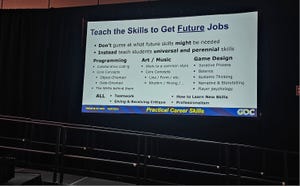
[Congratulations to my Think Services colleagues for co-organizing an inaugural -- and apparently quite successful -- GDC Canada in Vancouver this week. Gamasutra's Chris Remo was on hand to document it, and here's a session round-up.]

This week saw the first annual Game Developers Conference Canada, held at the new Vancouver Convention Center by Gamasutra parent firm Think Services in conjunction with Reboot Communications.

There was a general focus on higher-budget games for the first GDC Canada -- reflecting the output of many Vancouver-area developers like EA Canada, Relic Entertainment, Next Level Games, and Radical Entertainment, all of whom had representatives at the show.

2009 GDC Canada's relatively small size gave it an intimate feel, although the keynotes by Don Mattrick of Microsoft and Drs. Greg Zeschuk and Ray Muzyka of BioWare saw fully-packed rooms.

Here, we have highlighted all of Gamasutra's session coverage from the two days of GDC Canada, including both keynote addresses:

Microsoft's Mattrick Talks Distinctive Days, Pioneer Spirit
"In the first of GDC Canada's two keynotes, former Electronic Arts and current Microsoft executive Don Mattrick spoke with Victor Lucas about his history in the games industry, from Distinctive Software to Xbox. There was particular relevance to the assembled crowd -- after all, Mattrick can arguably credited with having sown the seeds for the now-thriving Vancouver-area game development scene."

BioWare Bosses Talk The Future Of Storytelling
"BioWare co-founders and medical doctors Ray Muzyka and Greg Zeschuk never have any shortage of things to say about interactive narrative, and that held true in the second GDC Canada keynote. The good doctors conveyed their studio's mentality towards game storytelling, from different player character perspectives to internal versus external narrative, to character archetypes."

Next Level's Tronsgard On The Anti-Crunch Manifesto
"With all the recent discussion about the necessity of crunch in video game development, this triumphant talk by Next Level Games CEO Douglas Tronsgard provides much-needed reassurance: it is possible to develop high-quality video games without crunching. Tronsgard explains that his studio was explicitly founded to achieve that goal, and its "intentional culture" of rooting out the causes of crunch has allowed the studio to maintain its standards with few slip-ups."

Rogers On Determining Studio Value To Publishers
"The games industry is notoriously secretive about its own financial affairs, which makes Dan Lee Rogers' comprehensive analysis of high-profile video game studio acquisitions like Rare, BioWare, and Shiny particularly fascinating. Rogers, a longtime acquisition negotiator on behalf of studios, drills down into what publishers actually want out of their developer purchases, and what they did get (or didn't) out of some of the priciest ones."

EA Montreal's Schneider Gets Disruptive On Army Of Two
"EA Montreal producer Reid Schneider's current project is Army of Two: The 40th Day, but in this postmortem he focused on that game's predecessor -- and through the experience of developing that game, the team 'built a studio, learned a ton, and created a franchise.' Learn why "they" shouldn't be telling you how to make your game, why execution can trump disruption, and why you should listen to Gore Verbinski."

What Game Developers Should Know About Windows 7
"In one of the conference's more 'brass tacks' talks, Microsoft senior software design engineer Chuck Walbourn laid out many of the changes coming to the anticipated Windows 7, with a particular focus on games. In particular, he touched on 7's successive relationship to Vista, concluding with, 'If you have any issues with Vista, fix them now. They're not going to go away. If you're a developer, you should be using Windows Vista 64-bit or Windows 7.'"

Researcher Chandler Talks Creating Emotion, Belief
"Did you know scary games can kill you? Here, researcher Clive Chandler explains how games with prolonged frights can cause a harmful buildup of the stress hormone cortisol. On a less medical note, Chandler also broadly discusses emotion in games, including the importance of building player trust and providing an appropriately varied emotional roller coaster."

More information on this year's just-concluded GDC Canada event is available at the official Game Developers Canada website.

May 14, 2009

Painting the Future: David Schleinkofer's Game Covers

David Schleinkofer's paintings --gorgeous scenes teeming with futuristic buildings, space crafts, and lasers -- have graced many science fiction magazines and book covers since the 1970s. You'll likely recognize his talents from the packaging artwork for PC games like SimCity 2000, SimCopter, SimTower, and Crossfire.

According to Schleinkofer, he now focuses more on creating landscape paintings, Marine paintings, people and dog portraits, and a Sue Henry mystery book cover now and then.

His Flickr account, though, shows off his work from those bygone sci-fi years -- you can see a couple of his illustrations used as game boxarts below:

Crossfire:

Sim City 2000:

Opinion: Designing a 'Single Server' MMORPG

[In a new opinion piece, designer and Divide by Zero Games founder James Portnow looks at design approaches to unsharding MMOs, in order to create more immersive, integrated game worlds.]

We won’t be able to provide meaningful stories in MMOs until we can allow the players to affect the world they play in. Currently, this is impossible because of the nature of “shards”, “mirrored worlds”, or, as they are best known, “servers” (though this last term is somewhat inaccurate).

The reason for this is: If players on Server A can make choices that differ from those made by players on Server B and those choices actually impact the game world, on the development side you soon end up with a fracturing storyline and so much content to develop that you’ll be fast on your way to learning a lot about bankruptcy court.

There are many ways to solve this problem, my favorite of which is a largely instantiated world tied together with an overarching story structure (I know that’s a dense sentence – come to one of my talks, you’ll find out exactly what I mean by it – but, as it doesn’t really affect the rest of the article, I’m not going to steal more of your valuable time by parsing it).

But I’ve been asked time and again by major companies and interested designers how to build an unsharded MMORPG with a single, vast world space that all the players can play in (for some reason people seem to like to do things the hard way). Well today you’ll all get to hear my answer.

Just to be absolutely clear about what we’re discussing, imagine a game like World of Warcraft, but instead of all the players on different servers they all play on one server. I’m sure your designer brain is reeling at all the problems this presents. You’ve probably already spat out this list of issues, but here’s what I see as the major hurdles to overcome if you are to build such a world.

1. Population Density:

a. Getting enough physical space for all of your players to play in.

b. Making sure towns/areas of interest aren’t over populated.

c. Allowing players to traverse quickly enough between areas of interest.

2. Varied Content:

a. Providing all the players something compelling to do.

b. Having a world that feels cohesive to the players.

3. Production

a. Creating the game economically.

b. Ensuring scalability and cost-effective ongoing content creation.

So now that we’ve identified some of the problems, what will you need to make your Unsharded MMORPG? Well first you’re going to need about 100 million dollars. You’re going to be technology heavy, because you’re going to need a robust backend plus some sophisticated world building systems... What can I say, big world MMORPGs aren’t cheap (and building infinitely extensible ones are even more ‘not cheap’, we’ll be doing a lot of tricks to get it down to 100 mil).

Assuming you’ve got that 100 million. What will you need to do with it? Well, first off, you’re going to need an infinitely extensible world. Clearly you can’t build such a thing by hand without going bankrupt, so what can we leverage to help us create this world? Procedural Content and User Generated Content.

World Enough and Time

In order to create the incredibly immense world you’ll be building you need to create a procedural terrain generation system. This system has to be able to create a varied environment on a large but limited set of assets. How varied? Well remember that we’re talking a world that is potentially unending.

At its very least this world should be about one hundred times bigger than the current World of Warcraft world (this calculation was done with some very rough back of a napkin estimates on how much “space” an MMO player needs to thrive in a virtual world -- which were in turn based on the fact that the peak concurrent on a heavily populated WoW server is about 4000 and that a game of this nature would have to be design for peaks of at least 80k, accounting for differing nature of this type of game).

Your system also has to allow you to scale your world and push the edges of the world out as your populous continues to migrate and explore. Additionally it has to generate a cohesive and traversable world.

There are lots of articles out there on how to procedurally generate terrain, so I’ll skip the specifics. Let’s see what else we need to do.

Works of Days and Hands

Okay, so now we have a world. Now we need to put some stuff in it. Let’s talk about what ends up in an MMO world, because really there isn’t that much, there’s:

1. Cities and Settlements

2. Monsters

3. Natural Resources

4. Dungeons (instances)

Town Building:

Well, first let’s discuss cities and settlements. For the most part we aren’t going to want to build these either…so let’s let the players do it. This leads to a more dynamic world with more player ownership. It also means that the towns will naturally sift out to be where the players need them in your procedurally generated world. Of course this means building a robust and, more importantly, fun, town building/management system. It also means giving players a reason to build and manage towns. Looking at EVE Online’s station management system here is a good guide.

EVE has taught us that player built locations can encourage social interaction, drive player conflict and take some of the burden off developers. How did they do it? By properly incentivizing station building. Rather than being an afterthought – as it is in most MMOs that even include it – ‘town’ building in EVE is an integral part of the design. Player who build stations get economic resources otherwise unavailable, thus highly encouraging structure creation (and defense). This is essential if we are to rely on player created towns in our game.

Additionally this sort of town building gives us one further benefit: it broadens our audience and allows for a new form of play. There will be players who do nothing but manage towns and help build the world. Some of these players will end up being some of your best evangelists, rather than simply washing out of an ‘all grind’ game.

So what sort of system should town creation be? Sadly it is going to require building a totally different interface than your standard MMO controls. This is expensive, yes, but not as expensive as building all the towns of the world. The key to this system is that it be simple to use.

I recommend going with a top down “gods eye view” perspective for your town building, this allows players to see all the buildings in an area in relation to one another and allows you to do basic usability enhancements like outlining buildable plots of land. Building buildings should be as simple as having the resources, clicking on what you’d like to build and where you’d like to build it.

For the most part players should be able to build a single building in a town, let it auto-manage itself and receive income based on the usage of that building (with occasional trips back to upgrade it) if so desired.

This should be completely separate from town management (which we’ll talk about below). On the art side, buildings should be based off simple templates with modular segments for player customization (obviously simple re-colorizing is the cheapest and goes a long way but, if you’ve got extra cash in grip, building finishes will really make your world more vibrant).

Now about town management. There should be a system where certain players can manage an entire town or section of larger cities in order to keep things cohesive. For doing so those players should receive income based off the use of all the buildings in their town (can even be a tax system with a neat slider!) which can only be used to upgrade the town and some sort of personal incentive based off the success of their town.

If you really want to mix things up and incentivize player politics, which we’ll talk about below, allow a “graft” system where players controlling towns or areas can skim some of those funds for their personal use.

How players get to control towns is up to you. Depending on your game you might want it to be a conquest system, or democratic elections, or both.

This system will give your MMO a much needed ‘elders game’ and will allow you to have meaningful player interactions at the high end. This is important since in an unsharded world standard high end raid content becomes much less vibrant as it will be much more diffuse, so anything we can do to create interesting high end gameplay without having to handcraft raids will help a great deal.

But before we can examine that we need to give player’s a reason to congregate in certain areas.

Socially Designed Procedural Resource System

Just because much of our game is procedural doesn’t mean that it isn’t a directed experience. We want players to have the best experience possible, so this means creating “smart” procedural systems that take into account more than just mathematics; we need to build systems that account for human behavior. We’ve just talked about the town creation system. Now we have to consider why people build towns.

For the most part humans build towns around trade routes or natural resources with some minor consideration for defensible terrain. In pre-industrial societies, towns located around natural resources tended to grow until slightly past the point where the per capita access to resources was less in the town and surrounding area than it was in the wilderness.

Trade route cities obviously grow and die with the trade routes they exist along. Major economic centers tend to occur at the confluence of multiple trade routes, so long as that location has some access to independent resources and some natural defenses.

So now the question becomes: how do we allow for this behavior with our resource system? Well first off I’d encourage you to have a designer who has a lot more background in how humans choose to congregate than the above paragraph (fascinating topic, I could go on about it for hours, luckily for you, I won’t…), but just using the above brief information, there are several keys:

1. Remember that monsters ARE resources.

2. Have a weighted distribution system that makes "resource lanes" and "resource nodes"

3. Allow for resource thinning over time

First and foremost, I’ve met a few MMO designers who seem to forget that monsters are their number one resource. Players will tend to congregate in good spawn areas. It’s amazing how quickly even marginally advantageous spawn areas get discovered and exploited. This means your spawn placement and natural resource placement systems should be viewed as one holistic system rather than two disparate entities.

Once you’ve got that overarching view of what your resource system should be, how should you implement it in order to best take advantage of natural human grouping instincts?

Well, first off, you’re going to need to view your world as a grid. You’re going to start off with a group of “resource nodes” - heavy resource concentrations - that will form your starting towns. These towns will have to be built by you, the developer, to give the players a place to start from; luckily the town building system you’ve already implemented should make this cheap.

Once you have these nodes, you’ll have to set the content around them. You will basically be creating "newb zones". This will serve as a seed for your procedural system. Your system will take into account the difficulty of the content in the neighboring grid squares in order to place similar content next to it, getting more difficult as it moves away from the initial nodes.

It will also have to take into account the amount of content in neighboring grid squares in order to algorithmically generate channels of resources that guide players to further resource nodes (where you can expect players to create cities).

It’s important to remember that resource spawning takes place over the lifecycle of your game rather than simply being established when you launch the server, so your spawning mechanic should be able to adjust dynamically as your gameworld/player distribution changes.

It needs to be able to factor in social elements such as what the average level of players in the area and how long an area has been player dominated (so that long held territories become more peaceful, encouraging players to explore and disperse).

I won’t take the time here to go into the specific algorithms to do this, but consider your system to be a cellular automata in the vein of Conway’s Game of Life (if you don’t know what I’m talking about you should immediately stop reading this and Wikipedia Conway’s). This should help contextualize your thinking on how to distribute natural resources, monsters and instances.

Monsters and Instances:

Ok, so far we’ve created the world, we have resources distributed around the terrain so as to direct the players to congregate in specific areas and we have a town building system to facilitate their doing so... now we have to contemplate how to make the actual game fun.

Combat in Fantasy MMOs is well established and many cleverer individuals than I have opined on how to improve it, but it’s not unique to an unsharded world, so let’s skip past that part and talk directly monsters and instances. In an unsharded environment we have to look at monsters and instances fundamentally differently than we do now.

Right now the paradigm is to spawn individual ‘mobs’. To keep things feeling fresh in an environment of this size you should instead be spawning encounters. Some simple scripting will allow your battles to feel more vibrant and get more millage out of a limited amount of content so:

Instead of spawing some orcs, spawn “some orcs fighting some elves” or “some orcs attacking a wagon train” or “some orcs attacking a wagon train with some elves defending it”. In these sentences the terms “orcs”, “elves” and “wagon train” are all variables: they can be plugged in with any monster, humanoid or ‘stuff’. This allows you to create more interesting encounters for your players to stumble upon and while repurposing content to keep costs down.

To re-illustrate: running into orcs sitting around a campfire or elves sitting around a campfire is more interesting than running into a randomly spawned pile of orcs or elves, moreover in both of these scenarios we can reuse the campfire without creating any new assets.

This is important because it will give your world the feel of a vibrant, living environment without handcrafting specific encounters for specific zones (which you won’t be able to afford to do in a world of this magnitude). If you layer on top of this a function in your resource system which tries to deploy a similar set of creatures in any specific geographic region (with these creature sets blending into one another on the boarders) you will have created a cohesive world.

Instances will also have to be largely randomly generated. Handcrafted instances will provide too much incentive for players to group in any specific area, so instead you can distribute entrance points to random instances across your world as it is being created.

Each of these “random” instances should be pseudo-random. They should have attributes such as: difficulty (expected level range), environment/theme, monster types encountered, loot types dropped, etc. Most of these attributes should be set by your procedural spawning system.

What Man Has Made of Man

It is growing late and I grow weary (as probably do you, this is like six pages... of reading... words…), so I’ll try to keep the rest of this brief. There are two major boons that unsharding provides

1. Player interactions can have real meaning.

2. Players can affect the world they play in.

These things may at first seem similar, but I assure you, their distinction is important. Player interactions range from political interactions to the economy of the world where as when I say, “Players can affect the world they play in” I mean that you can give player’s real agency over what occurs in your MMO. There is a vital interplay between the two, but they are separate ideas.

It’s important to focus on both of these things because otherwise, why unshard?

This means that:

A. You should focus on the strength of your MMO: the number of players.

B. Create opportunities for your players to affect the world.

Normally I talk about these two points in great detail whenever I discuss unsharding MMOs, but as that would meander into another several pages of text which would not be directly relate to the practical problem of building a single world, shared story space, fantasy MMORPG I’ll leave you to think on these two points and offer simply this:

In a game of this nature you are not going to have the high end raid content a person might expect from a standard MMORPG, so you have to find other ways to encourage top tier player retention. The two ways to do this are to allow for a thriving player society, where player empires rise and fall, trade monopolies are gained and fortunes are made then lost and to allow player deeds to have a permanent effect on story and game play.

The first way mentioned is sort of the high end PVP aspect of your game, and, if I’m going to give you any advice here on it, it’s to write it into your story. Let player guilds and player wars become part of the lore of your land. Let player factions ally with your NPC groups and influence the future of your game. Patch for things they do and let them engrave their names on part of your world. You’ll get higher retention from this than from a thousand well built instances.

The second is your sort of your PVE. It is events, crafted by you the developer, which take in the whole scope of your world and allow players to decide how they want their world to grow. This can be anything from upping the rates on Goblins spawning and having players fight off the “goblin horde” until finally they unlock the power behind it, to turning in medical supplies to stave off a horrible plague.

Of course, to do this well you have to let people ally with the goblins or the dark forces secretly spreading the plague…and those forces can’t be de facto evil. And you have to be willing to patch differently depending on whether the goblins win or forces opposing them. If you do that you give players a chance to say “I was there”. When they pass by the town ruined in the goblin invasion or the plain haunted by those dead of the plague, they’ll have an unprecedented sense of ownership of the world they are in.

If you want a longer diatribe on how to do this, feel free to email me (my email address is at the end), but simply put, if you are going to do this, remember why you went to all this trouble in the first place.

Flights of Angels

Take this, run with it. I hope it does some of you some good. More importantly I hope it gets us a little closer to delivering the kinds of worlds and the kinds of stories that our medium has long promised. If you use it, I would simply ask that you find the time to share something you learn.

[James Portnow is a game designer, formerly of Activision, and now at Divide by Zero Games, where he is also the founder and CCO. He received his master's degree in Entertainment Technology from Carnegie Mellon University.]

GameSetAnalysis: The Mamas and the Papa

Just as Majesco's Cooking Mama series sought to turn living rooms into virtual kitchens for teaching cooking fundamentals, Activision's new Science Papa game hopes to "turn living rooms into virtual laboratories" for teaching science fundamentals.

Considering that Majesco has sold over four million Cooking Mama games so far in North America alone, it's not a bad formula to copy! Just like in Cooking Mama, players will have a series of minigames to enjoy, but instead of making meals, they'll "pour and mix chemicals, pound objects into dust, monitor Bunsen burners, fix and use lab equipment, and more."

Rather than talk at length about Mama (who also gardens on the side) and Papa's obviously kindred designs, let's compare art from the two IP's DS and Wii titles to see how deep the similarities run:

Wii boxart comparison (Science Papa and Cooking Mama: Cook Off, via GameFly):

Wii gameplay comparison (Science Papa and Cooking Mama: World Kitchen):

DS gameplay comparison (Science Papa and Cooking Mama):

Activision plans to release Science Papa for DS and Wii this July. I'll make sure to do another image comparison series whenever Electronic Arts announces its own kin-based minigame collection -- House Painting Uncle or Snarky Gaming Blogger Auntie or whatever.

Commander Shepard's Facebook Page

Joe Shephard's Facebook page, imagined and mocked up by Penny Arcade forumer TychoCelchuuu, is predictable but nonetheless hilarious.

The faux profile page tracks the default Mass Effect player character online life with a friends list featuring familiar faces from the game, and even a terribly typed Wall message left by a blue-skinned fling.

You can load the full page here. I love the game referencing ads in the sidebar and the super corny personal message just above the Info section.

101 Free Games For 2009

Looking out for cheapskates or just those of us with tighter wallets this year, 1UP's Scott Sharkey put up a selection of 101 free games to play this year spread across genres like adventure, strategy, RPGs and more.

There are a couple of 2009 Independent Games Festival finalists on the list -- Coil and You Have to Burn the Rope.

But there's also many recent releases, like addictive tower defense game Gemcraft Chapter 0, and other PC/Flash titles from the past year that you might have been meaning to play but just haven't gotten around to, such as Barkley Shut Up And Jam Gaiden and The Sewer Goblet - The Wu-Tang Clan and the Wu-Tang Baby.

That last title reminds me that there really aren't enough non-fighting games out there featuring the Wu-Tang Clan. The symbol is coming back!

Column: @Play Special: The Rights to Rogue

Roguelike column thumbnail ['@ Play' is a monthly column by John Harris which discusses the history, present and future of the Roguelike dungeon exploring genre.]

Perhaps no genre of computer game has as as close a tie to the open source community as the roguelikes. Eric S. Raymond, noted open source booster, both wrote the guidebook to an earlier version of Nethack and wrote the oft-read argument for open software, "The Cathedral and the Bazaar," in which Nethack is mentioned.

Angband's source is so open that it's become one of the most-permuted computer games of all time. Linley's Dungeon Crawl picked up new life when the Stone Soup guys started developing their variant, which is now recognized as pretty much the premier version of the game. And all of the 7DRLs are open source.

An interested observer could be forgiven for assuming all roguelikes must be open, but they aren't. None of the Japanese commercial roguelikes are. The source code of one of the big ones, ADOM, remains closed.

(This fact means the game is falling out of prominence now since all changes must be approved by the game's creator, Thomas Biskup, who has moved on to other things. But it also means it's the most mysterious of the major games.)

But the first closed-source roguelike is the first of all of them.

A recent article over at Gamasutra, "The History of Rogue: Have @ You, Deadly Zs" attracted a fair number of comments from people involved with the development of the original game, including Ken Arnold and Glenn Wichman, two out of the three of the original guys.

The information in the article's comments, which are fascinating, go as follows:

1. Rogue was, and is, copyrighted by the Regents of the University of California, with the justification that the game was developed on their computers. Whether that rationale would suffice today I don't know; most commercial software these days is owned by the developing studio under, if I remember correctly, the principle of work-for-hire.

But the developers were not concerned with it. The game continues to be distributed with BSD Unix, but unlike most of the other parts of the system, the source code is not shipped with it. The reason they gave for keeping it secret was to prevent people from source-diving to discover the game's secrets.

(Such diving is the main reason Nethack's so throughly spoiled now, and Rogue, being a much simpler game, would be more easily harmed by this inspection. Although take note: the game is also more resistant to spoiling, since it has far fewer tricks.)

It also hindered player efforts to hack save files, the high score list and the wizard's password. (To continue the comparison with Nethack: it contains consider safe file tampering protection, it doesn't bother protecting its score list, and access to its wizard mode can be compiled out of the game.)

Ken Arnold notes that at the time of the height of Rogue's popularity, Richard Stallman had yet to start the GNU project, upon which Linux and most of the current open source movement is based. Open source was just a vague notion floating around, not a legitimate movement yet.

This probably explains why Linux distributions make it available in an extra non-free supplement to the bsdgames package, although to produce that package they probably have the source code form somewhere. BSD's license was eventually opened, according to Andrew Grillet, since the U.S. taxpayer has ultimately funded it.

(It must be noted that many universities are not making this observation nowadays; patent rights are a source of income for some institutions.)

David Dingwall notes that Rogue's source, once escaped into the wild, quickly suffused the user communities for both BSD and AT&T versions of Unix, and that it was even backported to older versions of BSD running on PDP11s. He also notes the spread of Rog-O-Matic, the first roguelike "bot" and predecessor of Ben Harrison's Angband Borg.

2. The source code then escaped. Several possible incidents are reported in the comments about when this occured; a student used an open terminal logged into the games account, and the source was accidentally left world-readable one day. They then spread around between systems.

These inadvertent source releases could also be the origins of some of the code in the "lost roguelikes," which are all fairly close to Rogue in many of their features, but some/all of them could be reimplementations too.

3. When the developers of Rogue reimplemented it and attempted to sell it for home computers, first under the name A.I. Design, then when they granted a distribution license to fondly-remembered classic games company Epyx, they had another reason to horde the code; to preserve their commercial rights to the game.

The game didn't do well in the market, perhaps because of a high piracy rate, although the authors of the article doubt it. (And so do I, for that matter.) Ken Arnold states that if he wrote it now, he'd go ahead and publish the source. (He does have the source of the most recent version of the game up at Sourceforge.)

Mastertronic also released some versions for various computers, including the Commodore 64; I have no information on how they obtained the rights.

More information, gathered from other sources:

4. There is a game called "Rogue Clone" out there that is definitely open-source. It's an independent close reimplementation of Rogue and pretty much the same in most ways I've noticed. It may be a little easier; I've had multiple wins at Rogue Clone IV, but I've never won PC Rogue without cheating.

5. The "lost roguelikes," Advanced Rogue, Super-Rogue, UltraRogue and XRogue, as well as versions of the original game's source, are available from the online/offline Roguelike Restoration Project. They were also closed source for a long time, and have only recently been recovered and make working again.

Advanced Rogue's copyright notice states that AT&T is one of the copyright holders. This may be due to confusion over who owned the rights to Rogue; BSD Unix contained some AT&T code, and so BSD carried an AT&T copyright notice in addition to one held by the Regents of the University of California.

6. The game Hexarogue is a recreation of Rogue in Java using a hexagonal grid instead of a rectangular one. It also supplies two modes that are more like the original game, Newer Rogue and Old Rogue. These are also open.

7. There was also a Japanese version of the game, for early computers over there. The developer of that version seems to have authorized the Japan-only PS2 remake Rogue Hearts Dungeon. I suspect that these versions are not authorized by Rogue's creators. In any case, they do not seem to be open.

Other facts of possible interest:

- The wizard's password for the original versions of Rogue, according to Ken Arnold, is "cute,huh".

- The article shows a close-up image of the graphics from Glenn Wichman's Atari ST port of Rogue that makes it plain that Nethack's dungeon graphics are taken more-or-less directly from it.

Ys I&II Chronicles Trailer Makes The End Of Battle

Ys I&II Chronicles is a hard sell for Falcom, considering that Interchannel already released remakes for the two games just last year in Japan (and the originals were posted on Virtual Console recently, too), but this trailer for the PSP game does a lot to pick up interest from the ARPG series' fans.

Along with its rock-out arrangement of Falcom JDK Band's "To Make The End Of Battle", the video shows off the remake's new character art, and reminds us of how great the PC edition (which the PSP games are based on) looked, especially compared to the unimpressive 3D graphics in the DS remakes. I love the preorder treasure bit at the end, too!

Ys I&II Chronicles ships in Japan on July 16th. No plans for a U.S. release have been announced.

[Via PSPHyper]

The Community Manager Interviews: Cryptic Studios' Nicole Hamlett

[It's a testament to big sister site Gamasutra's community manager interview series that Chris Remo keeps getting to talk to notable game studios who realize the importance of community. This time round, Cryptic...]

As the community manager for MMO developer Cryptic Studios, Nicole Hamlett's role is particularly long-term. No community manager's job ends when a game ships, but with an MMO the position becomes all the more crucial.

We spoke to Hamlett for the fourth part of our series of interviews with community managers from several companies -- publishers, publisher-owned studios, and independent studios. Previously,we featured 2K Games' Elizabeth Tobey, Naughty Dog's Arne Meyer, and Bethesda Game Studios' Matt Grandstaff.

Hamlett is currently focusing on Atari-owned Cryptic's two announced upcoming games, Star Trek Online and Champions Online. (Cryptic originally developed City of Heroes and City of Villains for NCsoft before the games were passed off to Paragon Studios.)

Here, she discusses her experience in editorial and marketing before landing a community gig, the duties of an MMO CM, the overlap and separation between marketing and community, and the essential qualities of the job:

In your view, what is a community manager? In particular, what is the role of a community manager for an MMO?

Nicole Hamlett: Most people aren't sure what a community manager does these days. Or, worse, they think a community manager is a glorified forum moderator. That certainly isn't correct.

Thankfully, quite a few companies are getting wise to the job and giving their community managers quasi-marketing roles. This is because the primary goals for a CM are user acquisition and retention -– the same goals of a marketer. That means we use whatever tools we have available to acquire new people for our community and then make them happy enough to stay.

Pre-launch, available tools might include social networking, contests, game feature reveals, etcetera. Whatever it takes, right?

I encourage my OCR [online community relations] folks to visit the forums and interact, but not spend all their time there. I think work hours are better spent coming up with ways to make our community's time more enjoyable when they are with us.

How did you end up in your current position?

NH: I came into development in a roundabout way. I started in editorial, working for a gaming community website and then moved into a developer relations role where I spent a lot of time interacting with community managers and PR reps to gather content, generate stories, collect assets – whatever I could get my hands on.

It occurred to me later that I would really enjoy working with communities on that side of the fence. I was fortunate enough to get a job with NetDevil and then Cryptic. Now I do just that.

Does previously being in the press and then marketing side give you any insight into community, or are the disciplines too separate?

NH: Oh, I absolutely think my past editorial experience gives me insight. Walk a mile in someone else's shoes, you know? I believe that every decision I make in regard to my community stems from what I wished I could have seen when I was part of the community on the receiving end.

So, my experience allows me to better understand what community participants and fansites are looking for, and it gifts me with a general idea of what's newsworthy when we come up with content ideas and plans.

When I'm looking to fill an OCR role, I scan resumes both for past experience and editorial background. I think it helps. In fact, when people ask me how they can get into the industry, I point them to the various editorial websites and tell them to start there. That's where we look, anyway.

One sentiment I have gotten from community managers is that the role is very much still being felt out, and has not yet had time to be well-documented or taught. Would you agree with that characterization? How have you gone about defining your own place?

NH: It's a valid statement. Everyone has their own idea of how a community needs to be run; however, if you ask a hundred community managers what they think they should be doing, I'll bet you'll see a consensus.

Personally, I have been extremely fortunate in that I have had really amazing directors who have said, "Do what you think works. It's your expertise." Of course, I also have the advantage of having some really incredible friends who have been doing community for a long time. I take pieces of their expertise, add in some of my own ideas, and throw it all out there. If it works, great. If it doesn't, I still have the director-given freedom to change it.

I've gotten the sense that although they work together in many cases, there are times when community and marketing/PR don't see eye to eye, due to the difference between the driving a message and fostering discussion -- have you found that to be the case?

NH: Well, as much as we are the same, we're different. Marketing and PR tries to sell the game. They do this utilizing high-level tactics. Community also obviously wants to sell the game, but we go about it differently. I think our focus is on the players and what they want to see -- what they want to hear. We work very hard to give them a sense of what is under the outer layer that marketing provides.

How much of your job is focused on actual direct interaction with the community itself?

NH: I interact directly with the community on a daily basis. As I've gained more responsibility, it becomes increasingly hard to do so, but I make an effort. I think that the community should have at least one person that they can identify and attach to.

I think you have to build a trust with your community. They need to believe that what you're telling them is truth. So, I try to talk to them every day.

How important are social networking sites or techniques to your particular approach, if at all?

NH: They are becoming much more important. These days, the community manager has to do things more economically. It's easier for us to do a grassroots marketing campaign through Facebook or Twitter, for example.

We have the job of stealth acquisition and these social networking sites are the best place to gain new community members. It's easier to branch out when you can reach people who have targeted interests.

Do you have ways to measure the "success" of the community, be it through specific metrics or tracking, or more subjective observations?

NH: I'd like to say that it's all very standardized; it's just not. Benefits are still, largely, intangible. I would like to see more concrete methods used to gauge success, actually. My team uses a variety of metrics to determine ours. Some are based on forum comments, contest entries, traffic, outside influencers. We are working on getting a better system in place.

I've heard from some community managers who can get overwhelmed by the responsibility of dealing with such a large group of people, who tend to be very dedicated. Any tips on how to avoid that, and keep the right mentality?

NH: When you deal with any large group of people it can become extremely overwhelming. There are thousands of people who depend on your ability to communicate effectively with them. There are some who border on fanaticism and there have been cases of stalking. It gets very hectic and the pressure is extraordinary at times.

Something that I have had to do is separate myself from my job. I go home and I don't read my forums. I try really hard not to work once I leave the office. It allows me to come back the next day with a fresh perspective. With any job, there is absolutely going to be burnout. It's just a matter of making sure you take a step back when it approaches. The world doesn't rotate by the will of our words, after all.

Having an old-fashioned thick skin helps, too. I've had a player tell me that I should just do the company a favor and kill myself to save them from having to fire me. I'm pretty grateful that I can laugh that off. An extremely supportive management system helps, too. I think that without them, I would have a harder time with it.

Any general tips for those going into community, or hoping to?

NH: More and more companies are looking for good community people. I've heard people say that anyone with half a mind and a forum presence can do the job. Sure, they technically can, but they won't be good at it.

If you are patient, creative, and a good communicator, find a place at one of the media networks and watch yourself rise to the top. We look for people who can handle a bad forum situation, a tricky communication issue -– people with perseverance and drive. It's not an option to give up in this job.

And play on your strengths, damn you! Having a unique perspective on how to keep people interested in a product is always beneficial. Also, you would be surprised at how many people who are not gamers try to get into community management. That's pretty much a requirement. You must play and know games.

May 13, 2009

Interactive Highlights From ITP Spring Show 2009

New York University held the 2009 Spring Show for its Interactive Telecommunications Program last weekend, inviting anyone interested to a "festival of interactive sight, sound, and technology" projects from its student artists. The curious works on display ranged from a wind responsive LED screen to a taxidermied squirrel that removes its own head at sunset, waiting until sunrise to put it back on.

DIY-site Make attended the two-day event and shot the above video, which includes a couple clips of the show's game projects. The program's students showed off over a dozen pieces with game elements, five of which we've picked out with media to share with you!

Ant Warz by Oscar Von Hauske and Vitaliy Dikker

In this tabletop real-time strategy game, up to four players control a colony of ants with "colored LED finger-wearable devices." To survive against competing armies, players need to grow their colony, exercise their ants, and send their soldiers into battles.

Urban Alpinist by Anderson Miller

Teams compete against each other to get to the highest points possible in a city in this "microlocative" game. A special iPhone application and a device that measures barometric pressure records how high players are, and after the teams register three heights, the groups can view their accomplishments in a Google Earth visualization.

Tuuug-of-War by Nobu Nakaguchi

This deafening multiplayer project has two teams of up to three people each yelling "TUUUUUG" as loud as possible into mobile phones, with the noisier group winning a game of tug of war between monsters displayed on a big screen. The installation takes a photo of the winners, which it then pastes on the monsters, posts on a website, and sends to the players with an SMS link.

SimSnails by Craig Kapp

SimSnails aims to help users "learn about and experiment with the concept of natural selection" with an augmented reality setup that brings to life a colony of 3D snails that "live, breed and get eaten by predators". Waving cards with printed symbols in front of a video camera help affect the colony's landscape, reproduction cycle, and rate of mutation.

WikiPaths by Alex Abreu and Tim Szetela

WikiPaths is a Greasemonkey Firefox Add-on that acts as a scavenger hunt played across Wikipedia.org. This casual game challenges players to "find the shortest path between two, seemingly unconnected, encyclopedic entries" on the website.

Ripped Rock Band Music Tracks' Potential

In the seedier corners of the internet, people have traded and distributed ripped music tracks from Harmonix's Rock Band franchise for some time now.

This might not seem any more remarkable than the pirated MP3s that we're already so familiar with, but you should remember that these are based on the songs' masters and stored as "multitracked audio with isolated guitars, drums, vocals, etc.", perfect for remixing.

Flash developer Mike Nowak insists, though, that for everyday listeners and even collectors, this isn't a big deal:

"Multitrack audio like this is heavy and bloated and not really of interest to the average listener. These are of interest to obsessive completists, fellow musicians, and/or mash-up artists. For them, there already exists a shady underground network trading original master recordings (this is how those SongSmith versions of popular songs were created) so, for them, the Rock Band rips are actually low quality. The only thing of interest is new multi-tracks for songs that might not have had masters leaked, but I don’t know if this is the case here."

So, taking all that into account, why should you care about the miscreants out there distributing these files? As Nowak puts it, "combine 'rip multi-track audio from Rock Band' with The Beatles Rock Band coming this September and, well, things seem a little more notable.

Interview: Feist Creators Talk Design And Development

[Starkly-illustrated, physics-driven indie platformer Feist has generated a lot of attention, and in this new Eric Caoili-penned interview, creators Adrian Stutz and Florian Faller explain their thoughts and process.]

The sidescrolling platformer Feist quickly struck up attention in the game development community when screenshots, video, and a temporarily-available demo surfaced last year. Its striking silhouetted visual style and physics-driven gameplay immediately stand out.

Developed by Adrian Stutz and Florian Faller, two graduates of the Zurich University of Arts' game design program who started the project as a senior thesis, Feist was a Student Showcase winner and Excellence in Visual Arts nominee at this year's Independent Games Festival.

In this interview, Stutz and Faller explain the driving ideas behind the game, discuss its development process, and reflect on the state of the larger game industry:

What development tools did you use?

Florian Faller & Adrian Stutz: We used Unity as our game engine, which was also great for prototyping and building levels. For content creation, we also used Cinema 4D for modeling and Photoshop for texturing.

Can you explain Feist's title? The game doesn't see to have much to do with any "belligerent mongrel dogs" of any sort.

FF & AS: "Feist" is a seldom used German word meaning cheeky, brazen and fat. We think that all of those meanings fit our game. There's also the English word "feisty," which we also found fitting. We didn't think of any dogs when we came up with the title.

Why did you decide to present Feist with silhouettes?

FF & AS: Suggestion can be more powerful than spelling something out. We wanted to take advantage of that and create a game that uses suggestion to create a striking image. And because we love classic graphic design, we were looking for a way to find some kind of graphical abstraction. So we took the idea of a hazy shadow or puppet theater as inspiration for the visual design.

That also lent itself to mix 3D and 2D objects and to add and remove depth to the visuals during the game. Feist is actually not a pure silhouette game. Depending on the lighting of a scene depth is added to the front, especially visible on the ground.

What exactly is the creature in Feist? And why does it always seem to have a smokey trail behind it?

FF & AS: The identity of the lead creature in Feist is up to the player to establish. We deliberately only want to leave its identity open and avoid any clear associations. Though there were specific traits the we wanted to bring out clearly, like the fragility of the creature to bring the player to care about it and to feed it.

The trail pronounces the movement of the player and encourages to try to move gracefully. That almost turns the creature into a brush and allows the player to paints figures in the air while playing.

The controls and movement are a bit "floaty" -- was this a conscious design decision?

FF & AS: We wanted the movement to be rewarding by itself. The player cannot fall down in pits or be instantly killed by touching an enemy. Instead, we wanted to create a movement that allows the player to get into a flow. This floaty movement, with some training, allows to pass through the levels smoothly and we liked how that made it fun just to jump from tree to tree. This kind of blurry control also matches the visuals and game mechanics -- Feist is an analog game, in a sense.

Additionally, the player is another physics object, like any other object or NPC in the game. It's controlled by applying forces and handled by the physics engine. The player is physically part of the world and equally subject to inertia and friction. This also contributed to the floaty movement because the input doesn't immediately take effect on the player's movement.

What specifically influenced your choices behind the designs for the enemies? The mountain and forest setting? The background colors?

FF & AS: We didn't do any paper drafts but instead did all our drafts directly in the engine itself. We weren't influenced by what looked good on paper but rather could directly see what would work in the engine and the final game.

Finding a look and setting for the world consisted of watching lots of independent animation clips and looking at contemporary character design, but also of experimenting with the engine and seeing what interesting things we could draw from it.

As for the mountain and forest settings, we wanted to create a world that would be discomforting and appealing at the same time. The world should express the dangerous unknown but at the same time make the player to want to explore it. From a cultural and historical point of view, both forests and mountains have both those sides as in being part of nature and beautiful but at the same time home to unknown and dangerous inhabitants.

You've mentioned that you'd hoped to create dynamic/emergent gameplay with Feist -- how so?

FF & AS: There are only a few objects in Feist that only serve a specific purpose. We rather created objects that can be used differently depending on the situation. Stones, for example, can be used as weapon, as a weight or to loosen objects not reachable otherwise. Those functions are also not limited to the player but also open to the enemies, they can theoretically use objects the same way as the player. All objects in Feist are treated equally; the same rules apply to all of them.

The modularity of the Unity engine was a big help in that regard, and we also created a modular object-oriented groundwork, which is very open for additional objects or creatures. The player and the enemies share most of the code, which means that implementing something for the player makes the function also easily accessible for the enemies.

We tried to create the groundwork of Feist in a way that allows games with different kinds of goals to be integrated. We wanted to create more of world that an specific kind of game, where the inhabitants and object could interact with each other and be a stage for a game to work in. All that, the physics and the autonomous NPCs should all contribute to a dynamic gameplay.

So in a sense Feist is more like narrative toy than a game. In contrast to other platformers Feist doesn't encourage the player to go through the level quickly or to hunt points. Instead, it wants the player to explore and to linger in the world. We believe that it therefore has a good replayability.

As a result, Feist can become a bit chaotic at times and we're trying to find the balance between openness and directed gameplay. It's a much fun to create new elements, put them into the game world and to see what they create for possibilities and how they change the game. It's like a working in a laboratory which sometimes collapses or explodes in your face.

What were some of the elements that you experimented with but didn't make it into the final game?

FF & AS: To take an example: We originally wanted to add eating as a more general part of the game, where the player could not only eat the food himself but feed it to the enemies, which would then mutate and change behavior. It turned out that the limited scope of the camera and the mutations didn't work well together. The player usually already moved on before the mutation took place and it would seem just as if a new enemy appeared out of nowhere. We liked the idea conceptually but it turned out to be badly comprehensible for the player.

You've mentioned that you designed Feist with the intention of attracting casual gamers and even non-gamers. What steps did you take to make the game more appealing to those audiences?

FF & AS: In terms of usability, we decided to use simple controls with only a few control parameters and only a very flat and minimal menu structure. That is because we believe that people who don't play regularly don't want to engage with tasks not directly inherent to the game, like character selection and customizing, story, or tuning the game rules. Hardcore gamers may like that complexity and control. Other gamers need to be taken in by the game quickly and are deterred by a complex menu structure or a long-winded introduction.

We tried to question a lot of things we have become accustomed to in games and may have their value in terms of tradition and custom. Instead we tried to find out what non-gamers in our surrounding find attractive in games and what is disincentive to them.

We have completely resigned to using an in-game GUI and also to many purely abstract game elements like winning points by collecting items. We also tried to find a look which isn't associated with games and to bring the engine to create a look that would be appealing for non gamers.

If you could start the project over again, what would you do differently?

FF & AS: We started with a very open design process and hope that had a positive effect on the game, though today we would define our concept and goals more precisely. That's also what we have done and how we will continue for finishing the game.

Do you have any plans to expand on the beta released so far? If so, how are you looking to add onto it?

FF & AS: The term "beta" didn't really fit what we released back in September of last year. It contained the groundwork and many elements that will be in the final game but it was also far from feature-complete, as the term would imply. There will be many additional game elements and levels with varying environments in the final game. Many of them are already implemented or will be soon.

We are also working on a simple narrative setting, which should communicate the goals of the game, structure the levels more clearly and motivate the player. However, rather than a story that seems grafted to the game, this should possibly be told in-game and be perceived as a part of the world. Conversely, the story should also be continued in the game itself. That is to say, what happens to creatures and objects in the game should be seen as a continuation of the story.

What do you think of the state of independent game development, and are there any other independent games out that you currently admire?

FF & AS: The game industry wants to expand its target audience. With increasing production cost of big AAA titles and a saturated market they also have to. But apart from maybe the Nintendo Wii, which manages to attract a wider audience with many titles targeted at families and females, many big studios struggle to reach new audiences.

Interestingly, it's especially the indie games that manage to expand their audience. Some of the interdependent games are targeted at the core gamer market, such as Dwarf Fortress, but there are also titles that show it's possible to make games for a wide audience -- Samarost, flOw, Line Rider, etcetera. That's also remarkable because all of those games feature their very own style and are appreciated by many.

The big studios have possibly ogled too long at Hollywood and thought reaching the masses could only be achieved by uniformity. But it is just that uniform identity that deters many people from playing games. The future of the gaming industry can only lie in diversity and the recent focus on independent games makes this clear.

Apart from the games mentioned above, we are also very fond of many other independent games like Crayon Physics, Gesundheit, Fez, World of Goo, or Mount and Blade, just to name a few. Of course we also like good big titles like Half-Life 2.

What have you two been up to since graduating last spring? Has winning the IGF Student Showcase and two Unity awards affected your careers?

AS: I've always had some software projects running and currently I'm trying to make MPlayer OSX the video solution it ought to be. I'm also head of programming for a local anime convention.

FF: I am currently working on a serious game project in the field of rehabilitation. It is a game for a walking therapy that uses a robotic device to help children whose ability to walk has been impaired learn to walk again. I recently did some electronic music for the lovely label interdisco and since last summer I am working at the Zurich University of the Arts.

A&F: As for our career, we are still waiting for a call from Valve.

Helms' Metal Gear Solid Scenes

Andy Helms, whose name you might recognize from his Dude-A-Day project in which he draws a single character every day, recently created this piece -- simply titled "!" -- bringing together snapshots from each of the four Metal Gear Solid games. I love the numbers in each shot subtly indicating which game the scene is taken from.

Helms must have been in a real MGS mood, as he posted 12 sketches of characters from the series (specifically from MGS 2 and 3) last March:

Best of Member Blogs: From Interactive Stories To Cheap Scare Tactics

[Showcasing highlights from Gamasutra's Member Blogs, we hand out a lifetime Game Developer magazine subscription for a look at interactive storytelling, as well as a discussion of game pricing's 'happy spot'.]

In our weekly Best of Member Blogs column, we showcase notable pieces of writing from members of the game community who maintain Member Blogs on Gamasutra.

Member Blogs can be maintained by any registered Gamasutra user, while invitation-only Expert Blogs -- also highlighted weekly -- are written by selected development professionals.

Our favorite blog post of the week will earn its author a lifetime subscription to Gamasutra's sister publication, Game Developer magazine. (All magazine recipients outside of the United States or Canada will receive lifetime electronic subscriptions.)

We hope that our blog sections can provide useful and interesting viewpoints on our industry. For more information, check out the official posting guidelines.

This Week's Standout Member Blogs

- Some Definitions About Interactive Storytelling
(Emanuel Montero Reyno)

Discussion of interactive narrative and storytelling is nearly constant in game circles, but discussion is often vague. Here, software engineer and PhD student Emanuel Reyno attempts to nail down some succinct definitions and structures of various concepts surrounding interactive storytelling.

For his effort, Emanuel will receive a lifetime subscription to Gamasutra sister publication Game Developer magazine.

- I Like Motion Control / I Don't Like Motion Control
(Jaime Kuroiwa)

While gamers passionately discuss the merits and relative necessity of motion control (and console manufacturers that aren't Nintendo allegedly scramble to implement it more fully), little attention has been paid to how the growing trend affects the disabled. Jaime Kuroiwa considers the issue.

- Putting horror back into horror titles.
(Josh Bycer)

Years of a trend of "horror" meaning "cheap scare tactics" may be devaluing the genre, argues Josh Bycer. One particularly interesting point raised deals with the dissonance between combat and horror: if you know the game expects you to be able to kill any enemy that comes at you, why fear it?

- Game Pricing's Happy Spot
(David R.)

Are games too expensive? A lot of gamers understandably think so -- after all, no other form of mass media entertainment, be it literature, film, or music, costs $50 to $60 a pop for the "standard" experience. David R. chips in his thoughts, and a hefty comment thread results.

- The difference between dreaming and designing
(Josh Bycer)

Design may be one of the more ambiguous game development disciplines, but it still requires solid execution. In another blog post, Josh Bycer reflects on that crucial distinction between the vagaries of imagining and the reality of designing.

An Odd/Awesome Live Chiptune Performance From Omodaka

Another painful reminder of the chiptune shows that I never get to enjoy, living in the Midwest! This performance, put on by Soichi Terada last March at New York City's Bowery Ballroom, has the masked artist playing his single "Yosawya San" with a flat panel display, a Kaossilator Dynamic Phrase Synthesizer, and KORG DS-10 music software running on a Nintendo DS.

Omodaka is a collaborative project between Terada and various visual artists, their music and accompanying videos combined "with the result being a piece of art whose music and visual aspects are fully unified aesthetically, with neither aspect over-emphasized as to overshadow the other," according to music site HearJapan.

For this song (and many of Terada's others), the composer/remixer worked with veteran Enka singer Kanazawa Akiko. You can see Omodaka's original music video for "Yosawya San" below:

[Via True Chip Til Death]

GameSetInterview: All Hail Stalinator! Inside Stalin Vs. Martians

[Continuing a GameSetWatch-exclusive set of interview with some of the more alternative influences in the game biz right now, Phill Cameron catches up with Stalin Vs. Martians co-creator Alexander Shcherbakov to discuss the game's deliberately provocative, and frankly rather entertaining attitude.]

Extremely wacky PC real-time strategy game Stalin Vs Martians may well be remembered more for its viral marketing more than it will for being a fun RTS about saving Russia from an alien invasion.

It's hard to ignore a dancing dictator, and it's even harder to ignore him when it's Russian pop he's dancing to. The game moves away from tradition, focusing more on satire and humor than anything else, so it's fitting that the creators are just as intelligent and funny as their game.

In this interview, we spoke to developer Dreamlore's Alexander Shcherbakov (also credited are Black Wing Foundation and N-Lore) about why the decided to make a game about saving the world from an alien invasion, what possessed them to stick a 4 minute rendition of the Soviet anthem at the beginning of the game, and, uh, whether they liked cats:

For those unaware, could you give a brief rundown on who you are and what sort of games you make?

My name is Alexander “Zima” Shcherbakov. I’m sorta producer and lead designer of the epic Stalin vs. Martians game. We develop different kind of games, actually, but this one, the most insane and kitschy, will always be our favorite!

Stalin Vs Martians is a very tongue-in-cheek game, even if you look at only the game’s fiction. What sort of message were you trying to get across?

I don’t really know if I should call it a “message”. But Stalin vs. Martians obviously is a parody, which sometimes gets close to being a satire.

First of all, it is a purposely trashy game. That’s quite unusual. It is the game that really mocks the WWII strategies. And lots of different stereotypes as well. Like stereotypes of Stalin. Or Russians as a nation, with all that vodka-bear-accent-balalaika nonsense. Some little political comments here and there. There are few layers actually.

In (Soviet) Russia, some people even think that the game is actually a troll. And it really is.

Why Stalin, and, more importantly, why Martians?

It’s super weird. How much more weird could this be?

Instead of an opening cinematic, you decided on having a four minute rendition of the Soviet anthem in front of the Red Flag. What was the thought behind such a bold move?

Seems nobody noticed how the game really starts, what is shown before the Soviet flag. Okay, I will explain you part of the idea behind all this.

It is actually a nod to Bollywood and Asian cinema. In India, the movie starts with a certification. Just like Stalin vs. Martians. Then, if you’re in the theater, you will have to stand up for the national anthem. You hear the anthem and you watch a giant poorly animated low-res Indian flag on the screen.

In Thailand, you have to show your respect to His Majesty the King. Everyone stands up, listens to the music and watches the archive footage (low-res, poor quality) of the King doing this and that.

That’s exactly what we did in Stalin vs. Martians. And like most of the Bollywood productions, our game is like an artifacts from the parallel universe. Some people dig it, some feel it doesn’t fit to the standards of a decent production. We’re like Bollywood for the Western man. Or a Troma movie for… well, pretty much everyone. “Not everybody likes us, but we drive some folks wild”, like one cool cow-punk country singer once sad.

How important do you think humor is to games?

I have no idea. How important humor is to movies? To literature?

It is important. Sometimes. And sometimes not. But I feel there’s a imbalance in the gaming industry, especially in Russia, when everyone’s so dead serious it makes you sick.

Do you like cats?

Sure. And cats like me.

Do you worry that people will take Stalin Vs Martians too seriously? What did you do to make sure the game’s tone was properly conveyed?

If the people take Stalin vs. Martians too seriously, it’s their problem. There’s no cure for the idiot, we can’t help it and there’s no need to worry, unless the idiots will try to break our legs. I think it is quite obvious that this game just can’t be serious, it’s like a Troma movie, but with more elements of parody.

People often cry out for games to be more than just entertainment, and the satire in Stalin Vs Martians certainly seems to move away from pure entertainment and closer to parody and pastiche. Do you think that making a game that is not particularly fun but has an interesting message is viable?

That sounds like a Theory of Art discussion. I don’t really know. You see, there are works of literature. Which are deep and meaningful. But not really entertaining. Like “Ulysses” by James Joyce. Or Kafka’s “The Castle”. Masterpieces, but most of the people would never call reading these books truly entertaining or “fun”. And there are deep and meaningful films. Masterful films. But boring.

Can we call games works of art? Actually, we can. But the games which are not entertaining, regardless of their “meaningfulness”, will always (or almost always) be treated as a worthless piece of shit. And possibly for good, since games can be art, but it doesn’t mean they cease to be games. We still expect entertainment. Or, I think, the more appropriate term is “experience”.

What we sell with Stalin vs. Martians is, first of all, an experience. Why do people watch “Inland Empire”? Because of David Lynch’s cult of personality. And because “Inland Empire” is truly an experience. Hardly an entertainment or a “meaningful” chewing gum for the brain. But our game is still entertaining, I believe so. (It is not quite a game, actually, but it is interactive.) It is fun.

The game features a lot of very catchy music. Given the attention you paid to the music for the game, how important do you think it is?

The soundtrack plays a huge role In Stalin vs. Martians. It highlights the game’s psychotic weirdness and sets the mood. And it is catchy, which is very rare these days.

You’ve stated before that Stalin Vs Martians is an ‘Arcade RTS’, downplaying the whole simulation aspect of the genre. Do you feel there is space in the RTS genre for many light-hearted games?

I think there’s a lot of space for light-hearted and, what’s important, light-headed games. Anywhere. In any genre.

Traditional RTS thinking doesn’t seem to serve very well in Stalin Vs Martians, instead favouring a rush approach. Was this a deliberate choice to make a comment on the RTS genre?

You see, we haven’t even tried to make a “real” RTS game. Yes, it’s rush and only rush, except for maybe one or two missions close to the end, when you have Katyushas and have to be a little careful instead of creating one huge bunch of tanks and moving around the map as quickly as possible, avoiding the hits, killing everything and collecting coins. Basically, that was the main pattern in the early RTS games, not counting the base construction “Town Hall > Power Plant > Barracks”.

I don’t think that it is a comment on the entire RTS genre, but certainly it is a mockery of the WWII strategy games. Very serious and mostly very boring. We used the Blitzkrieg 2 engine, it is a very serious game, very “strategic”. We modified some stuff a little, added surrealistic power-ups and it became absolutely abnormal idiotic rush-oriented pandemonium.

Stalin Vs Martians is being published under the newly formed ‘indie’ focused Mezmer Games. How were they different, beyond the name change, to being published under someone like Paradox?

It’s hard to say, since we’re not published by Paradox yet! I think it’s kinda like Paradox, but with a focus on digital distribution. And possibly they can be brave enough to publish games like Stalin vs. Martians, which “don’t fit into the current line-up” of most of the companies.

Stalin Vs Martians had an incredible amount of publicity before it was released, if only because it was such a novelty. Were the various music videos and trailers a response to that, or had you always planned such an elaborate strategy to raise awareness?

I don’t really think that the game had an incredible amount of publicity. Yes, we had some very successful videos on the net. Few nice interviews. But mainstream press never realy paid attention. They kinda woke up only after the release, but don’t really get what Stalin vs. Martians is about.

You know, Stalin vs. Martians was conceived by two people, who are, actually, former game journalists and PR-managers. For example, I’ve spent about 8 years in game journalism in Russia, including the editor-in-chief position. I also was the head of the PR department of Akella.

So basically I’ve learned couple of tricks, and at a certain point I’ve also noticed that average company’s take on promo materials, official websites, interviews, press releases and the whole attitude is incredibly boring, strangely serious, pathetically official and at times very stupid.

Of course we wanted to use something ultra-weird, shocking and viral to promote the game and to create a certain climate around it. Because that’s what we felt was right, smart enough (or stupid enough), that’s what we like and how we feel.

Stalin Vs Martians seems to break the mould from the bleak and depressing that seem to be the staple of Eastern Europe of late. How do you feel about the state of game development in the region?

No, Eastern Block games are not that depressing. Yes, there’s S.T.A.L.K.E.R. and Cryostasis. But we also have X-Blades, starring an anime-styled girl wearing a thong. Thongs are not depressing. Well, sometimes they are. But not in X-Blades.

So, despite the fact that our Dostoevsky-fueled soul is in pain, stucked in this hopeless morbid abyss of sorrowful existence, we can still be very good in pretending that everything’s fine, when it’s not.

The game is being priced significantly lower than the majority of new releases on PC. Was this due to any particular reason?

That’s quite obvious that you can’t sell the game titled Stalin vs. Martians for, like, $50. Or, worse, for 50 pounds! It’s a game that’s halfway to becoming a trash icon of gaming industry for years. We do understand it and we don’t pretend that we should sell it for the same price as StarCraft II (honestly, I think that games shouldn’t be priced like StarCraft II at all, but that’s a different subject).

Yes, Stalin vs. Martians is a work of art, and artistic performance that, by some chance, is interactive. And we could have priced it as such, as a pure work of art, as an artistic performance. Like, $1000. But we were born in the Soviet Union and think that art must belong to the people.

Is there anything you would like to add?

Stop playing games, start reading books!

Vectorized Commodore 64 Loading Screens

Way of the Rodent forumer Mugsy has posted an assortment of C64 loading screens grabbed from an emulator, and then vectorized. The resulting images are these swanky pieces of retro art.

They're desktop wallpaper-sized, too, so if you want, you can stare at Nebulus' loading screen all day, admiring Pogo in his stylized submarine. My favorite loading screens out of the bunch:

GameSetLinks: The Sports Game Stats Bunkum Caper

[GameSetLinks is GameSetWatch's daily link round-up post, culling from hundreds of weblogs and outlets to compile the most interesting longform writing, links, and criticism on the art and culture of video games.]

Continuing the GameSetLinks goodness on a fine Tuesday evening in late spring, this set of links includes odd stats on online games, news gaming discussed on CNet, Black Company Studios on digital download sighing, Super Nintendo review neatness, and more.

Oh, and while I'm here, PixelVixen707's Rachael Webster mailed, and - as you might expect - there's some oddness going down:

"My dad... made a bet with me a couple weeks ago that we could track down the first video game I ever played: a Mr. Do! coin-op that was in a Sacramento roast beef place in 1987. We're not looking for a copy; we're trying to find the exact same machine."

She's found something in LA, and... I'm guessing this is going somewhere. You work it out - I'm too stupid. And with that, onward to the links:

1UP's Retro Gaming Blog : Heart on Fire: Key Moments in the 16-Bit Era - #16
More great analysis on the nooks and crannies of the SNES era.

EVERY GAME… EVER
Alphabetical SNES game reviews, but written... really interestingly! Lots of fun.

Broken Toys » Second Life Played More Than World Of Warcraft… No! Really! Sex May Be Involved. Oh Wait, We’ll Take Care Of That.
Confusing double subject post, but boy, those Nielsen stats are bunkum.

The Brainy Gamer: The sports game ghetto
'Why don't we talk about sports games? Why do we assume they fall outside the domain of game criticism? Why have we relegated them to the game ghetto inhabited by the latest iterations of DDR, Yu-Gi-Oh! and Barbie?'

Black Company Studios » Blog Archive » Bad Digital Distribution Stores Make Kitties Cry
'I think there’s still a large place for brick-and-mortar game shops, and they’re certainly not going away any time soon. But I think a large part of the continuing need for retailers is down to the failings of the various digital providers.'

'News games' put public in charge of hot topics | Geek Gestalt - CNET News
'Doherty's Fubra bought Sock and Awe from its original creator on eBay for more than $8,000, but said ads on the game earned the money back in just 48 hours.' Maybe super gimmicky news games are better for raw page views than traditional playable titles, despite gameplay iffiness?

May 12, 2009

Create LittleLittlePlanets With Made in Ore

With seven games released since 2003, the WarioWare series that surprised everyone with its ingenuity and simple fun when it debuted now seems rote, despite the gimmicks Intelligent Systems tacks onto every iteration.

Made in Ore, the newest entry and the third WarioWare game for DS, however, has a gimmick that makes the franchise seem new and exciting again: tools to easily create your own microgames (like the goofy Karateka one above!).

Made in Ore, or DIYware as my friend JC describes it, is far from the first game to invite users into the creation process, and it's certainly not the most robust set of game creation tools -- the microgames are substantially smaller and more shallow than the experiences you can create in something like LittleBigPlanet.

As Wired's Chris Kohler points out, though, Nintendo's game has a place:

"Creating great user creation tools is hard. Even when the opportunity is offered in a tantalizing package, I rarely bite. For example, as easy as it was to start designing an action game with LittleBigPlanet, I wasn’t about to invest days and weeks creating levels. Ditto Spore’s lauded creature creator.

The big advantage Made in Ore has over rivals in this genre is its simplicity and quick development cycle. You can create a decent Wario-style game that takes five to 10 seconds to play with just a few hours’ work. It turns out that’s just about what I’m willing to spend to create my own videogame."

To get users started, Made in Ore provides a tutorial that takes them through the creation of a complete microgame, starting with simple elements like drawing background graphics. The game's object-oriented design then has users creating, animating, and defining objects that players will later be able to interact with.

Kohler explains how Made in Ore introduces novice designers to the process:

"Once you’ve got the objects drawn and animated, the real work begins. Jumping into the 'AI' mode, you’ll see your background and your list of objects. You can now start placing them into the game. As soon as you decide which one you want to put into the field of view first, the real genius of Made in Ore reveals itself.

You don’t just start plunking down objects. Before you place something into the game, the creator starts walking you through a step-by-step process, using plain language, asking you what you want this thing to do."

1UP contributor Justin "sp0rsk" Epperson also posted videos demonstrating how he was able to create a simple microgame with the software (watch part two here):

You don't have to be a programmer at all to make your own engaging microgame with Made in Ore! Of course, there's still the obstacle of navigating its Japanese, as the game is currently available only as an import, and Nintendo hasn't announced the game for U.S. release yet. Considering that every WarioWare game so far has crossed the Pacific, though, it's safe to assume North America will eventually get this, too.

Mondo21 Airing Shoot'em Up Show

Japanese satellite TV channel Mondo21 is airing a new bi-monthly show centered around shoot'em ups, titled シューティングゲーム攻略軍団参上!, which I'm told translates as "Calling the Shooting Game Advice Corps." Program host Nakano Ryuuzou, who also produced the Dodonpachi: Daioujou Black Label superplay DVD, brings in different expert players for in-depth discussions on particular games from the genre.

The first of the show's 13 hour-long episodes covers Raiden IV, featuring an interview with a gamer who plays with two ships at a time. Future shoot'em ups planned for the program include Darius II, Mamoru-kun wa Norowarete Shimatta, and Chopper I. Normally, I'd hold out hope for someone to collect and bring the shows stateside with subtitles, but I'm still waiting for Retro Game Master's DVD release in North America.

[Via shmups.system11.org]

Analysis: April 2009's Xbox Live Arcade Hits, Misses

[Courtesy of sister site GamerBytes, which is dedicated to downloadable console games, Ryan Langley examines April 2009's Xbox Live Arcade debuts, from OutRun through Flock and beyond, to find out what flew and what fell to earth from last month's XBLA releases.]

xblaapril.png

This week, the NPD Group will reveal the top retail sales of April 2009, and at GamerBytes, we take a look at what they don’t cover -- Xbox Live Arcade and the PlayStation Network.

We're analyzing the weekly Top 10 Xbox Live Arcade game purchase list released by Microsoft through the Major Nelson weblog, checking out leaderboard data for games when available, and seeing what new releases have done well, and ones which have fallen off the map.

For April, there were 7 new digitally downloadable game releases for the Xbox Live Arcade on Xbox 360. All but two of them were released at the new premium prices (1200 Microsoft Points [$15] or more), but as we’ll see, it worked for some, and not for others:

Three Tier Week

April began with the release of Capcom’s Flock for 1200MSP and Puzzle Quest: Galactrix at 1600MSP. This was also the week where Penny Arcade Episode 1 was a part of the Xbox Deal of the Week, and retailed for 800MSP – 50% off its standard price.

Despite a lot of last-minute online advertising from Capcom, Flock did not catch on at all, not even making it into the Top 10. We haven’t seen such a poor-selling first week game since EXIT 2 was released. It did end up getting its fair amount of average reviews, alongside some more positive ones, but to bomb like it did is unexpected.

Capcom has not had the best of luck when it comes to their downloadable games not based on previous franchises. Flock, Age Of Booty and Rocketmen: Axis Of Evil (technically based on a constructible strategy game) have fallen below sales expectations -- at least according to the Top 10 lists we can see -- compared to Mega Man 9, Commando 3 and 1942: Joint Strike. With Marvel Vs. Capcom 2 the only digital title announced from Capcom this year, we'll see how they proceed with original IP going forward.

Puzzle Quest: Galactrix did make it into the Top 10, but only it to 5th place. This is a little misleading in terms of financial success, as its higher price point means it likely grossed more revenue than the titles above it. Galactrix was able to squeeze into the Top 10 for its second week, scraping in at No. 10, but it disappeared right afterward.

Unfortunately, due to the way both Flock and Galactrix leaderboards work, we are unable to get any numerical leaderboard data to true up the games' sales with the Top 10 list.

Magical Sound Shower

The second week had OutRun Online Arcade released for the low price of 800MSP. Sega had taken almost a year off of releasing any games on the Xbox Live Arcade, but OutRun was able to do very well, topping the charts in its opening week. It held onto second position for its second week, and dropped to 7th in the final week of the month.

Due to OutRun having multiple routes and not counting online modes we’re unable to determine a definitive player amount from the leaderboards, but we can see that well over 32,000 players have played through Route A in single-player modes -- not a bad start.

Taking A Virtual Lode Off

Despite the fact that Lode Runner brings back a classic franchise to a new audience, it appears not a lot of people were very interested. The game debuted on the 3rd week of the month in 4th place, with the Journey mode leaderboards showing a little over 10,000 entries thus far.

This might be another case of right game, wrong price. The game was accidentally released at first for 800MSP, but a few hours later it was corrected to its 1,200MSP ($15) price point. Despite being filled with a lot of content -- certainly enough to warrant the higher price point -- it wasn't quite as successful as title such as OutRun.

The game is set up for a lot of downloadable content -- with more puzzles and levels due soon. Perhaps it might have been a better option to release the game at 800MSP and therefore get more owners to potentially buy the DLC?

The final week of XBLA releases had 3 titles – Virtual On, Banjo Tooie and Sorry for Hasbro Family Game Night. Unlike the week of Flock and Galactrix, both major titles did very well at a high price points.

Virtual On hit the top spot, which may be surprising for a relatively niche mech fighting game. But if you check out the leaderboards, you’ll find a lot of people from Japan whose Achievement lists show this game specifically -- It has quite a few hardcore fans, apparently.

Meanwhile, Rare's Banjo Tooie was 2nd, with roughly 20,000 players on the leaderboards to date. The original game was released free for those who pre-ordered BK: Nuts & Bolts, so the chance of Banjo Tooie doing as well may be lower. On the other hand, less people ever played or finished Tooie compared to the original, so it might continue to sell well.

The State Of XBLA DLC

We did see some new downloadable content for The Maw in April. According to the leaderboards, over 95,000 have played the game online, but the first DLC level has garnered a little less than 10,000 plays despite being available for 12 weeks. The second piece of DLC has had over 5,000 people play over 8 weeks, and this week's DLC garnered over 2,000 players on the leaderboards.

While this totals a decent amount of cash for Twisted Pixel, it’s interesting to see the conversion rate from full game to its DLC. There are several examples of why they might not have sold as well as hoped. Twisted Pixel themselves have said that calling them “Deleted Scenes” had put off people, with some gamers thinking that they were getting already completed levels that the developer had cut out of the game just to charge for.

Another reason would be that add-on DLC gets easily taken off the list of the list of latest downloadable content, thanks to each week’s Guitar Hero, Lips and Rock Band songs, which are listed individually -- and there's no obvious in-game way to inform customers that The Maw now has new DLC.

Games We Just Can’t Quit

March was host to a lot of releases on Xbox Live Arcade, and three of them have stayed in the Top 10 throughout that whole time. Peggle has continued to stay near 6th place throughout April, and The Dishwasher: Dead Samurai did well above expectations in its third week and continued to hold on throughout the month, slowing to 8th place -- and will likely drop off in May.

Hasbro Family Game Night continues to sell very well, but its place on the charts is a conglomeration of all the Hasbro games together. Despite Sorry making its debut in the package in the final week, it didn’t seem to affect the compilation's place in the rankings.

Castle Crashers continues to sell incredibly well. Looking back at the data provided by Major Nelson’s blog, it has continued to be in the Top 10 since its release 8 months (34 weeks) ago – and in fact, has never been lower than 4th place. Worms has also continued to be in the Top 10 since its drop to 400MSP over 20 weeks ago.

In addition, 3-On-3 NHL Arcade finally bowed out this month after 10 weeks of being in the Top 10, while Teenage Mutant Ninja Turtles has made a sudden resurgence in the past 6 weeks after a long hiatus, with no particular reason for its return to the charts.

Finally, we've been going back through the archives of Major Nelson Top 10 lists to see just how well UNO has sold. UNO has been in the Top 10 116 times out of the 122 weeks Major Nelson has been following them. (This doesn't include the 21 weeks that were not disclosed by the Major Nelson blog, UNO's 4 months on sale before the Major Nelson charts started.) It has done remarkably well -- far better than any other XBLA game to date.

Next, we will be discussing the PlayStation Network sales. Due to the delayed release of the Pulse program which reveals PSN charts, the analysis will not appear until next week.

Fouts' Next XNA Game: Grapple Buggy

Mommy's Best Games head Nathan Fouts might not have seen as many sales for his last XNA Community Games release, Weapon of Choice, as he hoped for, but that hasn't stopped the Insomniac veteran from working on his next title destined to enthrall gamers looking for an old-school experience with a modern edge.

Grapple Buggy, which concisely explains its main draws in its title, looks just like a hybrid of Blaster Master and Bionic Commando, as gaming weblog Offworld describes it. Along with its buggy that can be upgraded with "new wheels, jumping abilities, and devastating new grapple arms", the game features "dynamic decision branching, and multiple, story-driven endings".

You can see more of Grapple Buggy's swinging action and gross-looking platforms below:

Best of FingerGaming: From Caster to ZombieGame

[Every week, we sum up sister iPhone site FingerGaming's top news and reviews for Apple's nascent -- and increasingly exciting -- portable games platform, as written by editor in chief Danny Cowan and reviewers Tim Lockridge and Louise Yang.]

This week, FingerGaming details the release of the 3D terrain-deforming platformer Caster and explores the GPS-driven adventure title The Hidden Park. Featured reviews for this week cover ZombieGame, Saucelifter and 9 Innings: Pro Baseball 2009.

The top stories of the week are as follows:

- Review: ZombieGame
"While the game takes place in a first-person perspective, it's inaccurate to call it a first-person shooter. You don't actually move forward in the game. Imagine standing in a room where all you can do is turn left and right and that's exactly the perspective you get in ZombieGame."

- Top Free Game App Downloads for the Week
"Konami's free demo version of Metal Gear Solid Touch finds immense popularity among App Store customers in its first week of release, but ultimately comes up short against Exoweb Labs' Pee Monkey Toilet Trainer."

- Review: Saucelifter
"Saucelifter is a mostly a re-imaging of the classic game Choplifter; In Saucelifter, you’re the pilot of an alien spaceship, and your job centers on the rescue of tiny aliens that you have to liberate from containment, load into your ship, and return to a mothership—all while battling enemy tanks, turrets, and planes."

- GPS Adventure Game The Hidden Park Debuts in App Store
"Developer bulpadok takes the concept of location-based gameplay several steps forward with The Hidden Park, an adventure title that tracks the player's physical location and movement."

- Free App Roundup, May 2nd - 8th Edition
"This week's free releases include demo editions of UniWar and Dropship, along with free full versions of Battalion and Bug Landing."

- ngmoco Releases Rolando 2 Gameplay Trailer
"Rolando 2 sports a new, 2.5D look that meshes well with the series' lighthearted aesthetic, and the sequel offers expanded gameplay variety in levels that will see Rolandoland's denizens rolling underwater, flying through the air, and riding in mine carts."

- iPhSoft Ports Flight of the Amazon Queen to iPhone
"The Secret of Monkey Island-inspired Flight of the Amazon Queen is very similar to many LucasArts adventure titles released during the same period, and runs on a modified version of LucasArts' Scumm engine."

- Review: 9 Innings: Pro Baseball 2009
"9 Innings attempts to deliver a robust baseball experience, and in that capacity, it's a successful title. Players select a team and work through an extensive season by either playing or simulating games."

- Top Selling Paid Game Apps for the Week
"Glu’s 3D flight simulation title Glyder takes third place in today's App Store sales list, finishing behind reigning chart champions StickWars and Flight Control."

- Terrain-Deforming 3D Action Game Caster Hits App Store
"Elecorn's debut iPhone effort Caster is remarkable, not only because it's impressive from a technical standpoint — players can deform the 3D terrain in real time — but because it also manages to be both playable and fun."

Learn How To Make A LocoRoco Piñata

Creating a LocoRoco that will sing and split into many tiny, smiling blobs just like in the PSP games isn't feasible for most crafters' talents and budgets, so instead, why not construct a LocoRoco filled with candy?

Game journalists Tracey Lien and Alan Moore (no relation to the comic book writer, I assume!) posted a photo guides for making LocoRoco piñatas to help you do just that.

Using cheap supplies like newspapers, regular paper, glue, a big balloon, a coat hanger, paint, and of course sweets, you too can recreate the cute and colorful character.

If that sounds like too much work for you, Moore is actually running a competition to give away one of the piñatas pictured above -- all you need to to do to enter is suggest another gaming icon for their next piñata project before the end of next Tuesday.

So, what you should do after you make/win your LocoRoco piñata? Why not hang it from a tree so that blindfolded children can smack its paper body with sticks and gorge on its dripping candy? Eugh.

Column: 'Homer In Silicon': Sub-Façade

facademini.jpg['Homer in Silicon' is a biweekly GameSetWatch-exclusive column by Emily Short. It looks at storytelling and narrative in games of all flavors, including the casual, indie, and obscurely hobbyist. This week she looks at conversation design in support of narratively compelling, well-paced scenes.]

Last year, Brent Ellison published a Gamasutra article on dialogue systems in games. A little while later, Jonathan Blow posted on his blog an open-ended query about designing conversation in games. Then, this February, Krystian Majewski posted about dialogue choices in Emerald City Confidential, speculating about the challenges of presenting decision-filled conversation to casual players.

These three posts -- all interesting -- and the followup comments suggested that there's relatively little public discussion of core methodologies for conversation design.

In particular, much of the existing analysis conflates user interface (how are dialogue options presented? when do they appear on the screen? is the player offered full text of the next sentence, or a truncated version of what his character will say?) with the underlying model (how does the game decide which options are available when? how are the player's options restricted or made open? what controls when and whether the NPC speaks on his own?).

User interface is the more visible and thus the better understood of the two. It's easy to play a game and see how the dialogue choices are being presented, but much harder to guess what code lies beneath.

Yet the underlying model does matter a great deal.

In practice there is already an assortment of conversation models at work in commercial and indie games. The world of gaming dialogue is not quite divided into "Façade" and "everything else", and sometimes games that seem inexplicably more effective are so because they are relying on logic that has not received much public analysis.

If we're to understand how those things work, we need to start talking about conversation at a level beyond "what kind of menu does the player see?" -- because, as important as that question is, it only touches the surface.

There's a huge amount to look into here: how is conversation information stored? Is it merely dialogue text, or are abstract values associated with conversation content -- for instance, to indicate that one statement is more offensive than another? What is the relationship between what the PC says and the NPC's response? Does saying the same thing always garner the same reply? How is the idea of context handled in the code? What about repetition of dialogue?

What follows is a description of one model that I have found particularly useful and extensible. It has been refined in the course of writing for about a dozen conversation-centric projects since 2000, and also thanks to the influence of other conversation theorists, especially in the interactive fiction community.

It's absolutely not the only way I can imagine attacking the problem, but of the things I've tried, it is the most versatile.


Conversation Structure

Ellison identifies two fairly common kinds of dialogue design which he labels "Branching" and "Hub-and-Spokes". He writes:

"Though ultimately a variation of [Branching], Hub-and-Spokes Dialogue creates a very different conversation flow compared to basic Branching Dialogue. The player listens to the NPC's lines and then chooses their response from the main "hub" of the conversation... After hearing the NPC's response, the player either returns to the main hub, from which they can ask the same question again or inquire about another topic, or enters a deeper hub with more options to choose from."

As Ellison points out, this kind of conversation dynamic allows for a lot of player freedom to explore different topics, but can lead to repetition and give the impression of an implausibly patient NPC.

Both of these designs arise from a fundamentally tree-structured model of conversation. Let's call the lines of dialogue the player is allowed to speak, and their attached NPC responses, quips. We might picture a hub-and-spokes conversation that looks a bit like this:

Hub
	Quip about origin of werewolves
		-> automatic return to Hub
	Quip about wolfsbane
		-> automatic return to Hub
	Quip about Lord Fangclaw
		Quip about Fangclaw's bride
			Quip about making cake for the wedding
				-> automatic return to Hub
			Quip about bridal registry
				-> automatic return to Hub
			Return to Hub
		Quip about Fangclaw's castle
			Quip agreeing to storm the castle with pitchforks
				-> automatic return to Hub
			Quip refusing to storm the castle with pitchforks
				-> automatic return to Hub
		Return to Hub

Each quip in this dialogue has a place in the hierarchy. When we reach the end of a productive branch, we automatically go back to the hub. Perhaps some of the quips are only conditionally available -- we might not be able to ask about Fangclaw's bride until after we've seen the wedding invitations, for instance. Sometimes, too, we're forced to stick to a conversation thread until we've made a choice (as in the case where we either agree or refuse to storm the castle).

The advantage of a tree-based structure is that it's (relatively) easy to code, understand, and debug. The disadvantage is that it tends to a certain kind of design rigidity, and conversation flow is (as Ellison notes) seldom very realistic.

A range of other options open up if, instead, we regard quips not as branches of a tree but as atomic entities whose behavior is governed by prerequisite rules, and each of which is associated with one or more subjects. These prerequisites might be based on conversation state, the mood of the NPC, or details from the surrounding world model.

For instance:

	Quip about origin of werewolves:
		subjects: Fangclaw
		prerequisite: none
	Quip about wolfsbane:
		subjects: Fangclaw
		prerequisite: NPC trusts the player
	Quip about Fangclaw's bride:
		subjects: marriage, Fangclaw
		prerequisite: player has seen the wedding invitation
	Quip about making cake:
		subjects: marriage, Fangclaw
		prerequisite: immediately follows the quip about Fangclaw's bride
	Quip about bridal registry:
		subjects: marriage, Fangclaw
		prerequisite: follows the quip about Fangclaw's bride, not necessarily immediately

Now we offer the player whichever quips are both relevant to the most recent subject(s) of conversation and currently available (according to their prerequisite rules). Saying a quip whose subjects are "marriage, fangclaw" might lead to other quips about marriage and other quips about Fangclaw.

Conversation can now flow naturally from one idea to other related ideas, just as it does in real life.


Restricting Choices in the Atomic Model

There will of course be times when the dialogue needs to be restricted a bit, as when we are going to ask the player to commit to one of a finite set of options (storm the castle or not?). It is still possible to enforce strict tree-like branching if we want it, by making a prerequisite that the quip immediately follows some other specific quip, and by placing special restrictions on what can follow the initial question quip:

	Quip about Fangclaw's castle:
		subjects: Fangclaw
		prerequisite: none
		followups: only quips that immediately follow this one
		
	Quip agreeing to storm the castle with pitchforks:
		subjects: Fangclaw
		prerequisite: immediately follows quip about Fangclaw's castle
		
	Quip refusing to storm the castle with pitchforks:
		subjects: Fangclaw
		prerequisite: immediately follows quip about Fangclaw's castle

When the player asks about Fangclaw's castle, he will be forced to choose one of the two answers before again getting unrestricted access to other quips.

This still leaves the question of what the player will see when he first starts a conversation with a given NPC, or when he has exhausted all the conversation on a given subject so that no natural transitions remain.

There are several possible approaches to this. One is simply to show all the currently available quips; another is to have select quips marked as conversation-openers, so the player can choose from those; a third might be to invite the player to start by choosing a general subject of conversation and narrow his quip options that way.

The best design will depend very much on how many quips there are in total for a given NPC. A sparse design with few quips can afford to show the player most of his options at once, while a dense one will have to prune heavily.


Managing Knowledge and Repetition

Compared with hub-and-spoke dialogue, the use of atomic quips means that the structure of the dialogue becomes less repetitive -- once the player has made the quip about the bridal registry available, for instance, he doesn't necessarily have to re-ask the questions that led him to that conversation option the first time.

But we are still left with a choice of how to handle quips once the player has used them once:

- remove them from play so that they're never seen again (fine if they're decisions to make; not so good if they contain vital information the player might need to review, unless that information is getting recorded in a game journal)

- leave them in place to be revisited (stiff and unrealistic)

- provide alternate "repetition" versions of the dialogue so that on subsequent occasions when the player tries this quip, the NPC shows he knows he's repeating himself (doubles [or worse] the amount of writing and voice acting required)

- remove them, but offer a general consolidated quip on this subject, so that the player can say something like "remind me of what you told me about Fangclaw's wedding" and get a summary of the already-spoken quips on this topic (requires dynamic generation of the summary dialogue; may not be suitable for voice recording at all)

Again, the selection of the best approach will depend a great deal on what kind of work the game is and how the NPCs are intended to function. Easy recall of past conversation is most important in games where NPCs are primarily dispensers of information and quests; unrepetitive and realistic dialogue is most important where relationships and emotional states are the center of gameplay.


Modeling NPC Initiative

Part of what makes NPCs feel shallow and non-human is their lack of initiative.

Games partially overcome that by providing them with goal-seeking behavior, the ability to traverse a map intelligently, and cut-scenes in which they start new action.

Conversations, however, too often remain purely reactive, with the player asking questions and the NPC responding. Occasionally, to shake things up, an NPC interrogates the player character -- an improvement, perhaps, but one that simply reverses the dominance of the conversation.

Either way, a 1:1 ratio of comment and response makes for an exchange that feels a bit mechanical and lacks the dynamic richness of real conversation.

In real dialogue, people convey a great deal not only by what they say but by their use of conversational pragmatics. Do they insist on getting in the last word? Interrupt constantly? Come back over and over to the same tired topics? Avoid answering questions?

Well-observed characters in books and movies have these characteristics, but game conversation systems are rarely equipped to provide this type of characterization.

One way to enliven NPC behavior and supply better guidance to conversation scenes is to have the NPCs recognize when a given line of conversation has reached an end and suggest a new subject themselves. Perhaps the player has just spoken the last available quip on the topic of Lord Fangclaw's wedding. The NPC might answer, but then (before the player has a chance to select another option) change the subject to the castle. Occasionally, as a special effect, the NPC might even refuse to answer one question and deflect it with another.

This makes a much more natural transition than forcing the player to choose to go back to a conversation hub. It allows the conversation system to model different kinds of characteristic behavior. A pushy NPC might obsess or nag about a single topic. A flighty one might change the subject frequently. A reticent one might volunteer less information than others.

If we allow NPCs to volunteer information and change the subject, we must also decide how the model will choose new directions of discussion.

Some of my games have used very explicit queuing -- e.g., if the player talks about Lord Fangclaw's bride, the NPC will as soon as possible ask about the bridal registry. In others, the NPC has a list of topics he wants to hit before the end of the scene, and will choose the next unexplored one each time the conversation seems about to grind to a halt. In still others, the NPC's motives and interests develop over the course of a scene, depending on mood or narrative developments.

In fact, these methods can be combined to provide both macroscopic and microscopic control over conversation flow.

It may seem dangerously open-ended to step away from a rigorously pre-programmed tree of options. In practice, though, it reclaims a great deal of control for the author. The player has the freedom to drive the conversation and doesn't experience an NPC's script as quite so mechanical as in a tree system -- but the author is free to manage the pacing by minimizing dull re-navigation of the conversation tree, adjusting how proactive the NPC is, and offering longer or shorter sequences of related quips.

Once some of these pacing issues are solved, the resulting conversation feels much more like a coherent scene -- and the NPC feels less like a machine.


Modality

Discussions of Façade's conversation system often look at the interface (parsing of typed commands) and at the underlying drama management, but pay less attention to the game's lack of a separate conversation mode. Speech mingles freely with the other kinds of action available to the player, such as movement towards or away from other characters, embraces, and object manipulation.

This makes a subtle but critical difference in the way the game feels and the way the non-player characters inhabit their space. When all conversation takes place in its own interaction mode and is separate from the other action of the game (which stops for the duration), the NPCs come to seem as though they primarily inhabit some other plane of existence from the player character. Non-modal conversation, on the other hand -- however it is handled -- allows characters to react to all the player's behavior as though it in some way contributes to the dialogue.

This kind of interpenetration between game world and dialogue world is not always possible. Regular game play may simply be too different from the interface used for conversation. Making NPCs aware of what the player is doing to the surrounding environment may also require extra content-generation, and sometimes that burden may be too great.

When it works, though, this method does a great deal to elevate NPCs from the status of objects to the status of fellow-participants in the game world.


Not all of these suggestions will be appropriate for every game, and I've really only scratched the surface of the possibilities in conversation modeling.

Notice, for instance, the immense assumption I started with, that a quip is an atomic unit made up of PC speech and NPC response. It doesn't have to be so at all -- as Façade demonstrates -- but working with a model where the input and output are not strongly coupled introduces a lot of additional complexity, and the narrative and game-play advantages are not as immediately obvious.

Still -- these are things we should be talking about. The craft of dialogue writing for games is only partly about choosing the right words. It's also about choosing the right procedures.

[Emily Short is an interactive fiction author and part of the team behind Inform 7, a language for IF creation. She also maintains a blog on interactive fiction and related topics. She can be reached at emshort AT mindspring DOT com.]

Photos From Gamelab's End Of Business Sale

Were it not for a few messages that appeared on my Twitter feed, I would have had no idea that Gamelab, the New York City-based developer behind popular casual titles like Diner Dash and Jojo's Fashion Show 2, closed its physical office last month.

As far as I know, the company didn't disclose any reasons for its shuttering, though with Gamelab laying off nearly half of its employees last October and with developers shutting down every week now it seems, it isn't difficult to imagine the cause.

Global Kids' Barry Joseph took a few photos from the studio's office closure sale with his camera phone, showing shoppers sifting through stacks of books and hauling away boxes of board games.

area/code's Frank Lantz also has a few sad pictures from the sale. It appears the company is not technically out of business quite yet, but is clearly a shadow of its former self.

Company co-founder Eric Zimmerman is not yet commenting on the office closure, presumably because there are still plans afoot. But the Gamelab site, which used to redirect to the Gamestar Mechanic online game co-produced by the developer, now displays a history of its three dozen games developed since its launch in 2000.

GameSetLinks: The Sam, The Max, The Mob Of Bits

[GameSetLinks is GameSetWatch's daily link round-up post, culling from hundreds of weblogs and outlets to compile the most interesting longform writing, links, and criticism on the art and culture of video games.]

As this week wends on, it's time to continue with GameSetLinks galore, and in this case, we start out with 1UP's Jeremy Parish discussing the slightly crazy announcement that the Sakura Wars series is finally coming to the West - a little past when people were the most excited about it, but hey.

Also in this set of links - a new blog about writing in games, Steve Purcell's drawings for a Game Developer mag cover, Bitmob's debut, a tease on an unreleased NES title, and more kerfuffle besides.

Thank you for smoking:

1UP's Retro Gaming Blog : Sakura Wars Comes to America, But is it Too Late to Matter?
Good Parish analysis on, yeah, something that people don't care about any more, which is odd when you remember the frothing fanboy demand 10 years ago: 'For anyone who followed the RPG or import scene in the late '90s, this is a pretty big deal; the prospect of a Sakura Wars localization has existed in a perpetual state of will-they-or-won't-they limbo for ages.'

Narrative Flood - Because Story Matters
An _excellent_ new blog about story in games by Richard Cobbett. Plz bookmark/RSS nw.

SPUDVISION: A Bit of Process
When we had this Game Developer mag Sam & Max cover painting by Steve Purcell in the office (we've never, before or since, had a painting delivered to be the cover!), we SOO wanted to steal it. But we didn't, aw.

What lies ahead, and when. — Lila Dreams Blog
This is interesting, if a little anecdotal: 'Lila Dreams is no longer slated to appear on Kongregate as a premium game. In fact, Remnants of Skystone is the only premium game which will be released in the future. Kongregate will not be green lighting any more games. The economy is bad, so certain things had to give, I’m told.'

Bitmob: About Us
Dan Hsu and friends' new site: 'Whenever you post something to Bitmob, a quick teaser of your story will go to the Mobfeed, a catchall for every update from anywhere on this site.... If we feel your stuff is top-notch material, we’ll editorially vet your post for quality control, then promote it to the front page to sit alongside our own content.' Broadly agree, that's what we're doing in Gamasutra blogs nowadays. People writing cool things are awesome! :)

May 11, 2009

The King of Fighters XII Sprites, Sticks

One of several details King of Fighters fans will appreciate with KOF XII's stateside console release this July will be its "new 2D high definition, high resolution sprites". To compare the new sprites, Japanese site Hachimaki juxtaposed different fighters posed in identical positions -- above are Elisabeth Blanctorche and Mature, two of the game's console-exclusive characters.

In related news, Japanese company Exar intends to put out two new PS3/USB-compatible arcade sticks in Japan close to KOF XII's release, one using a six-button configuration with official art from the SNK Playmore game, and a stick with a four-button horizontal layout modeled after the original Neo Geo AES arcade stick. Unfortunately, Exar hasn't yet revealed any plans to bring them to North America.

NEOGEO Stick 2, ¥5,229 ($54):

KOF XII USB Stick ¥6,279 ($64):

[Via Arcade Renaissance, Andriasang.com]

Tracking Teitoku no Ketsudan to Sofmap #666

GameSetWatch contributor Kevin Gifford is off to a great start with Magweasel's new format, covering "game/Japan/retro/nerd-culture" in a way you're likely to see elsewhere. His article on The Phantom of Akihabara: GAME OVER, for example, translates what he describes as "almost certainly the only apocalyptic SF novel themed around used video games that has ever been written."

Written by Yoshitaka Ohsawa, the serial novel was published during 2002 to 2004 across eight issues of Yuge (now called GameSide), a Japanese magazine devoted to old and new games.

You can read an immensely interesting (to me at least!) excerpt from The Phantom of Akihabara's first chapter that Gifford translated below:

“I don’t care what it takes. I want to play Teitoku no Ketsudan [P.T.O.: Pacific Theater of Operations] from Koei. The first one,” the man said, as if confessing his darkest desires. “I’m not talking about the console port, either. The PC-8801 one. First printing.” With that, he fell silent.

Now I knew why that envelope was so thick. I had heard stories about that one. Even back when otaku culture was booming, the game was infamous, treated by the industry like some kind of demon spawn. Koei was a publisher that made it big with historical simulations, especially the Nobunaga’s Ambition and Romance of the Three Kingdoms series, and Teitoku was their World War II sim, one that attracted an exceptionally dedicated fanbase. WWII sims had a tendency to be obsessively detailed and accessible to only an elite few, and Teitoku (released in 1989) became a hit because of its comparatively simple and “game-like” battle system. Releasing a “war” game like this nowadays is something beyond anyone’s wildest dreams.

The initial pressing of the first game in the Teitoku series had a command called “Comfort.” This option, when selected, displays a little animation that shows a soldier putting his arm around a (presumably native) woman. It was a simple command that let you rest your soldiers, but the media at the time was perpetuating a scandal at the time about “comfort women,” something or other whose significance is nil at this stage, so the depiction was not taken to very kindly. It became the target of pundits claiming that video games are socially irresponsible, and so another version got made.

“Huh. No wonder you’re throwing that kind of money around.”

“During the Second Korean War, I was–”

“Wait. This doesn’t need to get depressing. I don’t need a reason — you’ll pay whatever it takes for that game, right? That’s all I need to know.”

“Yeah.”

“Pretty generous guy. Does being an author get you that much?”

“It doesn’t matter what I write about. With all the regulations, all they need is something coherent, and they’re ecstatic.”

I checked the envelope after the writer left. There was a million inside. Inflation being what it is, that was about a month’s salary for your typical office flack, but even an office flack is an enviable position these days. I thanked myself for calling him generous.

The full translated chapter is available at Magweasel.

Sound Current: 'Reaching Out to the Truth - Vocal Tracks in Persona 4'

[Continuing the GameSetWatch-exclusive 'Sound Current' game music interview series, Jeriaska chats to the composer behind the intriguing music for Atlus' Persona 4.]

Last week marked the release of Persona for the Playstation Portable in Japan, Shoji Meguro's debut as a game director. The title appears well over a decade after Atlus first localized Revelations: Persona for English-language territories.

In North America, this month will see the continuation of the Devil Summoner series with Raidou Kuzunoha vs. King Abaddon serving as the latest entry in the Shin Megami Tensei series, also scored by Meguro.

This August in Tokyo, three of the composer's songs from the Playstation 2 RPG Persona 4 will be performed live at the Press Start Symphony of Games concert at the Tokyo Metropolitan Art Space in Ikebukuro. In this interview on the subject of the game soundtrack, the composer comments on the innovative use of English-language lyrics during animated cutscenes and battle sequences.

In addition, the discussion touches on how precisely the Persona 4 scenario, which in several respects broke new ground for a console role-playing game, impacted the design of the score and its best-selling original soundtrack album.

Meguro-san, thank you for joining us for this conversation on the subject of your music. Before we begin discussing your original soundtrack for Persona 4, the release of Shin Megami Tensei: Devil Summoner 2 is approaching in English-language regions. Will the soundtrack be an important part of establishing the game's historical setting of Taisho era Japan?

Shoji Meguro, composer of Persona 4: Not all the songs on the soundtrack are seeking to represent the Taisho era through the use of traditional Japanese instruments or those styles of melodies. The Raidou series has already established a unique atmosphere, and I composed with a feel for that material in mind.

In the opening, the use of the shakuhachi, which is an end-blown bamboo flute, serves to convey a sense of the period. I think that for a lot of people the impression it leaves is very clear. In my judgment, the use of this instrument alone is enough to conjure up a sense of the Taisho era.

On the subject of Persona 4, several English-language websites including Gamasutra and Kotaku have hosted editorials on the subject of the repressed personalities that feature in the story. This narrative theme appears to be succinctly described by the titles of your songs "Pursuing My True Self" and "Reach Out To The Truth." Were these songs intentionally meant to reflect the game's recurring theme of overcoming self-deception?

There is something to be said for creating a link between the underlying themes of the Persona titles and their music scores. In terms of my process as a composer, the opening theme "Pursuing My True Self" to a certain extent helped to inform my understanding of the psychologies of the central characters. Though the protagonists act calmly on the surface, underneath they are in conflict. The battle track "Reach Out to the Truth" is an expression of the strength of these characters to work through their internal struggles.

"Reach Out To The Truth" plays during the battle sequences that take place inside The Midnight Channel. The song is scheduled to be performed live at the Press Start Symphony of Games concert, which is a first for the series. How did you and singer Shihoko Hirata go about creating such dynamic emotional range for this song?

First off, I searched around for a singer that would be able to represent the setting of Persona 4, and that was how I came across Shihoko Hirata. Hirata-san was able to convince me without hesitation that this project was meant for her. In terms of the demands of the soundtrack, I was able to leave it up to her to address the challenges that this song entailed.

While writing "Pursuing My True Self," were you aware of certain elements of the storyline, such as the drama revolving around a murder mystery or the main characters' inner conflicts?

The music for the opening sequence had been written first. However I had received a rough outline of the scenario. The details of the composition came together just as the development of the story and all the spoken dialog was underway.

In a sense, composing a soundtrack is a lot like writing a story. First it is essential to have an impression of the overall shape and then determine the finer details, such as the melody lines for each song. In my work, I construct a framework to guide my progress and only then do I actually start composing.

To what do you attribute the successful reception of the original soundtrack album published by Aniplex Records?

For one, a great degree of attention was given to each of the songs on the soundtrack when it came time to release the album. The vocal tracks in particular were revised for sound balance and the mastering process was optimized for 24bit/ 48kHz recording.

Persona 4 Original Soundtrack translated track list

Who was responsible for writing the lyrics to these songs?

This was the work of lyricist Reiko Tanaka. Since the start of Persona 3 we have collaborated on three songs together. She writes excellent English-language lyrics.

According to an interview with Play Magazine, your first song for Atlus was "Aria of Soul," the theme of the Velvet Room composed for the original Persona. How did you arrive upon the remix of this song found on Persona 4 Original Soundtrack and how do you see yourself arranging the song in the future?

"Aria of Soul" appears in the same form in Persona 3 and Persona 4. I really felt that the shape of the song had been well defined in the previous game. For that reason, it is likely that future arrangements will reflect a similar structure. I do have an idea of how I would like to elaborate on the theme further, but I'm afraid that's a secret. (laughs) "Electronica in Velvet Room" was planned as a bonus track for the domestic soundtrack, and so it is totally separate from the game.

In closing, you have stated that in graduate school you studied mechanical engineering. Do you find this training has informed your work as a technician in the field of electronic music?

Up until I had entered college I felt destined to be a scientist (in high school my focus was on math and science) and I had a strong regard for technology. It was only natural that my interests extend to electronic musical instruments.

A facility with computers can only count as an advantage for anyone interested in writing music for videogames. My personal experience programming since high school was extremely beneficial in that regard.

[Interview conducted by Jeriaska. Translation by Ryojiro Sato. This article is available in Japanese on Game Design Current, in French on Squaremusic, and in Italian on Gamesource.it. Images courtesy of Atlus. Persona 4 Original Soundtrack can be imported through Amazon.co.jp.]

GDC Austin Expands Advisory Board, Adds Indie/iPhone Game Summits

[Overall, here's news from our GDC colleagues about the impressively bulked-up GDC Austin board. But you'll also note that it confirms a new Indie and iPhone Game Summits for the show this September - watch out for lots more news on this next week.]

GDC Austin organizers have announced an expanded Advisory Board for the 'connected gaming'-centric September event, adding Nexon, SOE and EA/Mythic notables to the filled-out board.

The event, to be held September 15th-18th, 2009 at the Austin Convention Center in Texas, has added advisory board members including Nexon's Min Kim (MapleStory), EA/Mythic's Eugene Evans (Warhammer Online), Sony Online Entertainment's John Blakely (DC Universe Online), and Hangout Industries and former Disney exec Mike Goslin (Pirates Of The Caribbean Online), as well as Schell Games' Sheri Graner Ray.

They join existing board members such as BioWare Austin's Rich Vogel and Gordon Walton (Star Wars: The Old Republic), Metaplace's Raph Koster and Zenimax Online Studios' Matt Firor.

“The online gaming space continues to change and expand. GDC Austin addresses the latest trends and challenges in connected gaming,” commented event director Izora de Lillard in relation to the appointments and the main portion of GDC Austin, which will take place Wed-Fri, September 16th-18th.

In addition, GDC Austin will feature both existing and new 2-day Summits. Firstly, the Game Audio and Game Writer Summits will continue their long-running association with Austin.

It's also been revealed for the first time that two new Summits - an iteration of the breakout successful Independent Games Summit and the newly introduced iPhone Game Summit, will also debut on September 15-16, 2009.

Initial advisory board, lecture and submission details for the Indie and iPhone Games Summits at Austin will be revealed next week.

Online registration for GDC Austin opens in early June, and for more information on GDC Austin and the advisory board, interested parties can visit the official GDC Austin website.

8-bit Music Preservation Links

Doing its part to help preserve 8-bit music, 8bit Today put together a collection of links for sites that gather and archive "the musical efforts of many, from enthusiastic amateurs to professionals, throughout the history of computers." The resource includes repositories for systems like the Amstrad CPC, the MSX, the Sinclair ZX Spectrum, and the Nintendo Entertainment System.

My favorite links that I discovered on the list -- Kaminarimon HES Music Archive, stockpiling Hudson Entertainment System sound files from TurboGrafx-16 games; and the Chiptune Upload Server, a free upload service for hosting and sharing NES chiptunes. 8bit Today notes, "Some of these are ongoing projects, as even today there’s new music being made for even the rarest platforms."

Pauline, You Don't Have to Put on the Red Light

"Time may change some things. But your music remains the same every Saturday at 5pm on 95.7fm." That's the pitch Capitulo VII used to sell itself, a radio station presumably broadcasting in Dominican Republic capital Santo Domingo.

To help sell that message, the station enlisted the help of ad agency Grupo Novel and the cast of Donkey Kong for a series of three advertisements playing to the populace's video game nostalgia. The pieces envision the classic arcade game's stars as drastically different characters decades later, with Mario as a balding and downtrodden businessman, Donkey Kong as a pistol-waving hoodlum, and Pauline as, um, a lady of reputation.

I'm not sure if these actually ran last December as Ads of the World suggests, or if they did, in what form (e.g. magazines, billboards), but I doubt Nintendo approved the use of their characters in this disparaging manner!

[Via GamOvr]

Telltale CEO Connors On Bringing Episodic To Consoles

[Telltale Games (Sam & Max) CEO Dan Connors recently talked to Chris Remo - after the first part, here's the second, on bringing episodic games to PSN, XBLA and WiiWare, with Dan suggesting that "evolved adventure games" are a new mass audience console play.]

Earlier last week, Telltale Games co-founder and CEO Dan Connors talked to us about the studio's history and what makes episodic gaming work. In the second part of that interview, he discusses bringing episodic games to the various console download services.

While the company tends to develop its titles for PC first, Telltale has so far also released its Strong Bad's Cool Game for Attractive People series on WiiWare, and has announced both Sam & Max and Wallace & Gromit for Xbox Live Arcade.

Here, Connors describes the mentality required to make multiplatform episodic adventure games, the education required for the console manufacturers, and why adventure games, rather than being on the decline, are the mass market genre of the future:

You guys have games on WiiWare and announced for Live Arcade, but you also mentioned PlayStation Network -- are you doing anything with PSN?

DC: I really couldn't talk about it now, but I think it's certainly a big target for us, and it's something that we've got to get our brains around and work towards. With Strong Bad, the franchise was just so perfect for Nintendo, and the Chapmans were huge Nintendo fans. And with Wallace & Gromit, we'd been trying to work with Microsoft for the longest time, and it presented a great opportunity there.

Now we've just gotta figure out, "Okay, what's the strategy to get all our content over to PSN and take advantage of the stuff they have with Home?"

Everywhere you go, there's a different take on what digital retailing is. Someone's going to figure out the right formula, and that's going to end up being the winner, but right now, being able to try different things through each different channel helps strengthen the company. We get a little taste of what's working from all of those, and we can pull that back into our own telltalegames.com store, our own operation.

How much do those differences impact development? How early do you have to take the limitations into account? Is it in the early design phase or is it mainly a production issue? On PC, there obviously isn't much to worry about in terms of space or anything, but all of your console games are also on PC, so you still have to act with those limitations in mind.

DC: Yeah, yeah. I think WiiWare requires the most planning. There are things we could make on the PC that we wouldn't be able to make into a WiiWare product, but that could be on the other platforms.

When we think about it, the PC obviously still is probably the most robust online marketplace. It's an online marketplace of everything. It's funny, the "PC gaming is dead" thing, it's actually that PC retail gaming has shrunk while the PC has become the leader in online gaming.

Really, from a marketplace standpoint, it gives you so much opportunity because of the connectedness and the infrastructure that's been built up for years and years on the internet. It's forums and everything that is the internet, and now social networks. These are all different marketing tools and different ways you can get your product in front of customers.

The other [console services] are more like storefronts. They have a very specific customer base, and they put the product in front of them. We haven't necessarily worked with PSN yet, but from what I hear, they have a bit of an approval process you go through there. And with Microsoft, you go through their process, and with Nintendo.

These processes are there to kind of turn your product into something that's going to be in the language of their consumer. It's, "This is the way you make it into a game that works in the Xbox Live Arcade storefront. This is what we believe works with our audience. Achievements and leaderboards are a huge part of our plans and our intention."

We just take advantage of that and think of it as the way you converse with that customer, whereas on the internet, it might be about getting the demo propagated and getting some viral piece of content out there to get people talking about it.

We let Microsoft, Sony, and Nintendo tell us what they think is best for their customer, and then we tell them, since we know about episodic distribution, "Hey, there are the things that really worked for us. Can you integrate it into your system?" That's where we're starting to define these things that have been very loosely defined.

How much of a challenge has it been to get what you need to release episodic games on the console services? It isn't obviously what they're set up to provide by default.

DC: It is a challenge, because the bigger the organization, the harder it is to move. But all of these groups generally seem like they're pretty much their own distinct things. So, the companies recognized they need the ability to evolve in order to make it work. That's good.

We've got five years of experience in things that are second nature to us. Things that we communicate very naturally internally still need to be recommunicated to other people, because they haven't lived it. It's not super-complicated, it's just that certain things work and certain things don't work.

But the dialogues are open. Everyone believes that a steady stream of content over their platform -- where users have something to come back to every day, week, month, or whatever -- is just a no-brainer if you can get there.

But game development proper -- I don't know if it's the science, business, or whatever -- still doesn't really allow for it outside of what Telltale has been doing.

Previously we spoke about Hothead's backing off of full-steam episodic, but another thing they mentioned during GDC was about their reluctance to make a traditional-style adventure game, so Penny Arcade Adventures was more of a hybrid. How do you think Telltale has succeeded with not only on an unusual business model, but also exclusively a fairly uncommon genre?

DC: We really believe that the next wave of games that are going to come out are just going to be evolved adventure games. We don't feel like we're late on the end of adventure games. We don't feel like we're reviving them.

We looked at CSI and Law & Order and saw that the type of games that people were building to appeal to the mass audience were adventure games. And it made sense.

To us, perfecting character and storytelling, and figuring out the right way for the user to interact in that world so that they feel engaged and feel pulled through the world, we feel like that's the real innovation that's going to pull Telltale into the next generation.

It's not the episodic model or digital distribution or anything like that, it is about taking that mechanic that drops you in a world and gets you introduced to characters, gets you information, has you solve puzzles, and then you're going to feel like you're part of the world.

That's the panacea that we're going for -- the Holodeck, you know. [CTO] Kevin Bruner always says that when there is a Holodeck, Telltale wants to be the technology that powers it. That's the way we look at it, more than a revival thing.

Our games are stepped evolutions. I hope that people see, when they play a Telltale game, where it's evolving and morphing and how the characters are becoming more proactive in the world and reacting to your actions better, and doing all these things that will hopefully make this new wave of product.

And I hope people follow in behind us to do these interactive worlds that you solve puzzles in.

You can see that the casual users are responding to it with all the Mystery Case Files games and all that kind of stuff. There's reason to believe that it's the right kind of mechanic for the mass. We plugged into it because we saw a growth opportunity.

We also knew that in the short term, it was a niche we could conquer. We could come in, we had the skillset. We could own it. We could be the best at it. You don't go and fight EA on football, right? And you don't go and fight Take-Two on sandbox games.

You've got to establish yourself and your brand. That's what Sam & Max did for us. Hopefully, Strong Bad has introduced more people to the genre, and the Wallace & Gromit folks are going to get into the way we're presenting the game.

We continue to grow that audience outward. That, for us, is the exciting thing about adventure games. I don't care if it's called "adventure games" forever, but go and play Loom, and then come and play Wallace & Gromit, and you can see that they're really [the same] in name only -- and, you know, obviously solving puzzles, but the execution is light years apart.

Not that those weren't great games. But we're committed to continuing to evolve it and use it as a base for a launching point for years to come. If it doesn't evolve, it will go away.

There aren't enough people to support it as a genre if it doesn't bring more people in. So we've got to figure out the things that really attractive to people, and let them know that it's easy to do, it's accessible, they can get into it, they can enjoy it, they're not going to get frustrated.

It's a good way to try CSI in a different light; it's a good way to try Wallace & Gromit in a different light; it's a good way to experience Strong Bad in a different light. And hopefully that keeps growing.

Early Prince of Persia Target Render

In October 2007, when game industry rumor collector Surfer Girl was yet a household name among video game bloggers and forum posters, the tipster attracted a significant amount of attention after posting screenshots for what she claimed to be a new Prince of Persia game. Ubisoft formally announced the title in May 2008, but when it released last December, Prince of Persia of course looked very different from those initial images.

This short ten-second clip shows off that prototype Prince of Persia stage from which the screenshots were taken -- even early on in development, the game and the Prince's graceful movements looked great!

[Update: As David Pettitt commented, this was actually a target render that the team pitched the game with, and Ubisoft "showed the entire thing at a Vancouver SIGGRAPH event back in February". Neat!]

[Via Unseen64]

GameSetLinks: Enter The Enigmatrix, Indeed

[GameSetLinks is GameSetWatch's daily link round-up post, culling from hundreds of weblogs and outlets to compile the most interesting longform writing, links, and criticism on the art and culture of video games.]

Wackin' on with a new week of GameSetLinks, thanks to our 600+ RSS feed trawl addiction fun, I will again attempt to complement Eric Caoili's excellent GSW coverage with a collection of links to amaze and astound.

This time - revenue for Flash games discussed, a gorgeous infographic, MSNBC on how much we should pay for iPhone games, Kyle Orland's stat-gorgeous game blog analysis, and plenty more.

For all man:

San Francisco Chronicle: Small, independent games deliver big value
Another big-media print piece on why indie games rock - great news.

Wired: The Complex Universe of Games and Puzzles, Simplified
Infographics overload alert!

Pixelante Game Studios - Revenue Breakdowns
The guy who did hit Flash game Hunted Forever, and others, with REAL NUMBERS: 'So what can we conclude from this? Well for starters: making a living is possible. Going to get rich? Not likely. Difficult? Perhaps... Can you support a whole company like this? That's the bigger question. A single guy like me with a very laid-back lifestyle can get by on $30 000 a year. Two people? Notsomuch.'

Versus City » Blog Archive » Arcadia June - Top 10
Oo, Arcadia redesign, and also the Japanese arcade top tens are always fascinating. (Is it me, or are some of these titles getting more popular in the West again, thanks to real-time online play for console versions?)

Will the people pay for quality iPhone games? - Citizen Gamer- msnbc.com
'The question then is: Do you get what you pay for? And is this kind of rock-bottom pricing good for gameplay and the future of Apple’s new gaming handheld? More importantly, which games are actually worth spending money on?'

Press Pass: Blogging by the Numbers
'For a full week (April 27 to May 3), I read and cataloged the posts of three of the largest gaming blogs out there: Joystiq, Kotaku and Destructoid.' Some more fun stats analysis here.

May 10, 2009

Column: 'Diamond in the Rough': More Complicated, Please

x3_terran_conflict_pc_07.jpg ['Diamond In The Rough' is a regularly scheduled GameSetWatch-exclusive opinion column by Tom Cross focusing on aspects of games that stand out, for reasons good and bad. This week, Tom jumps into X3: Terran Conflict, so you don't have to go through the hassle.]

There’s something to be said for complexity, especially when it comes to games. This is despite the fact that so many ways, simple or intuitive games are easier, more fun to play. It’s not just Nintendo and various designers telling us this: we understand that our experiences with games are often hampered by muddled instructions, overly complicated UIs, and jam-packed missions structures.

Most people know what they want, and they filter their game consumption accordingly. This isn’t to say that a person who loves Peggle can’t also love Neverwinter Nights 2. On the contrary, many gamers enjoy switching back and forth between these different kinds of games, depending on their moods.

Even so, some games revel in their complexity, and for the right gamer, this complexity is absolutely worth it. The harder it is to succeed in a game, the more rewarding the experience, supposedly. There comes a point however, a certain level of obtuseness and opaqueness in game design, where I just give up.

I’m willing to play shooters with way too many buttons, RTSs with ridiculous amounts of options and tasks to perform, and of course, RPGs with long, wandering stories, murky, deep leveling systems, and unclear directions. I like the fiddly bits in these games, but I draw the line when a game makes enjoyment a nigh-impossible goal.

Some games reach this unpleasant achievement by treating you to punishing, hardly rewarding gameplay. The Ninja Gaiden’s of this world may give you a sense of accomplishment when you spend hours on one annoying boss, but your reward (other than this peculiar, fleeting sense of “accomplishment”) is hardly commensurate with the time and effort spent to attain it. After all, once you figure out what you need to do, the only obstacle you face is your silly human fingers. It’s with perplexity and joy then, that I’ve picked my way through X3: Terran Conflict.

x3_terran_conflict-2.jpgOne More Frontier, One More Headache

X3 is a space exploration game in the vein of Evochron Legends, Darkstar One, Privateer, and Elite. It’s extremely complicated, and it does next to nothing to ease the rocky journey to understanding its quirks, joys, mistakes, and omissions. The extensive manual that comes with the game poses questions rather than answers them. The explanation of the various technicalities, ins and outs of X3 can’t be comprised in this small space, and especially not in the way they’ve been presented.

So, with a cursory knowledge of how flight works in these kinds of games, coupled with a brief in game flight tutorial, we’re off. From the minute you enter the universe of X3, you’re bombarded with statistics, restrictions, threats, and more opportunities than I could ever complete in one playthrough.

Still, the game’s huge systems and myriad options are all visible from the distance of the starting line, you don’t have to worry about the game surprising you. It’s tough enough to get a handle on what you know is coming. The promise of intergalactic combat and trade are hard to pass up; thus, I found myself giving an overly hard game that I liked for no good reason even more of my gaming hours.

Unlike a game like Darkstar One, this is not a mix of light space sim, light trading, and light everything else. The space combat is still nothing close to that of a real flight sim, but the addition of escort fighters, drones, pilots who fly for you, and whole wings of allies, makes eventual combat possibilities daunting.

x29_screen1.jpgTraders Have it Harder than Ninjas

If anything, the mercantile portion of X3 is even more complicated. While initial trades consist of buying low and selling high, the game’s market fluctuates continuously, and not just because of your miniscule trades. Wars, blockades, trade shortages, and other complications will change your plans drastically. The first time another trader beats you to a location and floods the market with the goods you were trying to sell, you’ll start to understand how much more fluid the system is.

That’s only for single ship runs though. When you start building up your trade fleet, a whole host of interesting opportunities and hard choices are thrown at you. How well will you armor and outfit your trade vessels? Will you provide them with fighter escorts? When you amass enough capital to build factories, how will you protect them? Of course, this isn’t taking into account the main storyline, the pirating and smuggling options, the various alliances that you can make and break, and of course, the deep ship upgrade system.

Of course, none of this is that different from other games of this type. We’ve been flying, trading, and fighting in space for a long time. What makes X3 such a unique experience is not necessarily the aforementioned facets, nor is it the game’s excellent graphics; in fact, the most impressive thing about X3 is that after puzzling through a large percentage of its initial content, the reward in depth and scope of gameplay pales in comparison to the feelings the game can illicit from you.

X3TC_1600x1200_Minimale_Detailstufe_kein_FSSAA_AF.jpgMore Than Just a Couple of Spice Runs

The immense hurdles between you and enjoyment of the game are products of the game’s poor documentation, but only initially. After your first hours of confusion and failure, you’ll reach a point where you can comfortably engage in the simplest of the game’s interactions: one ship trade, inter-system travel, in-system market monitoring, and combat.

Of course, while you may have mastered these simple techniques, you’re aware that the game is designed to provide you with opportunities far beyond anything you’ve tried yet. So you grind, making money trades that grow incrementally larger, or missions that provide slightly tougher enemies each time out.

The graduation from small-time pirate, trader or vigilante is a difficult one. Buying secondary cargo ships, fighter wings, and fellow pilots takes some work. Abilities are unlocked by a multitude of ship add-ons, meaning that advanced, exciting techniques (like factory complexes) require a massive financial investment.

I haven’t even gotten to the space stations yet, or the larger wars and fleet actions that you can take part in and use to your advantage in trade and other endeavors. If all of this sounds needlessly complicated, then it is. Complicated that is. Obviously, X3 does not model the true complexity of a multiple system-wide market that changes based on war, economic policy, and other factors. However, it comes closer than any other game within the deep space sim genre. Its economy and building systems can’t compare to certain 4X strategy games like Galactic Civilizations, but at the same time, where it chooses to specialize, X3 models things to an impressive degree.

Again, all of this would mean nothing if the doing of these actions was enjoyable. And in the end, enjoyable is both too weak and strong a word. There is, in the arduous, long, painstaking performance of the game’s various rituals and necessary activities, a sense of taking apart in something vast and complicated (and with good reason).

I mean to differentiate this sensation from the sense of accomplishment or skill achieved by succeeding against superior odds or enhanced difficulty in other games. We may feel victorious when we defeat far superior foes, but we take our enjoyment from the difficulty involved in performing the task, not in comprehending what it is we do to succeed.

It’s another feeling entirely to spend a long time understanding and comprehending the depth and breadth of a game, and what intricate machinations need to be carried out to complete objectives. Sure, I can memorize the sequence of buttons to perform ridiculously complicated fighting moves in Soul Calibur or Devil May Cry, but there’s never a question of not knowing how to accomplish my task. It’s in the doing, the manipulation of my hopelessly inadequate fingers, that the victory lies.

23019_normal.jpgFelling Dumb Never Felt so Good

In X3, completing tasks is never that difficult. The mechanical aspects of the game are not impossible to get a handle on: really, the only difficult area is learning how to survive in the larger battles you’ll become embroiled in. Thus, you’ll only feel a real sense of accomplishment when you finally piece together the best way to produce certain goods, or when you finally find the right system (possibly adjacent to warring factions) to produce your weapons and armaments.

This is also where X3 can be maddening. This isn’t a game that ever rewards you in bursts, in ways that you notice. I love watching my tiny trade empire grow, but it’s not the same as destroying The Colossus of Rhodes from the inside: it’s a slow, deceptively rewarding experience, not a rush of “did you see that” gameplay. Sometimes it’s a bit too slow, but that’s the nature of X3.

It’s a unique feeling when you realize that you’ve mastered a way of examining, understanding, and approaching a game, not just the execution of in game activities. It helps that you find yourself trading, battling, and building to the tune of catchy futuristic music, with every warp gate and space station backlit by beautiful nebulae and glowing planets. The sense of grandeur these backdrops and settings provide is indispensable. It doesn’t matter how hard you work to understand a game’s inner workings, the arena you’re working in has to be equally as interesting and rewarding.

In this, X3 succeeds from a purely artistic standpoint. It’s best to treat the game as a vast space opera, which stars some kind of brilliant but vacant hero with no personality, because the acting and story are awfully implemented. Then again, as this piece testifies, this isn’t a game that you’ll come to looking for interesting characters or deep dialogue options.

Instead, you’ll come to experience a frustrating, lengthy, ultimately rewarding tale of micromanagement in space. I’m glad most games aren’t this difficult to wrap my head around, but the existence of X3 is comforting: it shows that we’re still willing to invest more time and effort than we probably should in order to immerse ourselves in a truly unique experience.

[Tom Cross writes for Gametopius and Popmatters, and blogs about video games at shouldntbegaming.wordpress.com. You can contact him at romain47 at gmail dot com.]

GameSetNetwork: Best Of The Week

Again, another blessed weekend is upon us - so time to recap some of the week's top full-length features on Gamasutra, plus some bonus original news stories and interviews from the site and GameCareerGuide that you might not have seen.

This time - interviews with senior folks from Guerrilla and Infinity Ward, as well as a much-discussed history of Rogue (more on the comments discussion from John H. soon), game design pitfalls explained, and lots more neat stuff besides.

Hoo ray:

Development Lessons From Killzone 2: An Interview
"Following the odyssey that took Killzone 2 to stores, Guerrilla Games' Hermen Hulst and Arjan Brussee talk about the game's development, from team structure through balancing and beyond."

10 Game Design Process Pitfalls
"Game designer Fisch looks into the process of making games, suggesting the ten biggest reasons why a game's production doesn't end up working out quite as hoped, and possible fixes for those issues."

Game Tools Tune-Up: Optimize Your Pipeline Through Usability
"How do you perfect your custom-created game tools? Sega and LucasArts veteran and Robotic Arm Software founder Goodman discusses tips and tactics for methodology when you roll your own tools."

Secrets of Multiplatform Data Baking
"In this technical article, originally printed in Game Developer magazine late last year, veteran game programmer Llopis continues his look at data baking by examining how different console and PC game platforms treat data in memory."

The History of Rogue: Have @ You, You Deadly Zs
"UNIX-based dungeon crawler Rogue: Exploring the Dungeons of Doom (aka Rogue) is a key early video game, despite not even originating on a home platform -- Loguidice and Barton extract bonus material from their 'Vintage Games' book to analyze it in detail."

Inside Infinity Ward's Art: Michael Boon Speaks
"In this new Gamasutra interview, Infinity Ward's technical art director Michael Boon, who has worked on the Call Of Duty series back to its original 2003 incarnation, and is currently working on Modern Warfare 2, exposes some of the process behind the game's visuals, and discusses the developer's creative philosophies."

Bonus Gamasutra, GameCareerGuide originals: Analysis: What The Nintendo 'Slowdown' Really Means, Activision Talks DLC Advantages, Starcraft II Beta, GCG Feature: Student Illusions About Being a Game Designer, EA's Riccitiello Sees Pause In Console 'Arms Race,' Prepared For 'Very Extended' Console Cycle, GCG Feature: Four Ways To Write Your Design Docs.

COLUMN: 'Game Mag Weaseling': Weaseling Day and Night

['Game Mag Weaseling' is a weekly column by Kevin Gifford which documents the history of video game magazines, from their birth in the early '80s to the current day.]

amazingseta1.jpg   amazingseta2.jpg   amazingseta3.jpg   amazingseta4.jpg

A small bit of advertising this week. After what I guess is a couple years' worth of dormancy, I've realized that I'm never going to have the time to create the ultimate game- and computer-magazine database I envisioned with Magweasel, my personal site.

So I've decided to make it into a weblog instead. Not exactly the most original concept, I know, but the coverage I'm planning -- old mags, old games, Japan stuff, ridiculous industry insider stuff, and other things that may be familiar to people who remember my weblogs from the early part of the decade -- should be unique enough. You can take a look to see what I've done so far.

One of the things I plan for Magweasel in the future is to post selected articles both from my magazine collection and my file cabinet full of old E3 and CES flyers, a collection that extends back to circa 1989.

I have a wide variety of stuff, from sales sheets to licensee lists to pamphlets for console copiers and unreleased games, covering nearly every facet of video game history from the NES forward. And yet the only thing anyone ever requests from me is AMAZING SETA HELPS RETAILERS.

People remember it from when I first posted this 1990 fold-out comic nearly a decade ago, and the pure destructive effect of its contents is still etched into their minds today, apparently.

I can't deny the effectiveness of it, no. Japanese game publishers have gained a lot of prestige and influence over the industry in modern times, but I miss the...shall we say...fly-by-night-ed-ness of the small-time 8-bit licensees sometimes.

(Note: That really is what Japanese people look like. Honest. I've been there, so I know this for a fact.)

[Kevin Gifford breeds ferrets and runs Magweasel, a really cool weblog about games and Japan and "the industry" and things. In his spare time he does writing and translation for lots and lots of publishers and game companies.]


If you enjoy reading GameSetWatch.com, you might also want to check out these CMP Game Group sites:

Gamasutra (the 'art and business of games'.)

Game Career Guide (for student game developers.)

Indie Games (for independent game players/developers.)

Finger Gaming (news, reviews, and analysis on iPhone and iPod Touch games.)

GamerBytes (for the latest console digital download news.)

Worlds In Motion (discussing the business of online worlds.)


GameSetWatch [Twitter / RSS feed] is an alt.video game weblog from the people who run:


Copyright © 2009 Think Services