« April 5, 2009 - April 11, 2009 | Main | April 19, 2009 - April 25, 2009 »

April 18, 2009

Interview: Kevin Bachus On The Fall Of The Phantom

[Kevin Bachus was formerly an Xbox co-creator and then, oh dear, CEO of Infinium Labs, the firm behind the much-maligned Phantom console, and when Brandon Sheffield caught up with him for big sister site Gamasutra, I felt like something awkward, personal, but ultimately humanizing resulted.]

Game executive Kevin Bachus rose to prominence as a product manager for DirectX, and wound up being one of the four major creatives behind the original Xbox console for Microsoft.

From Microsoft though, Bachus went on to become CEO of Infinium Labs, maker if the ill-fated and much-maligned Phantom console, which aimed to make PC gaming easier to bring into the living room, but which never came to market.

Former CEO and founder Timothy Roberts was accused by the SEC of stock manipulation, and the company diverted into creating a 'gaming lapboard' peripheral.

Recently though, the renamed Phantom Entertainment has been on the attempted rise, trying to get new investments and interest in a new iteration of the console/PC hybrid model.

At a recent event, and just before the launch of OnLive, which addresses some of the goals that the PC-based Phantom was aiming for at one point, Gamasutra caught up with Kevin Bachus.

Bachus actually resigned from the firm back in 2005, and in this interview, we find out what he's up to, and get a few more details about the many trials of Infinium Labs:

What have you been doing since your time with Infinium Labs?

Kevin Bachus: Well, I kind of have taken the last year off. So now, I'm kind of trying to reconnect with the industry and kind of get a sense of what's going on and what the big challenges are, that sort of thing.

I'm curious to know what you think, having previously been in charge of Xbox, how do you think the three consoles are sort of doing in terms of their online experiences because those seem to be the main differentiating factors right now?

KB: Well, I think that in general, what we're seeing is what you'd expect to see at this stage of any console cycle, which is that the three systems have matured and they have all sort of staked out their particular niche or their particular territory.

I think that Nintendo clearly has done a fabulous job of reaching and embracing a segment of the population that maybe historically hasn't thought about playing games. I think that's great for all of us.

It's driven a much healthier industry, financially speaking, that allows publishers to invest in bigger games and more compelling games that are enabled by this generation of hardware on the other systems. And so, I think that's fantastic.

I think Microsoft continues to innovate in the area of different types of online gameplay and enabling publishers to do things in a consistent way, in an easy to understand way, and in a way that's really focused on what the gamer wants.

I think that Sony has done a really admirable job of raising the bar from a technology standpoint. I suspect that -- although you can never really know for sure -- they were wounded when Xbox came out right after PlayStation 2 with arguably more powerful hardware. I think that they responded by trying to produce the best piece of hardware possible.

Along with that comes the challenge of the price point, the challenge of having sophisticated development tools. But there again, I think that all the criticism that was leveled against PlayStation 2 and all the praise that was given to the first Xbox because of the maturity of the development tools challenged them to do a better job this time around.

This is why I think you've seen very little griping from developers about the complexity of PlayStation 3 despite the very powerful Cell chip and the different architecture it poses.

I've actually seen some griping.

KB: Not as much as ... Remember how it was last time? It was off the charts.

How do you feel about [Phantom Entertainment] kind of trying to start up again? They sent out a PDF trying to get more funding again.

KB: Sure, that PDF has been sent to me about a hundred times by about a hundred different people. Well, it's hard to say. I've not really stayed in touch with anybody who's still at the company, and so I only know probably about as much about it as you do. I guess that on the whole, I wish them nothing but success.

I think that for me, there's kind of an empty place in our heart where Phantom should be because there was tremendous skepticism about the system and a lot of joke-telling and a lot of criticism.

In some cases, there was also some bitterness and nastiness that was directed at the product, which is unfortunate because for those who actually spent the time to get to understand what we were doing and looked at it, I think they saw something that probably was pretty cool.

Maybe in a way, it was a little bit ahead of its time because it was attempting to make the whole process of accessing games easier and therefore more accessible to a broader audience.

I'm not naive enough to think that it was on par with what Apple has done with the iTunes store and applications for iPhone, but on a much, much smaller scale, it was trying to address the same opportunity that Apple saw.

There's a large number of people who have a passion for games but don't consider themselves to be gamers, don't check out the web sites, and don't haunt Best Buy. They don't know what's worth their money.

I think the idea still is very sound. I think that it's unfortunate because one of the things that I really reflected on when I left the company was that to some extent the business was unfinished. And more than that, I realized that if the product never came to market, there would probably be a lot of people that would have said, "Well see, that just goes to show you. It was never serious, it was never real; there was never anything there."

The truth is quite the opposite. The product was tantalizingly close to coming to market. But there was so much momentum that was difficult ultimately to overcome. I think that it sort of was a case of self-fulfilling prophecy.

A lot of people looked at it and said, "Well, there's gotta be something else going on. There must be something behind the scenes, something nefarious."

And so, they looked at evidence selectively, including the fact that the product still hasn't come to market as evidence to prove their point. In fact, what they were doing was continuing to make it harder and harder for us to actually ship the product that we had already designed, built, and lined up content for with retailers and all that.

Although, there were a couple of quirks involved, ultimately, and the founder being brought up on various charges. He was kind of a crook.

KB: So, you're talking specifically about the company's founder (Timothy Roberts), and I don't have enough insight... You know, almost all of that played out after I left the company. While I was there, there were initial allegations. He left the company, and we certainly did everything we could to respond to the request that the FCC was making, but I really honestly don't know very much about how that played out.

Somebody told me that there was a fine and some other restrictions that were imposed, which doesn't necessarily imply that he was ever guilty because if there was a settlement -- often times you reach a settlement because it's just easier to do that than to go through the hassle, costs, and time of a trial.

So, I don't know what to say about that. It's also difficult... It's easy to throw around the term... I don't want to defend Tim either. I'm in an awkward situation here trying to explain my removed perception of it, and I don't want to be an apologist for him because I just don't know the situation.

But just to give you an alternative perspective, you'd have to kind of dig into what his motives were for the things he was accused of doing. Was he doing it simply for self-benefit? Was he doing it because he thought that it would in some strange way help the company?

Was he doing it in a way because it would help the company and also enrich himself? I don't know. But I think without really knowing the details of the situation, it's kind of inappropriate to jump in and say, "Well, the guy was a crook."

Again, it goes back to what I was saying that there was this perception long before I even jumped the company that the company must be a swindle -- "it has to be; it can't possible be doing what it was doing."

From my perspective, it absolutely was doing... You know, we built the product, we built the network, we acquired the games. Like, all the stuff that we talked about, it was all real. You could touch it, you could try it, it was ready to be manufactured.

But our funding situation was made complicated by a number of things, not the least of which was this lingering perception that, "Well, you know, they must be crooks." So, it's not as easy as just saying, "Well, he was accused of these things, and he settled, so he's a crook."

There's a lot of stuff that you have to look at, which is why I've tried to move on from that and not really try to figure that out.

So, I guess the Phantom is not something that you would be interested in revisiting necessarily?

KB: Me personally?

Yeah.

KB: Well, how do I answer that? I would really love to see it come out. I would really love to see it come to market. From a personal satisfaction standpoint, I would love to see that happen. But on the other hand, I've sort of imparted that already.

And so, to some extent, I'd have to go backwards in order to go forwards. For me personally, to try to answer your question, I feel like I've sort of already tried to tackle that mountain, and I don't really feel like I had to sort of reach the summit to feel fulfilled. I'd love to see it come to market.

And also, the company has changed. It's not even the same people anymore. So, you can't really go back to a moment in time. If I could go back to a moment in time and say, "Okay, well, look, here's a check for however many millions to start the assembly line." Would I do that? Oh, I'd do that in a second. You bet. But would I do that now, that's a complicated question to answer.

What are you looking to get into, going forward?

KB: Well, there are two things I've done ever since I left Microsoft in one form or another. One is to try and figure out a way to reduce the cost of production without affecting quality. You've heard about it constantly at DICE.

John Riccitiello said it well -- the only thing that's increasing faster than this industry's revenues are its costs. And I've seen that for more than a decade. I think that it's not healthy, and I've done a lot of things over the last several years to try in one form or another to provide solutions to that.

The other thing that I've done, and Phantom certainly fits into this category, is to increase the audience for games, for the reasons that I told you earlier. I think that an industry with a large and diverse audience is an important industry, it's a powerful industry, it's a stable industry, it's an industry that we can all be proud of without challenging the nature of having hardcore gamer's games.

And so, whatever I do, I'm going to continue probably for the rest of my career to try and find a way to do one or both of those things -- to reduce the cost of production without affecting quality, and to increase the audience for games. I think therein lies the key to growth for our industry. And hopefully, I'm not alone in that. Hopefully, there are a lot of people who feel that those are the two big pressing issues for the industry.

What do you think about the future of digital download?

KB: Well, clearly, it's the way forward for the industry. Will it entirely replace physical packaged goods? Probably eventually. But the challenge that we have is that as human beings, we're kind of hard-wired to value tangible things. It's just in our DNA, it's in our base monkey brains.

You look at a chair, and it has value. You think about a song or a story, and we're just not wired to think about that thing as having the same kind of value that a physical objects has.

This is why you hear over and over and over and over about how people who would never in a million years even think about shoplifting a CD, think nothing about downloading the music that's on that CD illegally. It's because the physical form has value.

And so, to really make the packaged goods software industry disappear, you'd have to sort of assume that there's a segment of the population that no longer feels that that's valuable. That said, there's no question that that time is coming, and you will start to see retailers transition away from software sales to hardware sales.

They'll become the primary distributors of hardware. And even then, hardware will potentially fade into the background as well at some point. It's very, very hard to say. The one thing that I can tell you is that whatever most people in the industry think that the industry is going to look like in five years, it's not going to look like that.

I don't know how it's going to look, but it will be different than what we think. And that's the cool thing about it; you go along and see an idea, and you improve on that, and somebody else improves on that. It's a constantly evolving, very, very dynamic, very innovative industry. That's what I love about it.

Anything else you want to say about Infinium?

KB: Being inside the company, I think we were all very, very surprised by how intensely some people followed the company, really examining things.

What was really remarkable about it was that when I would read certain things that people would forward to me or web postings or things like that, what was really remarkable was how extremely good at finding details and how extremely poor they were at analyzing them.

So, somebody would find some little tiny nugget of information buried somewhere -- which was amazing that they found this tiny nugget of information -- but they would look at it in isolation and draw conclusions from it that were completely wrong, which was often times amusing, sometimes irritating, generally just baffling.

But, I certainly learned a lot from them. You know, I don't regret being part of that company. I regret how things turned out. I really feel that they should have and could have turned out a very different way, but you know, it just is what it is.

Round-Up: Gamasutra Network Jobs, Week Of April 17

In this round-up, we highlight some of the notable jobs posted in big sister site Gamasutra's industry-leading game jobs section this week, including positions from Telltale Games, Blizzard and more.

Each position posted by employers will appear on the main Gamasutra job board, and appear in the site's daily and weekly newsletters, reaching our readers directly.

It will also be cross-posted for free across its network of submarket sites, which includes content sites focused on online worlds, cellphone games, 'serious games', independent games and more.

Some of the notable jobs posted in each market area this week include:

Gamasutra.com - Game Industry Jobs

Microsoft Games Studios: Development Lead, MGS Publishing
"Microsoft Games Studios is looking for experienced game developers to work on next generation Xbox platform titles and Windows games for the first-party publishing team. Come join the publishing teams that worked on games such as Jade Empire, Fable, Conker, PGR3, Rise of Nations, Zoo Tycoon, Dungeon Siege, Vanguard, and RalliSport Challenge. Work with our top first-party development partners to help ship a great first-party line up for next generation Xbox platform."

Infinity Ward: Environment Artist
"We need an experienced, creative 3D Environment Artist to create highly detailed, realistic environmental game assets. You'll be working on assets for levels as well as detailing and lighting alongside designers to make each level as beautiful and impactful as possible."

Telltale Games: Cinematic Artist
"Telltale Games is looking for a talented and promising Cinematic Artist to assist the art team in creating compelling in-game cutscenes in Telltale’s proprietary tool. The ideal candidate should have a strong sense of composition, timing and editing as well as a good understanding of storytelling, acting and cinematography."

Warner Bros. Games: Executive Producer
"The Executive Producer is responsible for overseeing all phases of development for one or more projects from the concept phase through release. The position identifies and communicates goals and risks, on an ongoing basis, to both internal and external stakeholders in the project(s). The Executive Producer has final authority (subject to the approval of the Studio Manager and General Manager) to represent the needs of the studio on any and all project-related issues."

WorldsInMotion - Online Games

Blizzard Entertainment: Software Engineer, Gameplay
"Blizzard Entertainment is seeking an experienced gameplay engineer to focus on game rules systems for an unannounced title. This is your chance to get in on the ground floor of a dynamic and focused team working on a brand new project. Blizzard Entertainment offers a fun, creative, and technically challenging environment with excellent compensation and a full range of benefits."

Working Library: Programmer, Virtual Worlds
"Working Library is an interactive creative agency that delivers integrated digital experiences with rich media campaigns, website design/development and HD/Film production. Working Library is looking for programmers that design virtual world content and want to push the medium."

To browse hundreds of similar jobs, and for more information on searching, responding to, or posting game industry-relevant jobs to the top source for jobs in the business, please visit Gamasutra's job board now.

Sound Current: 'Rolling with the Sounds of Night Game'

[Continuing our GameSetWatch-exclusive series of interviews with notable figures in game audio, Jeriaska sits down with Chris Schlarb, the musician behind the soundtrack for acclaimed IGF finalist and upcoming WiiWare title Night Game.]

Night Game for WiiWare was named a main competition entrant for the 11th Independent Games Festival. Designed by Nicklas "Nifflas" Nygren of Knytt Stories and published by Nicalis, the game situates the player in the role of a ball, steering its way through a two-dimensional nighttime setting, characterized by puzzle gameplay and an absence of enemies.

The soundtrack is by Chris Schlarb, a musician based in Long Beach, California, whose previous projects include the album Twilight and Ghost Stories. Released on the Asthmatic Kitty label, the album includes the participation of a virtual orchestra of dozens of musicians. A gamer himself, Schlarb attests to having had no shortage of ideas to bring to the table for his first game score.

This discussion with the composer, taking place after his East Coast I Heart Lung tour, delves into the process behind arriving at a structure for the Night Game soundtrack. The musician describes how recognizing which approach would best serve the game environment was an even greater challenge than composing the pieces themselves.


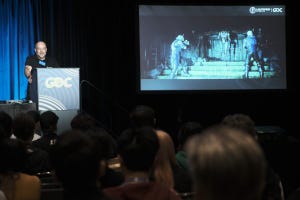
Nicklas Nygren and Chris Schlarb at GDC's Independent Games Festival

Night Game is your first videogame soundtrack, and perhaps some time coming, considering how much experience you have with games. When did you first begin working on the score?

Chris Schlarb: I began working on the music for Night Game at the end of 2007. My friend John Beeler, who works at Asthmatic Kitty--the label that I'm on--is a gamer, too. He sent Nicklas a copy of Twilight and Ghost Stories. At that point, I was not familiar with his work and it was rare for me to rap with people who are in both the independent music world and the independent game world.

What was it about Knytt Stories that led you to believe that a collaboration with the game designer could work?

I'm drawn to clean design and intuitive user interfaces. I love ambient music and experimental, abstract art. There are so few things in the videogame world that are sympathetic to those kinds of aesthetic decisions. When I played Knytt Stories, it had that atmosphere. It was so efficient -- like a 5 megabyte download -- crazy small.

What has been the reaction among fans of Knytt Stories to your working on the score in place of the game designer?

Nicklas has a rabid fanbase of people who are wondering everyday what he's up to. He maintains forums on his website, and one day he sent me a link, saying that they had some research on me. There were twenty people talking about me, like, "Here's Chris Schlarb's website!" "Here's what he did on this album!" And then some people were saying, "I like Nicklas's music better."

I am really not the person to call if you want music to sound like like a specific genre or idiom. If you like what I do, I'm glad you called me, because I can do that all day long. I have ideas about how music and sound can interact in a game. The blessing with Night Game was that I had total freedom. Nicklas knew my material, so he wasn't going to ask me to make something that was like something else.

Do you get the sense that Nicklas has a particular design philosophy?

Definitely. As I was playing the betas, I would see puzzles getting harder, little details to the landscape coming together. He has a very refined approach, which involves as much whittling down and cutting out of ideas as putting them in.

Some aspects of the game appear to be reminiscent of previous console eras, particularly the 2D gameplay. Did you feel nostalgic working on Night Game?

You know, I didn't, because I felt that the visual design of the game was so sophisticated.

It seems to me there are two schools of composing for videogames today. You either have the old school, retro style sound or you have the giant orchestral score to make a game seem like a Hollywood Blockbuster movie.

Which school are you working in?

Neither. Essentially, I'm working in a chamber ensemble mode of composing. I'm writing for around four instruments, but also incorporating electronics, found sounds and sound effects within the compositions, and I'm using live recordings of musicians on everything.

Are these recordings sampled? Are you using loops?

No. Once we understood that it was going to be on a platform, there were restrictions on time, four minutes per world. I started thinking that what I don't want... [hums the Mario Brothers theme]. That's genius, but I wanted something that was not repetitive. If you write one four-minute song for each world, it is going to be too predictable. At the same time, the game doesn't call for the music to change depending on the emotion of the situation.

What I decided was that I would utilize silence together with the sound designs by Nicklas, the sounds of the ball and the wind in the background, so that essentially, instead of writing a four-minute piece of music, I would write four to six thirty-second to one-minute pieces of music. Then what we would do is create an engine that would randomly choose from among the tracks for each specific world.

Is it really random?

It's totally random. In between each piece that is randomly picked, there would be an arbitrarily long interval of silence, anywhere from fifteen seconds to a minute. You're randomizing the pieces, and you're randomizing the silence in between the pieces. Once I had those parameters, I had a much clearer idea of how I was going to go about composing. I was in the home stretch.

How much time went by up until that point?

It was six months. Initially we had the pieces cross-fading, but it was too much having music playing constantly. I wanted to give the player some space, because you're thinking all the time in the game about how to work with this great physics engine.

Ultimately the music should be helping you play the game, not distracting from it. In general, I have this feeling that there is too much music in games and in movies as it is--that we are constantly bombarded by it.

Were you concerned at all that in allowing for these spans of silence that the soundtrack would feel too spare as a consequence?

I really was not, because it was a compositional decision to write these pieces to ebb and flow. When a piece comes in, the emotion is heightened momentarily. You might not even realize it consciously.

In terms of the gameplay, there is nothing resembling a boss battle that would require a special theme to focus your attention on that particular passage?

There are no enemies in the game. You have no nemesis, there is no adversary. Not to get all zen or anything, but it's essentially you versus you, and you're just a ball maneuvering through these obstacles.

Are there any games that you were reminded of during the making of Night Game?

What immediately came to mind was Marble Madness. I thought the music in that game was fantastic, and I actually did two arrangements of Marble Madness songs on marimba for fun during the early days of recording for Night Game.

Where did the recordings take place?

Initial recordings were done in Austin, Texas with my friend Nick Hennies on drums. When I returned home to Long Beach, California I recruited Anthony Shadduck on upright bass, Danny Levin on euphonium and valve trombone, and Andrew Pompey on marimba, mandolin and drums. The thing that I love about making music is that it's a deeply collaborative process.

What instruments did you play on the soundtrack?

Electric guitar, twelve-string acoustic guitar, piano and keyboards, marimba and percussion instruments, tabla, kalimba, I think there's some mandolin on there, weird things like a transistor radio. Each world has its own theme, but one of the tricky things was having the entire game be cohesive. All these had to work together on a macro level, world to world, and then on a micro level, in which the six pieces within each world work together. That was definitely tricky.

Will the soundtrack be made available online?

In the future, we may release all the music for free as a download after the game has been released. The strange thing is that it is not made to be listened to with no spaces in between. My hope is that people who are fans of my music and fans of the game already will appreciate it.

Night Game advanced trailer

[Images courtesy of Nicalis and Asthmatic Kitty. Photos by Jeriaska and Nari Mann. Find out more about the music of Chris Schlarb by visiting his official website.]

Best Of Indie Games: Hey Judith, Don't Be Afraid

[Every week, IndieGames.com: The Weblog editor Tim W. will be summing up some of the top free-to-download and commercial indie games from the last seven days, as well as any notable features on his sister 'state of indie' weblog.]

This week on 'Best Of Indie Games', we take a look at some of the top independent PC Flash/downloadable titles released over this last week.

The delights in this edition include the much-anticipated release of Braid for PC, an innovative 3D sliding tile puzzler, a Flash game with gorgeous visuals, a 'kiss-shmup', a multiplayer action game with real toy tanks to drive, and an experiment in narration from the melded minds of Terry Cavanagh and increpare.

Game Pick: 'Braid' (Number None Inc., commercial indie - demo available)
"The PC edition of Braid is out now on a variety of digital distribution channels. This Windows version has a couple of features which weren't included in the Xbox Live Arcade release, such as keyboard controls, multiple display settings, and an extremely cool level editor that will soon be put to good use by the community when extending the life and value of the critically-acclaimed gaming experience."

Game Pick: 'Cogs' (Lazy 8 Studios, commercial indie - demo available)
"Cogs is a sliding tile puzzle game where players must slide tiles around (some have cogs attached to them - hence the name), in order to line the toothy dials up and complete a number of different scenarios ranging from blasting rockets into space and ringing bells in time with each other. If these kinds of puzzles are your cup of tea, then there's plenty of fun to be had here."

Game Pick: 'Scarygirl' (Touch My Pixel, browser)
"Scarygirl is a completely free to play flash game which involves platforming, adventure, puzzle and even fighting-game style elements. The visuals are incredible and the content is absolutely expansive with over fourteen levels of gameplay to plow through."

Game Pick: 'RCTiger' (RCTiger team, browser)
"The concept of RCTiger is that a few remote-controlled toy tanks are connected wirelessly to the net, which can then be driven by players joining in timed battle sessions through their browsers. The 'World's First Remote Controlled Internet Battle' is now free as the wind, with battles happening 24/7 so there's no excuse not to give this a go."

Game Pick: 'Kissma' (Party-Tencho, browser)
"A score-based horizontal shooter with large blocky sprites and liberal use of vibrant colours, in which players must try to score as many points as they can under the strict time limit of sixty seconds. Quirky yet rather satisfying to play in short bursts."

Game Pick: 'Judith' (Terry Cavanagh and Stephen Lavelle, freeware)
"A new release from Mr. Rara Racer? Ooh la la. Judith is a collaborative effort between Terry Cavanagh and increpare, two developers known to the community for their imaginative and inventive games. Spooky, spine-chilling and intriguing are some of the words that could be used to describe this experimental work without spoiling too much of what it is all about."

April 17, 2009

One Step Closer To A Holodeck: Eon's ICube

Eon's ICube uses a combination of stereo projectors, stereoscopic glasses, motion tracking position trackers, and 3-6 walls that wrap scenes around their corners to give users the illusion of a "complete sense of presence" in a displayed virtual world.

The system also supports peripherals like force feedback devices, a gesture dataglove, and a wireless wand that looks like a power drill or a Romulan disruptor. Multiple users can walk around the setup at the same time, provided they all have their own pair of glasses. Here's a recent video of IDEO Labs taking the ICube for a spin (and almost falling over while trying it out):

[via Technabob]

Nintendo's Made in Ore, User-Generated Content

While Nintendo's user-generated content (UGC) features in its games haven't yet matched the scope of titles like LittleBigPlanet or Spore, the company has shown effort to include engaging UGC elements in its marquee releases such as Super Smash Bros. Brawl and Animal Crossing.

Nintendo president Satoru Iwata recognizes the UGC's importance in its future game, and explained at an investor meeting earlier this year, "The reason why we feel the potential of [UGC] through the Internet is because the fun that is generated by UGC can be appreciated by a higher percentage of our consumers as a fresh experience."

"There are some people, although they may be a minority, who love to create something creative, share that with others, and enjoy seeing other people being entertained or responding positively to their creation," he continued. "At the same time, [a] great majority of people are rather passive and love to applaud the creative efforts by others and enjoy playing with them. In other words, UGC has the unique characteristic that, regardless of their game skills, people on both sides can enjoy."

To really see how Nintendo's UGC offerings have evolved in the past three years, one should look to the company's first-party DS releases. In 2006, Mario vs. Donkey Kong 2: March of the Minis allowed players to create and swap levels with friends online. 2008's Daigasso! Band Brothers DX, a Japan-only game for composing music, enabled users to upload, download, and rate songs.

Late last year, the publisher released animation software Ugoku Memo Chou (coming stateside as Moving Notepad) for free through its DSiWare digital download platform. Partnering with Kyoto-based internet services company Hatena, Nintendo put up Ugomemo Hatena, a YouTube-like site where users can upload, download, rate, and comment on different animations. The animations can even be embedded on other sites, or, if the original creator permits it, remixed to make a slightly different or completely new cartoon.

The next release to flex Nintendo's UGC muscles? Made in Ore, an upcoming WarioWare game that enables players to create their own microgames, along with comics, sounds, and Famicom cart designs. Users can trade their microgames, comics, and records with up to 50 of their friends locally or online.

Made in Ore keeps up to two each of the microgames, records, and manga in an online personal storage area, so friends can access them at any time, according to Anoop Gantayat. As with Moving Notepad, users can edit games they've downloaded so long as the original developer leaves that option open.

There will also be an online shop for grabbing two new Nintendo-created games posted almost every week, games created by celebrities, and games that win Nintendo's periodic themed contests. The company will release a WiiWare counterpart, Asobu Made in Ore, on the same day with similar but somewhat limited functionality. Returning to its championing of connectivity, Nintendo hopes that users will transfer and play microgames between the DS and WiiWare versions.

Both Made in Ore and Asobu Made in Ore will both release in Japan on April 29th.

GDC Austin 2009 Calls For Session Submissions

[Our yearly GDC Austin conference is all about online games, and here's its latest call for papers, with community and social networking - plus audio and writing summits, and more (EXCITING!) summits to be announced - to the fore! More info follows...]

The organizers of Game Developers Conference Austin have started accepting submissions for the upcoming four-day trade show, to be held this September.

Proposals to present lectures, roundtables and full-day tutorials will be accepted for review by the GDC Austin advisory boards through Friday, May 8th.

Presented by Think Services, organizers of the Game Developers Conference in San Francisco, GDC Austin is a four-day event taking place at the Austin Convention Center in Austin, Texas from September 15 to 18, 2009.

GDC Austin focuses on connected games including online games, virtual worlds, and social networking. Submissions should address the most pressing development challenges for connected games related to business and marketing, design, social networking and community, services, production, and programming.

GDC Austin has also opened the call for submissions for the Game Audio Summit and for the Game Writers Summit. The Game Audio Summit is designed to elevate game audio development education, strengthen the community, and foster professional growth of the individual. The Game Writers Summit is dedicated to the art and craft of game writing, game narrative and interactive storytelling.

Said event director Izora de Lillard in a statement, "Now in its seventh year, GDC Austin will continue to serve the global online development communities through education and networking. Having developed an international reputation over these seven years for being the focal point of key learnings in the online games space, we are thrilled to return to Austin in September with expanded content focused on innovative designs and business models within connected games."

More information about the submissions guidelines, conference topics, and advisory board can be found at the show's official site.

2009 Bent Festival Featuring Chiptune Performances, Installations

The Bent Festival, the "annual art and music festival celebrating DIY electronics, hardware hacking, and circuit bending" is already underway in New York City, and will run until April 18th at The Tank. It's designed to entertain and educate both children and adults with installations, concerts, and workshops relevant to the DIY electronics and circuit bending scene. For the uninitiated, circuit bending refers to the act of "modifying the circuitry of battery-powered children's toys to create strange, new, and unintended sounds for creative purposes."

Chiptune group Burnkit2600 (music video below) will perform at one of Bent Festival's three nightly concerts, as will Tristan Perich, who was behind the intriguing 1-Bit Music project and will also have an installation at the festival. Jeff "noteNdo" Donaldson is slated to have his own installation, too.

Don "No Carrier" Miller, whose coding work can be seen in Pulsewave's fabulous ROM invites, will hold a workshop on "Soft Circuit-Bending on the NES," in which he'll show off open source software project glitchNES and explain how the NES Picture Processing Unit can be "abused and exploited to create stunning patterns and effects."

[Via True Chip Til Death]

Game Developer's Top 50 Developers Survey Opens

[Since our sister Game Developer magazine already has popular features like Top 20 Publishers, we expanded to also include Top 50 Developers last year, with some interesting results - here's a reputation survey you can fill out to help with this year's countdown.]

Sister magazine Game Developer has opened a public survey for the second Top 50 Developers countdown, used to inform upcoming research on the top developers in the industry.

The successful first chart, saw Nintendo Kyoto and Infinity Ward in the top two spots. Now, this new survey will help the authors determine the worldwide "top 50" developers, based also on statistics like sales charts, number of games released, and average game rating.

The magazine's survey, which can be found online here, allows all game professional readers to first score developers based on perceived reputation, on a scale of 1-10, providing comments along the way.

Second, the survey asks that persons who have worked with developers in a publishing, contract, or full-time basis rank those developers in terms of their overall value, including pay and perks, professionalism and competency, and how likely the respondent would be to work with the company again.

The survey is completely anonymous, and can be completed in full beginning today. It will close at the end of Friday, April 24, 2009.

Camille Young's Marvelous Mother 3 Sculptures

Just as Earthbound (Mother 2 in Japan) for the SNES included an official player's guide, Fangamer accompanied the recent release of Mother 3's fan-translation English patch with a Mother 3 Handbook, a 240-page guide brimming with game facts, secrets, and art.

Inspired by the clay models featured in the original Earthbound Nintendo Player's Guide, Camille Young, wife of Starmen.net (Mother online community) and Fangamer head Reid Young, created a series of impressive figurines for the new handbook, using "10-year-old scraps of Sculpey III polymer clay" and adding color to them with acrylics paint. Though the figures are small, ranging from 1.5cm to 4.5in tall, Camille spent around 12.7 hours on each piece.

I've gathered my favorites below, but you can see more of them and some in-progress shots on Camille's blog:

[Via 61 FPS]

Opinion: Why Raising 'Kane' Won't Help Games' Legitimacy

[In this new editorial, Gamasutra news director Leigh Alexander looks at that ever-ready comparison, Orson Welles' film Citizen Kane, looking at how relevant it is to any argument of games and legitimacy.]

The knell for deeper art, broader sophistication and greater maturity in games just keeps getting louder, but do we really know what we're asking for?

The question of "gaming's Citizen Kane," for example, has become so widely-echoed that it's begun to frustrate fans and industry-watchers alike. Maybe history will show us we've already got our Citizen Kane. Or hey, wait, aren't the cultural and practical differences between film and games so broad that it's useless to analogize?

There's nothing wrong with craving watershed moments for video games, of course. But problem with the Citizen Kane question, as with other similar demands, is that it's begun to reverberate wildly without any practical follow-through on what the answer might look like.

Being dissatisfied with the status quo is easy -- proposing practical alternatives or concrete answers isn't. It's easy to complain about the creative constraints of a hit-driven industry. And it's easy to take issue with the fact that a "recession-resistant", $21 billion industry still serves such a small segment of the market.

Because really, for the purposes of this discussion, it does. It may be fun to point to vague concepts like "casual gaming", "the success of the Wii," or any one of the thousand regular studies that purport that "the average gamer is a 35-year-old woman."

But while there is legitimate progress behind the vagaries -- audiences really are becoming broader, no matter what data you use to back it up. Peggle and Wii Fit don't really fulfill what core fans, bloggers, discussion groups, game critics and industry-watchers are really asking for: artistic legitimacy for games.

"It's a red herring, because we think that having a Citizen Kane will prove our artistic legitimacy, but masterworks are not how artistic legitimacy is proven anymore," says renowned designer and academic Ian Bogost.

If more internet commentators did a quick Wikipedia check before leaping into the debate, they'd see that the Citizen Kane issue is moot, anyway. Although its cinema technique helped movies fully come into their own, films were generally considered "artistically legitimate" right off the bat, so there's really no translatable parallel for games.

"The world doesn't work that way anymore," says Bogost. So as for raising Kane: "We should stop it."

According to Bogost, legitimacy simply can't be judged in the current era in the same way it could when we had few radio stations and fewer television channels, and all art and entertainment existed in individual walled gardens.

"Legitimacy has become distributed, a mesh," says Bogost. "We should all just work on our little vertex of the mesh, like we're weaving a big macrame of legitimacy."

That singular groundbreaking title we crave just won't appear. Rather than expect a Kane-like watershed masterwork, then, Bogost advises people look for multiple individual successes in the broader, evolving landscape.

"Success comes from earnestness, I think," he says. "When we work on ideas that are important to us and make them resound sonorously in our chosen medium, we create little peaks in its topology."

Bogost sees "earnestness" games like Braid, and in the work of Jason Rohrer: "He means it," he says. "It's about things he cares about and expresses well."

Perhaps such "peaks in the topology" indicate that games have not so much answered the legitimacy question -- but rendered it irrelevant.

Just for fun, though -- does Bogost think games have achieved the fabled grail of artistic legitimacy? "The squirrely answer is that I don't think artistic legitimacy exists," he says. "It's a fiction. The simpler answer is no."

Sinistar's Attract Mode Easter Egg

In a recent Gamasutra blog post professing his adoration and fright of Sinistar, Michael Molinari brought up an interview with the arcade game's creator Noah Falstein, in which he revealed, "There's an easter egg hidden in the attract mode, triggered by an odd combination of button presses that we've all forgotten, but soon I may have the chance to rediscover it."

Though Molinari was unable to find further details on the attract mode feature, commentor Ross Patrol located Jeff Vavasour's instructions on bringing up the easter egg, and created a video demonstrating the odd combination of button presses and its effects:

It's a complicated series of steps, but now you can look up the game's developers on Sinistar's screen whenever you want!

Gamasutra Expert Blogs: Pooling Ideas & Adding Rules

[Showcasing highlights from big sister site Gamasutra's Expert Blogssection, which we continue to be really delighted with, industry veterans discuss design collaboration, Resistance 2 frustration, and controversy over 'playing to win'. Go join up as a Gama blogger if you want to be part of the conversation, too.]

In our weekly Best of Expert Blogs column, we showcase notable pieces of writing from members of the game development community who maintain Expert Blogs on Gamasutra.

Member Blogs -- also highlighted weekly -- can be maintained by any registered Gamasutra user, while the invitation-only Expert Blogs are written by development professionals with a wealth of experience to share.

We hope that both sections can provide useful and interesting viewpoints on our industry. For more information about the blogs, check out the official posting guidelines.

This Week's Standout Expert Blogs

Ideas From Your Team: The Pooling Ideas Philosophy
(Bruno Urbain)

A designer's role is not simply to generate ideas, but also to collect ideas from the team and incorporate them into a coherent design.

Springing off a piece written by Game Developer magazine design columnist Damion Schubert, designers Bruno Urbain and Benjamin Dumaz describe the pros and cons of a number of strategies for collecting, communicating, and making use of ideas in development.

Choices: Not Just For Players Any More
(Dave Mark)

Responding to a Gamasutra piece by James Portnow about the distinction between "problems" and "choices" in game design, AI professional Dave Mark calls for more of the latter, and discusses the development mentality and realities that have led to a preponderance of the former.

Growing Up At Last
(Byron Atkinson-Jones)

Games industry workplaces are notorious for being more...informal than offices in many other industries. But how long can that last? Introversion producer Byron Atkinson-Jones speculates as to whether the games industry is finally growing up in the workplace, for better or worse.

Challenge in Games: Everyone Hates Nathan
(Trent Polack)

Drawing a distinction between meaningful challenge and induced frustration, developer Trent Polack points to Insomniac's Resistance 2 as a game that conflates those concepts a bit too much -- and he takes a brief look at the evolution of difficulty in games, then points to examples of other games with a more effective approach.

"Playing to Win" and a Philsophy of Competition in Gaming
(Mark Newheiser)

Spawning an enormous and in-depth debate in the comment section, Mark Newheiser takes issue with designer David "Machiavelli of competitive gaming" Sirlin's stated attitude on attitudes to competition in gaming, and argues in favor of the value of letting players impose their own rules on top of the game's own systems.

April 16, 2009

Sega Saturn Modded, Bagged

The child of an interracial coupling, this simple but effective Sega Saturn modification combines the shells of a White Japanese system and a Black North American console. Rising Stuff forumer Yoshimitsu points out that he added a blue LED, a switchless region mod, and a matching controller, too.

Note that the custom black and white console is sitting in between the rare Japan-only Hello Kitty Dreamcast and Skeleton Sega Saturn, both of which sell for crazy bucks. The Skeleton edition, the last produced Saturn model with a 50,000 run, is so great, Sega actually wrote "This is Cool" over its CD drive lid and controller.

In other Saturn news, fansite Segatastic noticed that Enterbrain's Sega Store has brought back its Saturn-shaped backpacks, over ten years after the company stopped production for the actual console. The nylon bag sells for a ridiculous $72 (¥7,140), and is only available in the less exciting and not-at-all rare color of gray

Victor Ireland and the Miami Game Machine

At a glance, Miami Law looks like the dozens of other DS adventure games that Japan seems flooded with. When it was announced for North America two months ago, I was convinced that it was a localization from D3 Publisher's budget Simple series, a suspicion supported by the game's middling 3D portions.

Miami Law has touches of Phoenix Wright, with segments devoted to examining crime scenes and interviewing suspects, but there are also action and puzzle elements. You can choose to play as two characters with different perspectives on the cases, police detective Martin Law or FBI Agent Sara Starling.

While Law's minigames put more emphasis on action, with car chases and touchscreen-based on-rails shootouts, Starling's segments are puzzle-focused, as she analyzes evidence and plays sudoku (I assume there's some loose connection between 9x9 grids and the case they're investigating). Another example of their unique perspectives -- during one of the game's car chases, you can either command the car as Law, or shoot at the escaping perpetrators as Starling.

It's a completely new title developed by Hudson in Japan, I later learned, and it's being brought to the States with the help of Gaijinworks, a relatively new (established in 2006) localization company founded by Victor Ireland. Those of you who played Lunar, Arc the Lad, or various other Japanese RPGs on the original PlayStation might remember Ireland as the former president of now defunct publisher Working Designs.

Ireland promises that he won't include any out-of-place Bill Clinton jokes, as many complained about after playing Lunar 2, but he will include a dash of comedy in Miami Law's police drama script. "The tone of the game would be similar to something like what we did for Arc the Lad, with maybe a little harder edge," he told Nintendo Power in a recent interview.

He has also made an effort to ensure that the game captures Miami's feel, bringing in hip-hop music production crew Miami Beat Wave for the soundtrack, and taking the Japanese development team on an extensive research trip through Miami that included visits to a local gun range and the Miami Police Department's gun range.

Ireland also went so far as to bring the Hudson developers to a cargo port, where they climbed hundreds of feet up into one of the port's cranes and sat "cowering in fear" for half an hour, according to Hudson's Amar Gavhane. I'm not sure how this played into the game's production, but who knows, maybe there's a portion in which you lift and transport huge cargo containers.

Miami Law will ship exclusively for Nintendo DS in North America this June. Konami plans to publish the game in Europe as Miami Crisis in September.

Arrested Development: 'Hard News'

[Semi-pseudonymous Game Developer magazine humor columnist -- and developer -- Matthew Wasteland discovers a hidden cache of news, from producer bug-tracking to Yuji Naka stalking and beyond, and is kindly presenting it to GameSetWatch readers.]

Game Journalist Totally Hung Out with Yuji Naka

San Francisco, CA — Area game journalist Benjamin Day recently hung out with Yuji Naka, one of Japan's top game designers, known for his involvement in seminal Sega titles such as Sonic the Hedgehog.

“Naka-san is totally awesome,” Day enthused. “He's super cool and I'm really glad I got the chance to meet him.”

At the most recent Tokyo Game Show, Day was lucky enough to be in a small group with some of the other guys from his work and some real-life Japanese people he knows, who said, “Hey, do you want to meet Yuji Naka?” And Day was like, “Of course I do!”

Day and his friends were led to an amazing shabu-shabu place nearby, which is not on any tour books or anything, you pretty much have to be Japanese and know the area to be aware it even exists.

The food there was just absolutely incredible, and you could never get it in America ever, not even if you had a Japanese girlfriend, which by the way would be totally sweet.

After the delicious meal, Yuji Naka made his appearance.

“I asked him a ton of stuff like, ‘What was Blast Processing anyway, and who came up with the idea for that term?’ And Naka-san was like, ‘Oh, I don't even remember, it was probably Tom Kalinske.’ We all laughed, it was really funny,” described Day.

Afterward, the group headed to a kind of traditional Japanese bar known as an izakaya and totally just hung out, chatting about games, life in Japan, and the future.

“He asked me what I wanted to see from him next, now that he's not at Sega anymore, and I told him, duh, make a real proper sequel to Nights! Not like that recent one for the Wii but a true follow-up, worthy of the original,” Day reported.

Day has since resumed his study of Japanese by watching anime, and now knows the proper translation of “scary,” “cute,” and “sister.”

Sound Designer in Marijuana-Use Shocker

Santa Monica, CA — A sound designer was found smoking marijuana back near the storage area of a local video game studio, according to several reports.

The man was not identified, but witnesses described him as having several days' worth of scraggly beard growth. He was heard muttering to himself about “stereo fold-down from a five-dot-one mix.”

Local residents expressed surprise at the sighting. “As if there weren't enough uncertainty in these times,” said one. “Now there's talk of a sound guy getting stoned! How much more can our world be turned upside down? What's next, the Q/A department?”

Local Producer Still Inept at Bug-Tracking System

Boston, MA — “Hey, what do I click to close a bug again?” called out Robert Cardinal, 39, to anyone who might hear him, on a recent Thursday afternoon in the office.

“Oh, crap,” he continued, “I think I just closed the wrong thing. Actually, did I delete it? I don't understand all these little icons. Christine? Christine, are you there?”

Production Coordinator Christine Vogel, 28, entered the office and calmly explained the basics of operating the bug database, as fresh-faced as the first time she ever did it.

“That's the ‘close’ button,” she said, pointing to an icon that resembled a green check mark. “Actually, I know that bug isn't closed at all—Frank just told me he hasn't looked at the caching code in over a week. You should keep that bug open.”

Mark Weston, the studio head who hired Cardinal, says that he was primarily looking for people skills when conducting the search for a new producer.

“Rob's good at a lot of things,” said Weston. “Maybe the nitty-gritty of operating the database isn't one of those, but what I really needed was a hard-hitting straight shooter who can tell it like it is.”

Weston explained that one of a producer's jobs is to fully understand the status of the project at all times, and to be able to communicate it when necessary. “Who could I rely on but Rob for that kind of thing?” Weston posed. Rumors of Miss Vogel fiddling with her resume during after hours crunch are as-yet unconfirmed.

New UI Code Created For All (non-German) Languages

Warwick, UK — Ian R. Hoffman, a programmer at Flinty Bruiser Entertainment, recently finished work on a complete user interface system for his company's next game that perfectly sizes text boxes to match average English word length.

The code, which Hoffman has dubbed BruiserUI, can handle both shell screens and in-game HUD elements. It includes support for multiple platforms and is fully double-byte enabled in order to support Asian languages.

“I made extra sure to check the longest words we could possibly use in our game against all of the text boxes, and it all lines up perfectly,” Hoffman said.

“Everything is readable and, best of all, there's no wasted space on the screen.”

When confronted with the possibility of German translations being longer than their English equivalents, Hoffman responded, “Eh? I'm sure it'll be fine.”

[Matthew Wasteland is a pseudonymous game developer who has a fairly common first name and who blogs at Magical Wasteland. Email him at mwasteland@gdmag.com.]

Follow Girl To Mars With Noby Noby Stats

As more and more players pick up Keita Takahashi's supremely odd Noby Noby Boy for PlayStation 3, stretching the worm-like Boy as much as possible to earn points, and then submitting those points online, they contribute to the PSN title's meta-game. That stream of accumulating points helps stretch Girl to different outer space milestones.

When Girl reached the Moon several weeks ago, a Moon stage was unlocked for all players. Girl's next goal is to stretch to Mars, which is considerably farther away than Earth's natural satellite.

To help estimate and track how long it will take before players stretch Boy enough to help Girl reach Mars, Evil Robot Stuff has put up Noby Noby Stats, a site collecting data from the official Noby Noby Boy site and presenting the information with graphs covering Girl's daily growth, the number of active Boys per day, and more.

According to current figures, Girl will reach Mars in an estimated 2700 days. So, quit wasting your time on the internet and get back to stretching!

Blanka, Mario, and Comic Characters Unite For Arcade Cab Art

With only a limited selection of paint colors, Jesse Balmer decorated this arcade cabinet, trading services with his "girlfriend's sister's boyfriend" in exchange for computer maintenance. Even with just the five or six colors, though, the cabinet looks fantastic!

One side shows Blanka breaking through a gray wall along with a Chinese dragon, Mario holding a grumpy purple goomba, a skull spider, and another character I'm unable to identify. The other side depicts a deteriorating zombie, Wolverine with his claws bared, Iron Man appearing very serious, an undead Thor, Doctor Doom shaking his fist, and Batman with what looks like a Charlie Brown shirt pattern patched to his chest. Wicked.

FCEUX Gives Mega Man Laser Eyes

Like the Super Mario Bros. hack that was popular on gaming blogs a month ago (and similar to the Super Mario Bros. 3 video making the rounds now), this modification of Mega Man 2 was made possible with cross-platform NES emulator FCEUX and its support of LUA scripts.

Using your mouse, you can drag the Capcom mascot -- or any other game object for that matter -- around, making short work of Quick Man's pesky stage and grabbing difficult-to-reach 1UPs. The hack also gives Mega Man laser eyes, which will track and obliterate most enemies with a single shot. Presumably, the laser eyes also make him more curious.

And, as JC Fletcher notes, the mouse control script enables you to live out your lifelong dream of jumping through a boss gate backwards.

Column: 'Diamond in the Rough': Forget 'Combat Mode Engaged'

Alpha_Protocol4.jpg['Diamond In The Rough' is a regularly scheduled GameSetWatch-exclusive opinion column by Tom Cross focusing on aspects of games that stand out, for reasons good and bad. This week, Tom looks at combat, dialogue, and other methods of engaging with game worlds.]

Combat is the biggest, most central game mechanic in most titles today, with platforming and environmental interaction coming in a close second. Even games for children feature extensive combat and platforming.

From Pokemon to Madworld, combat is the easiest and most popular method of interacting with and affecting the gameworld. And you can see why—developers are good at this. They’ve done it a lot, and they kind of have it down. When designers attempt to give gamers another set of tools with which we can affect the game and its denizens, gameplay often suffers.

There may be exemplary games that follow this route (Myst is the aging heavyweight of this genre, while games like Indigo Prophecy and Portal are examples of the newest generation), but for the most part, developers, designers, marketers, and even consumers have learned to steer mostly clear of such titles.

While I think it’s admirable that a portion of the industry still strives to forward the puzzle/adventure genre, it’s exciting to witness the evolution of other, less popular alternatives to combat. In particular, I like games that let the way I’ve built my character affect the outcome of the games. This kind of approach often manifests itself as RPG or RPG-lite gameplay elements, like those seen in many action adventure games today. Sure, you can change how you win, but you can’t change what you win.

There are of course, games that try to provide you with interesting choices and paths. The original Fallout games, Bioware games, Deus Ex, and others are all games that provide you with choices, both in game and in dialogue, that change the game world. A lot of gamers dislike this kind of talky, seemingly arbitrary interaction. It’s a bit like quicktime events: the fact that they aren’t a logical extension of the game’s main control/interface mechanic means that we gamers instantly feel divorced from play when forced to take part in such activities.

g179.jpgIf Not Run and Kill, Then What?

The solutions to this problem are not easy to discover. Many people argue that we just need to find better ways of integrating what we want (more cinematic, dynamic action sequences, in the case of action/adventure titles) into the actual baseline gameplay, as opposed to ghettoizing it in quicktime events.

There is another way to make non-combat (and thus, non “primary”) gameplay elements feel like natural parts of a game as a whole. After all, what I desire in my games has nothing to do with quicktime events; I want to see my character grow and change as an individual, and I want to be able to project myself - in combat, dialogue, and other formats – upon the world in a noticeable, effective way.

There have been games that turn dialogue into a character-based (and thus fluid, multifaceted) system, one that rivals combat and environmental interaction for gameplay hours and importance. Years ago, I would have pointed to the Fallout games as examples of these triple threat games, but more recently, Bioware and Obsidian have been furthering the genre.

It’s important to note that I’m not championing dialogue for dialogue’s sake. I dislike games with horribly lengthy chatty sections, badly written parables concerning the evils of vaguely paternalistic governments or dubiously overbearing corporations. I do, on the other hand, enjoy conversations and stories that I can guide in the direction that interests me most. If there’s an aspect of video games that needs a reboot, it’s the stories we are forced to sit through. Good writing goes a long way to alleviating this unpleasantness, but to really immerse myself in a game, I like to think that I’m not just making the computer-controlled characters horribly aware of my ability to kill them. I’d like to also have the ability to convince them of my intelligence, moral uprightness, apathy, cruel wickedness, or other character traits.

It’s true that lengthy conversations can take you out of the flow of play, but that’s only true if we remain stuck in the old paradigm by which combat, and combat-preparatiory actions, are what “play” is, with everything else more or less a diversion. It doesn’t have to be that way, though. True, when you’re playing through some “intense” action game, blowing up aliens left and right, it’s jarring when the action is broken up by a brief “story” scene, followed by a climactic boss battle.

Even games like The Witcher - which was heavy on story – feature the incongruous sights of vicious combat mixed with lengthy duels. But what if this distinction were broken down, and conversation, dialogue, characterization, and other “peripheral” gameplay elements meshed fluidly with combat, mutated it, or came to supplant it? What if the climactic bass battle was the story scene?

fallout_01.jpgFallout Leads to the Force

We already have examples of this kind of melding, sort of. Look at the original Fallout and Knights of the Old Republic 2. These games didn’t just include climactic battles of words; they also built their games around smaller, less significant conversations that still held sway in the game world. Throughout Fallout, your actions (in conversations) could change the way that the fates of entire towns played out.

Megaton and its companions inf Fallout 3 may be the present-day blueprint for world-changing quest outcomes, but the series was creating moments like these years ago. It’s surprising that we haven’t moved beyond those still relatively simple ideas. It’s surprising that Fallout is still one of the most suggestive titles out there for thinking about what the future of gameplay could look like.

Fallout is still one of the only games that allows you to talk the final boss into destroying himself. You could actually reach several different conversation-based endings, with the one mentioned above being a difficult, skill-based conversation option. Despite this praise, there have been games since Fallout that have included conversations of this magnitude and depth. It’s not actually that hard to do. All the designers need to do is hire good writers, implement a system that allows for character attributes to affect conversation outcomes, and you have a recipe for exciting multi-outcome conversations.

Today, games like Fallout are still rare. Luckily, even if we haven’t moved much beyond the Fallout model, there’s still a tradition of design built around those ideas. Obsidian (which is, after all, made up of Fallout and Planescape alums) continues this tradition in most of its modern games, especially KotoR 2.

In that game, there were the obligatory moral decisions to make, and alliances with enemies and party members to form. What stands out in an already well-written and constructed story are the sections where Obsidian channels Fallout strongly. One confrontation involves the main character and an old friend, now a possible enemy. Through verbal sparring, tests of certain attributes (force powers, powers of persuasion, etc.), and key branching points within the conversation, the player can significantly alter the tone of the narrative they experience.

This part of the game is also interesting in that it is the only really important or significant encounter in that hour-long portion of the game. That area was created mostly to showcase this “boss” confrontation, that consists entirely of words. It’s a bold move, and when done right, it proves that interactive, malleable dialogue can be a very powerful gameplay device.

903mal_2.jpgAll You do is Talk

While conversations like these make a case for good writing and dialogue structure, they are still seemingly unassailably static. You could, if you wanted to, leave your avatar blinking into the camera for hours, waiting to continue the conversation. There may be consequences for your actions, but unlike in game combat and platforming, there’s no time restrictions or time-based punishments. As such, you can unnaturally, peculiarly draw out conversations, thinking about each option.

Luckily for us, there are designers out there who obviously want to change this dynamic. Obsidian, again, is at the forefront of this nascent movement. Not content to use a radial, simple conversation hub (as seen in Mass Effect), in Alpha Protocol they’ve added a timer for each conversation tree. Thus, if a superior asks you for your assessment of a situation, or an enemy asks for quarter, you have your usual options, but you have to come to a decision quickly.

Not having seen this mechanic in action, I can’t say whether or not the conversations will play out as naturally as they did in Mass Effect, pauses and all. Conversely, this timer could make conversations unpleasant time-trial sequences, where you care more about beating the clock than picking an answer that’s interesting or in character.

If this idea succeeds, it could make conversations even more organic and flowing, something that most similar games desperately need. This is by no means the only area that can be evolved in this way. Most games suffer because of their careful insistence on discreet gameplay elements. They spend so much time trying to keep certain elements distinct, they lose sight of the benefits that can be had when disparate elements are successfully, unobtrusively melded.

Deep conversational options, combined with branching storylines (and thus branching gameplay) are not without their faults. Many games offer “branching” conversational paths but completely divorce these conversations from the actual gameplay. Between overly wordy, obtuse blocks of dialogue, and brief, badly written monologues, there has to be a better way. Alpha Protocol may not solve all of the problems of wordy, frequent conversations in games, but there’s a good chance it will turn a few more people onto the idea, or possibly even create a new direction for writers and designers.

alpha-protocol-20090317001122548_640w.jpgMore Than Just a Talker or a Shooter

Despite the tone of this piece, dialogue and conversation trees are not the only rebuttals to the violence-as-interaction problem the industry has. Obviously, environmental interaction and puzzle solving are viable alternatives. It’s interesting to look at how these different approaches to “playing,” “viewing,” and “solving” games have jockeyed for position over the years.

It used to be that text-based games were the best way to interact with certain stories and narratives. Now, the idea makes most people shudder. I’m not asking for a return to text-based adventure games, I’m just asking that games that emphasize non-combat primary interaction techniques not be viewed with doubting eyes.

[Tom Cross writes for Gametopius and Popmatters, and blogs about video games at shouldntbegaming.wordpress.com. You can contact him at romain47 at gmail dot com.]

GameSetLinks: Black And White And... Mad?

[GameSetLinks is GameSetWatch's daily link round-up post, culling from hundreds of weblogs and outlets to compile the most interesting longform writing, links, and criticism on the art and culture of video games.]

A slight return, via RSS craziness, for GameSetLinks, and there's a number of neat things in here, not least a couple of different posts about Konami and Atomic Games' Fallujah-set game, which seems to be causing some dissonance within video game commentators.

Also in here - further discussion on Madworld, a whole heap of Independent Games Festival-related interviews, more intriguing interviews with MMO gold traders, and various other sundries.

Zild jian:

Just own it « Word Games
Interesting because it mirrors some of the things we've been discussing in the office about Atomic's Fallujah game.

Wired: 'Games Without Frontiers: 'MadWorld' Is Black and White and Awesome All Over'
'What really makes MadWorld a breath of fresh air is how neatly it violates the tropes of modern 3-D realism.'

GameDev.net -- IGF 09 Interviews: Part 3
As always, GameDev.net does a great job of interviewing all/most of the IGF finalists, but it's difficult to find them on their site - here's Part 2, Part 1.

Six Days in Fallujah, One Small Problem - Shacknews
Another piece on the Fallujah game, and a really, really nice piece of writing.

Crispy Gamer - Column: Print Screen: Narrative Ludology in Three Somewhat Easy Steps
'It's a little odd that gamers and game journalists complain that games aren't taken seriously. In fact, games have proven to be a fertile, if still nascent, subject for Ivory Tower analysis.'

Gold Trading Exposed: The Developers Article - Page 1 // MMO /// Eurogamer
Interesting harshness in intro: 'Are those in the MMO industry really playing double-ball when it comes to gold sellers, launching their own sanctioned products while lambasting those who purchase outside the game?'

April 15, 2009

Hellgate (Not That One) Found, Released For Dreamcast

Other than its name, Hellgate for Dreamcast shares little to nothing in common with Flagship Studios' PC MMOARPG. Instead of bringing together Diablo and Doom, Hellgate was pitched by Horny Dog (an internal team of MTV Music Generator-developer Jester Interactive) as "a crossover between Quake and WipeOut."

The 3D shooter stars Hell's Angel Marv as he rides through the underworld, blasting away beasts and demons from a heavily-armed HellBike as he tries to find a way back home. Marv's bike is equipped with machine guns, gatling guns, grenade launchers, rockets, and more.

Hellgate was cancelled, however, in May 2005, several months after Sega announced that it would cease Dreamcast production. Horny Dog artist Steven Pick also noted that one or two members of the development team didn't have the game's best interest at heart. "I am extremely disappointed with this, as many of our team worked inhuman hours to try and rescue things."

Pick continued, "And although the art side of the game is more or less finished, the programming side of the game was inconsistant at best - Bigfish excluded, as he brilliantly communicated well with artists, changing code where necessary. We had spent 15 months developing the title, and although many of us felt we achieved so much, it wasn't enough to save the title."

The game was quickly forgotten as other consoles did their best to take everyone's attention away from the Dreamcast, and it didn't appear again until last February, when it was discovered by Assembler Games forum member Raylyd on a Dreamcast development kit that was auctioned off on eBay. Hellgate was dumped and a playable version was posted for others to download a month later.

You can watch 10 minutes of the game, including its cinematic intro, here, as recorded by Dreamcast Junkyard:

You can also see screenshots, artwork, and original press releases for Hellgate at this archived site. Horny Dog had big plans for the game, as it was supposed to offer online Deatmatch, Capture The Flag, Sumo, and Time Trial modes, as well as offline four-player Deathmatch and link-up Deathmatch modes. The team hoped that this would be the first Dreamcast game to support up to 12 players, too.

H-Game Features Hilarious Upside-Down Bug

Mink's latest hentai game Saimin Gakkyu, or Hypnosis Class, is already a strange (and likely sickening, to many) title in that it has players taking on the role of a hypnotist, manipulating and molesting students at a local school. One of the player's powers is the ability to convince characters to position themselves into headstands, providing for a below-the-waist view.

Failing to release the “headstand mode" before clearing the game, however, leaves the girls locked in this position in subsequent playthroughs, according to salacious Japanese culture site Sankaku Complex (NSFW). Thus, players may have a difficult time telling characters apart, seeing everyone upside down. I suppose this is a boon for foot fetishists, though!

Interview: Rohrer Talks Between Possibilities

[After his Innovation Award win at the IGF this year, our own Eric Caoili talked to feted indie designer Jason Rohrer about Between, inspiration and thinking different.]

Explaining Between to someone in words is fairly challenging -- and when you try, you feel you get a glimpse of creator Jason Rohrer's intention.

The prolific designer's already gained a rep for thought-provoking, layered work with free to download titles like Gravitation and Passage, and with Between, he takes his most substantial step yet into the arena of two-player games.

For details on his process and concept, we spoke directly to Rohrer about Between, winner of the Innovation (Nuovo) Award at the 2009 IGF:

What kind of background do you have making games?

I've been programming actively for twelve years, but only making games for three. At first, I just made a game or two here and there, dovetailed with my other programming projects (peer-to-peer systems), but over the past year and a half, following the minor success of Passage, I've been doing nothing but game development, and I released nine games in 2008. I just finished my 13th game, Primrose, recently.

What sort of development tools did you use?

I've used GameMaker for some prototyping and 1-week sketch projects, but all the rest of my games are programmed from scratch in C++. I use open-source development tools, with GNU/Linux as my main working platform. I edit in Emacs and compile using GCC, using Makefiles invoked from the terminal.

I've fallen in love with the open-source mtPaint pixel editing program, but I end up using The GIMP for a few graphical tasks, too. All the sounds in my games are procedurally generated directly in the code, so I don't use any audio editing tools. My cross-platform video and sound library of choice these days is SDL, combined with OpenGL as needed.

The upshot is that my games compile and run on almost every standard platform, and porting them to more finicky platforms is not very difficult.

What spurred you to create a two-player title with this theme of isolation?

After making a slew of single-player games, I started reflecting on the history of our medium. In fact, the vast majority of games were multi-player affairs before this strange little box called the computer came on the scene.

Are we missing something? Has our obsession with single-player blinded us a bit? Go was constantly brought up in conversation as one of the greatest, most beautiful works in our medium, despite the fact that it is a folk game with no "designer" behind it.

I found that if you wanted to make a single-player game with the depth and beauty of Go, you simply could not---at least not without relying on randomness as a crutch.

The beauty of deep two-player games comes from the back-and-forth question and counter-question of "here's my move, now how are you going to respond?" I've heard it described as two players making an endless series of puzzles for each other to solve.

Randomness accomplishes something similar in a game like Tetris, but it's just not as deep or satisfying, because it it doesn't respond at all to the choices that you make.

So I had it in my head for a while that I would never make another single-player game again. Crude Oil was my first two-player game, a 1-week game sketch about leasing and pumping oil reserves in a changing market. I knew that my next game had to be two-player as well.

As far as the subject matter goes, I really wanted to tackle something bigger and more ambitious than the themes that I had dealt with in my previous games. All of my other games could be distilled down into words pretty easily, and in some cases, they were (in my Creator's Statements), so why did I need to make them in the first place? Why not just communicate with words?

I was really impressed with what Jonathan Blow had done with Braid, and also with what he said about it publicly, that he simply could not put his intentions into words. After I played the game extensively and thought about it a lot, I realized that I had come to understand it pretty deeply, but that I couldn't really put my understanding into words either.

Braid is about something really big and complex, about humankind's relationship with this particular thing. Jon couldn't get his arms all the way around it. He couldn't corner and collar this beast, but he could point at it and hope that you could see at least part of it over there.

And that seems like a great utility of art: to express the complex and subtle things that we have trouble expressing in any other way.

So I wanted to make a game with that kind of ambition. I felt around in my life and mind, and I found this thing that had always intrigued me, this manifold of concepts that seemed to touch a lot of important human endeavors. I wanted to make a game about *that*. I sum it up in words as "a game about consciousness and isolation," but that's just a road sign pointing you in the right direction.

Since this "thing" that Between is about concerns our relations with other people (or illusions of other people, you never can tell), it was very natural to make a two-player game about that.

I didn't set out to turn multiplayer conventions on their head or anything like that. I set out to make a game that expressed what I wanted to express. Seeing the actions of the other player only indirectly was an important part of that.

Have there been any other multiplayer or single-player experiences that you've seen in other titles that you've admired with the same theme, or possibly with a similar approach?

Not that I'm aware of. Between was not directly inspired by any particular game. The inspirations came from the realm of philosophy instead, from the work of folks like Hume, Descartes, Quine, and Lewis, and of course from my own thinking along these lines.

Which came first -- the tower puzzle, or the sleeping/waking concept? Which was built around the other?

Sleeping and waking was an important part of my thinking from very early in the design process. We have the following problem: we like to believe that the people we interact with on a day-to-day basis are conscious entities just like we are, but then at night, we dream about people who behave like conscious entities too, and we can't seem to tell the difference until we wake up.

So, from early on, I was exploring this idea of differentiating the truly conscious from the non-conscious, distinguishing the waking state from the dreaming state.

Some of that ended up in the final game, but other parts did not. For example, there are no unconscious entities operating in the game---all artifacts are either produced by you or by your partner.

So I had this idea of waking and dreaming and trying to separate the two, and maybe the waking state would be the thing that joins the two people together. It took me a while to figure out exactly what the two people would be doing on these various planes. Trying to find each other? Trying to accomplish some task together? Trying to communicate something complicated to each other that ends up lost in translation?

At that point in my design notebook, I have the following real-life example: "I know what Braid is about, but I cannot communicate it to you." I wanted to capture something like that---how hard it can be to communicate something abstract to others that seems obvious to us.

The towers became a suitable metaphor for communication. You build it, and the other player might see it, but they might not understand it or read it the same way that you do.

Between ended up being a self-reflexive work in a way, because it's about this thing that I have trouble communicating. I build it (the game) and show it to you and say, "See what I mean?" You play it and scratch your head, and it might not make sense to you at all. But the game seems so clear to me, so symmetric and ordered. To you it might just be a jumbled, confusing mess.

Some people have pointed out that the tower construction becomes tedious after a few rows. That's also part of the point, because when you're driven to communicate something complex to another person, you often need to go to great, tedious lengths (like, several months of game development) to carry out that communication, and it still might not be fully understood by others.

What lessons were you able to take from your previous projects -- Gravitation, Passage, etc. -- and apply with Between?

The basics of game implementation have become easier and easier for me as I make more and more games. For example, I've been able to use the same music-generation code, with slight modifications, for all three of these games.

On the other hand, I decided to use full-blown OpenGL code for Between instead of manually rendering pixels to a frame buffer (which is what I did in Passage and Gravitation). There were simply too many complicated effects needed, like the block constructions morphing, and it seemed like it would take me forever to write pixel-manipulation code to do all that, plus it would end up being too slow without graphics acceleration.

But once you're in OpenGL, the tendency is to use smooth object motion and ignore pixel boundaries. Between still has a pixelated look, and I wanted it to be "real" about that. I took a lot of the things that I learned about screen blow-up factors and such from frame-buffer graphics and applied them in an OpenGL context.

The game is really complex in what players can do, and in what's available for players to accomplish; how would you succinctly describe the game and its goals to others who aren't familiar with the concept of art games?

Between is a game where you must interact with and communicate with another person through seemingly impenetrable barriers. The challenge comes not from what you need to do---build a tower of 27 blocks---but from figuring out how to do it with the limited resources at your disposal and how to communicate your need for help to the other person who is playing with you.

Between is a game that actually becomes *harder* if you take a peek at your friend's screen or chat with your friend as you play. That sounds impossible, but it is true.

Were there any elements that you experimented with that didn't work with your vision?

No, I fleshed out every major detail of the design in my notebook before I started implementing anything. The final game deviated very little from my notes.

Is the two-player setup and the method of connecting players -- "friend codes" and waiting at an undecorated screen for a stranger to play with -- what you envisioned from the beginning? Did you explore any other possible setups/methods.

From my experience with Crude Oil, which didn't use a centralized server, I knew that a centralized server was necessary to avoid firewall and router woes. But how do you quickly and easily connect to your friend once you both connect to the server? The use of codes seemed like the most elegant approach, instead of picking your friend from a lists of connected people or whatever.

You want to connect to your friend and to no one else. The use of a code ensures that this will happen. There isn't any other way to do it, at least not that I can think of.

Players can wait a long time waiting for another stranger to play with -- was this by design?

Connecting with a stranger is meant to be a fall-back mode for people who really cannot find a friend to play with. You never know when another person who is looking for a stranger might show up to pair with you, so you might need to wait for a while. But generally, you can't trust a stranger anyway---how long will she play before dropping out of the game and leaving you hanging?

It seemed like a less-than-ideal game experience all around: something that I had to support, but not something that I wanted to encourage. Hopefully, most people get bored waiting for a stranger and then try harder to recruit a friend.

But the long wait was certainly not intentional. Again, there's no way around it: you simply need to wait for another person who is also looking for a stranger-to-stranger pairing. That's reality, not a design issue. The wait is really a factor of how many people are trying to play the game at any given moment.

If you could start the project over again, what would you do differently?

Sorry if this sounds like a cop-out, but this project went pretty much as-planned. This was my 12th game, so there weren't any big surprises.

How did Esquire.com come to host the game?

They were doing a story about me for their "Best and Brightest" issue, and as part of that, they often ask the creative-types on the list to do a piece of work for the issue. For example, they had their B+B playwright write a series of mini-screenplays that their B+B actor fleshed out in a series of pictures. They wanted me to make a game for them, or at least give them a new game to distribute.

There was even some talk about an "Esquire Game," but that never panned out (what would it be about, Eskie chasing cheesecake?). I was in the process of making Between to submit to the IGF, and it just seemed like a natural fit.

You just released Primrose to iPhone, and before that, a port for your PC game Passage. Do you have any plans to release Between or any of your other previous titles to the iPhone platform?

Porting Passage to the iPhone seemed like a natural way to test those waters. It already had a bit of a following, and it only took me a week to get it working---a great crash course in iPhone development. Primrose was designed specifically for the iPhone (but it also runs on other platforms, too).

I don't have any specific plans about porting other games. Between would be a good fit in terms of technology, because of the always-on internet connection, but a terrible fit in terms of the iPhone's casual audience.

The other problem, generally, is that games which weren't designed for a touch screen generally don't work well on a touch screen. Passage is a perfect example, where my custom touch "widget" really isn't as comfortable as four arrow keys on a keyboard. Gravitation's controls are really twitch-sensitive, so I fear that it just wouldn't work. Between uses nine keys on the keyboard. How would I make something like that work on the iPhone?

What do you think of the state of independent game development, and are there any other independent games out that you currently admire?

The past year or so has seen the body of interesting, thought-provoking games grow dramatically. Unfortunately, I don't have time to keep up with new work as much as I would like to.

I've already mentioned Braid---that is by far the greatest work in the medium of video games, in my opinion. I've recently taken a strong liking to work of Daniel Benmergui. Also, I just played a few of the recent games by Terry Cavanagh, and I thought they were excellent.

Like Wii Sports Boxing, But Actually Hitting Something

Remote Impact doesn't just allow you to throw jabs, hooks, and body blows at thin air, it provides a "full body contact experience" allowing for punches, kicks, and charging bodies -- presumably, you can even throw 'bows at the game. Remote Impact's multi-touch detection system captures both the location and intensity of multiple simultaneous hits, so harder hits will result in more points.

Distance Labs, which showed off the project at Nordic Exceptional Trendshop (NEXT) in Denmark earlier this month, describes it as a "Sports over a Distance" boxing game, as it enables geographically distant players to trade punches, unlike Wii Sports's boxing game.

The company also believes that "the physical intensity of the game contributes to general fitness, weight loss and stress relief at the same time ... allows you to socialise and create new friendships over a distance in a fun way." Remote Impact also helps you deal with unresolved issues in your life, as seen here:

Best of FingerGaming: From Equilibrio to 24 Special Ops

[Every week, we sum up sister iPhone site FingerGaming's top news and reviews for Apple's nascent -- and increasingly exciting -- portable games platform, as written by guest editor Danny Cowan.]

This week's notable items in the iPhone gaming space, as covered by FingerGaming, include the debuts of Equilibrio and 24 Special Ops and free demo releases for Zen Bound and Galaga Remix.

- Fishing Cactus Releases Equilibrio in App Store
"After a successful debut on WiiWare earlier this week, the Fishing Cactus-developed Equilibrio premiered today in the iTunes App Store. Equilibrio is a tilt-based action game in which the object is to guide a marble through a series of traps and challenges."

- Top Free Game App Downloads for the Week
"3D Brick Breaker Revolution and Tap Tap Revenge 2 remain top picks this week, though competition in the Mafia clone genre has increased significantly with the recent releases of iMafia New York and Undead LIVE!"

- Free App Roundup, April 4th - 10th Edition
"This week’s free releases include demo editions of Zen Bound and Galaga Remix, along with free full versions of EyeCue and Mafia Wars."

- E-Poll Research: iPhone Users Buy More Games Than Other Gamer Groups
"Organizers of the MI6 Games Marketing Conference revealed yesterday that iPhone users buy more games per year than owners of any other gaming platform. The findings were based on a survey conducted by E-Poll Research in February."

- Bulkypix's Hysteria Project Escapes to App Store
"Told entirely through first-person full-motion video, Hysteria Project's gameplay largely revolves around decision-making and quick-time events. With fast reflexes and good judgment, your character will escape from a killer's grasp."

- Tap Tap Revenge Downloaded by 32% of U.S. iPhone Users
"Global Internet sales analyst comScore has released a report naming February’s top iTunes App Store downloads. Topping the list is Tapulous’ rhythm game Tap Tap Revenge, which the company claims has been downloaded by 32 percent of all iPhone users in the United States."

- Top-Selling Paid Game Apps for the Week
"Flight Control stays on top for the second week in a row, edging out new competition from the tile-arranging puzzler ParkingLot. Wolfenstein 3D Classic drops out of the top ten after a promising third-place victory last week, leaving ZombieVille USA to take its place."

- 24 Special Ops Sneaks Tiny Jack Bauer Into Your iPhone
"In 24 Special Ops, players will hunt terrorists, crack security codes, and chase suspects down crowded highways in an original storyline that takes place in the 24 universe."

Bubble Bobble All-Stars

I have an alarm that goes off in my apartment whenever anything Bubble Bobble related -- be it fan-made crafts or new Bust-a-Move releases from Taito -- appears on the internet. I woke up this morning with red lights flashing in my living room and my wall-sized war monitor displaying glowing spots of activity on a vectorized world map.

Sitting at my desk and pulling up a status report, I quickly identified the source of the early morning commotion -- handpainted Bubble Bobble Chuck Taylor All-Stars.

You can see more shots of Kass Healy's Chucks on her Flickr photostream. She has since added yellow, glow-in-the-dark laces to them, which sounds excellent, and which I guess explains why the nearby XO Lieutenant Commander has readied his launch key, preparing to send out a storm of nuclear missiles as soon as orders from the top arrive.

Graft Joins Think Services To Work On IGF, Gamasutra

[We're delighted to announce that Edge Online veteran Kris Graft is now working with us, both on the Independent Games Festival and contributing to Gamasutra - you'll probably see pieces posted to GSW from him in time, too, yay.]

Former Edge Online U.S. editor Kris Graft has joined up with Think Services to work as Content Director on the Independent Games Festival and as Senior Contributing Editor on Gamasutra, it's been announced.

Graft, who headed up North American editorial for the online version of Edge magazine for a number of years, will be working on the successful IGF event, helping to expand the judging pool and increase feedback for the 2010 Independent Games Festival and going forward.

He will be working closely with IGF chairman Simon Carless and co-chairs and Flashbang Studios indie developers Matthew Wegner and Steve Swink (Minotaur China Shop, Blush) to continue the event's success in highlighting the best indie games of the year.

In addition, Graft will be contributing daily to the double Webby Award-winning Gamasutra, which continues to lead the market in exploring the art and business of gaming.

His insight joins notable journalists such as Leigh Alexander, Chris Remo, Christian Nutt, Brandon Sheffield and Jeff Fleming.

All are also contributors to Gamasutra and sister publications including Game Developer magazine, and helping to contribute to Think Services' Game Developers Conference series of shows.

Doujin Shmup Cloudphobia Boxed, Now For Sale

Marsbound's brutal but gorgeous PC shoot'em up Cloudphobia is now available for sale as a boxed product through import retailer HimeyaShop. The Japanese game is presented in a 2D horizontal-scrolling format typical for the genre, but features dizzying 3D backgrounds alive with spiraling rockets and battling crafts. Each of the six stages has a time-limit, too, forcing you to recklessly dive into waves of criss-crossing bullets to neutralize incoming enemies.

A downloadable version for Cloudphobia has been out since last December, but those of you with digital download-phobia finally have an option to pick up the title. There's also a two-stage demo available through Marsbound's site, if you'd like to try it out yourself first. That trial, though, won't include this stunning level:

[Via shmups.system11.org]

GameSetLinks: Cleanup On Aisle Game Student

[GameSetLinks is GameSetWatch's daily link round-up post, culling from hundreds of weblogs and outlets to compile the most interesting longform writing, links, and criticism on the art and culture of video games.]

Continuing with the GameSetLinks goodness, even as Eric Caoili plants little seeds of wondrousness around these link round-ups, we start out with Nayan Ramachandran discussing the Western and Eastern markets, and some combination there-of.

Also in here - the top game design college ads, another interesting deconstruction of No More Heroes, a look at Metal Gear Solid 4 and camera angles, and all kinds of other fun.

Eight oh eight:

Cultural Assassination: Is Globalization Just Westernization? « High Dynamic Range Lying
'A global market does not mean a culturally united market. Culture is not something to be hidden from the public and to be worn as a yoke in private.'

Top 5 Game Design College Ads from 1UP.com
'I can't vouch for the quality of education these schools provide, but I can say a little something about their commercials, which are a non-stop cavalcade of hilarity.'

Press Start to Drink: No More Feminism: Postfeminism and No More Heroes
'In a postfeminist era where women are expected to occupy both roles as sex objects and roles as autonomous professionals... No More Heroes delivers an over-the-top, skewed reality that attempts to incorporate all of these contradictions and paradoxes.'

Visibility, Affordance & Feedback - The Quixotic Engineer
'To many people, video games are user-unfriendly software. Improving the UI design by applying proven principles will hopefully go a long way in opening up the medium to new audiences.'

Terra Nova: Medium Rare
'I thought [Jeff Kaplan's GDC] talk was further evidence of how Blizzard's success with WoW has a lot to do with their internal corporate culture.'

Daniel Primed:: Gaming Analysis, Critique and Culture » Analysis of MGS4’s Camera Perspective System and How It Fosters Unique Playing Styles for the Player (Essay)
'MGS4’s four modes of perspective each provide the player with various options for tackling the given situations on a spectrum ranging from stealth to action. Like layers of an onion, the further you move along, the further the supporting mechanics of one side tear away, revealing that of the other.'

April 14, 2009

Xenogears Perfect Works Translated, Now With English Scans

For all its cutscenes, there's a lot of unanswered questions and missing background information in Square's revered RPG Xenogears, likely left out as the studio rushed production due to budget and time constraints. Square cleared up a bit of Xenogears' convoluted plot with the release of Xenogears Perfect Works, a book featuring production notes, artwork, character profiles, information on the IP's intended six episodes (Xenogears was episode V), and more. Unfortunately, the book was only published in Japan.

While partial English translations have been available for several years now, Xenogears fan Ultimate Graphics proved his supreme devotion to the game by spending five months translating Xenogears Perfect Works, and then dropping the localized text back into its 304 pages. Finally, those of you who've waited over a decade for a complete account of Sigurd Harcourt's piercings, visible and hidden, can rest at ease.

Ultimate Graphics warns, however, that much of the Xenogears Perfect Works's information is already in the game, albeit buried in what seemed like hours of dialogue between Citan and Fei. "The game was perhaps not the right venue for a story of this magnitude," he says, "and it's plainly obvious from this book that they were still hashing out facts right up to the game's publication. An unfinished masterpiece."

The scanlation can be viewed here, but if you'd rather not click through and download hundreds of Flickr pages, the Something Awful forums has put up a torrent for the translated book. Ultimate Graphics also has other completed projects worth looking into if you're a Xenogears fan -- which you probably are if you've read this far -- such as a complete graphic script and a full mapping of the game created with screenshots.

[Thanks to Matthew "Fort90" Hawkins who tipped us to the scanlation's release.]

Quigley's Early Artwork, Screenshots for Spore

Maxis's senior art director Ocean Quigley has been posting a lot of concept art and in-game screenshots from Spore in the past month, sharing on his personal blog images of early creature textures and planet transformations.

He also has shared his non-work-related (but still very interesting) paintings and digital sculptures, along with screencaptures and details behind the art direction of Sim City 4, which he served as art director for, too.

As for the Spore images, I've picked out a few that I really like, accompanying them with Quigley's explanations behind the art and how they played into the final product.

This screenshot, taken from Spore's Creature phase, shows an unfortunate looking critter moments away from becoming another much bigger creature's lunch. Quigley turned up the depth of field effects for this still and others in this screenshot series, noting, "In-game, we tuned depth of field way back, people found it distracting, but for stills they really add to the sense of space."

The art director created this test render in Maya with an in-house exporter that outputs skinned, rigged meshes along with all of the textures. "Here I'm plugging all of those textures into Mental Ray's subsurface scattering material and using depth of field to make the creatures look like little realistic toys."

This art shows some of the patterns that the Maxis team was aiming for with procedurally texturing player-created creatures. He says, "In the course of figuring it out, I painted up this bunch of example patterns that we wanted to be able to hit. I wanted to get this level of structure out of our automatic skin painter, so that limbs, backs, fronts, etc. would be recognized and treated appropriately."

Quigley goes into more detail on developing Spore's system for texturing creatures automatically, working with Chris Hecker and Andrew Willmott on the solution. One challenge with the system was that it had to work on "all different sorts of creatures, no matter how many limbs they had or how fat or skinny they were."

Spore also needed a system that could "procedurally generate an essentially infinite number of planets", which could transform in different ways, changing from icy to overrun with lava, from dry to drenched, and so on. "This image shows a planet going through all those different states. The same landforms persist throughout. I was pretty happy with this series, it demonstrated that we could wrench a planet through all of these transformations and it would look good and represent its state clearly."

Quigley shares several videos, too, like this one of an early rig block experiment showing the transformation of building primitives. "The idea was that the player would be pulling on the handles effecting the transformations."

Here, you can see a view of all the celestial bodies above from a planet's perspective. Says Quigley, "I wanted to make the player feel like they were on a planet in space. Not just on a flat playing-field with a painted sky above, but actually on a planet, in a solar system, orbiting a star, with other planets visible in the night sky. Planets that you'd eventually be able to visit. I wanted the space above you to feel like a volume, not just a backdrop."

You can see more art and detailed explanations on Ocean Quigley's personal blog.

Interview: Why It's What's Inside Fat Princess That Counts

[Originally conducted by our own Christian Nutt at GDC, and massaged into shape by Leigh Alexander while Christian was on hols last week, this chat with the Fat Princess developers discusses the heavily multiplayer, pretty intriguing PSN exclusive.]

When Titan Studios' and Sony's upcoming Fat Princess was announced last year for the PlayStation 3's PlayStation Network, it made quite a splash -- for that kicky title, and for its slightly morbid twist on rescue-the-princess team play.

Multiplayer teams of up to 32 can battle royale for a rotund cartoon princess -- and can make things harder on each other by feeding her with sweets to make her heavier.

For obvious reasons, both the game's name and its central mechanic were a little bit sensationally controversial at the time Fat Princess was announced, but producer Chris Millar -- whose Seattle-based Darkstar Industries studio was bought by Epic China and renamed late in 2008 -- says there were no such intentions.

"It's not a social commentary; some people just took it too far," he says. "I think, while some people saw the negative, it just showed the game to a lot more people and got a lot more people talking about it."

"What it comes down to is most people saw that it was just a fun game—it's very light-hearted. There's these cute characters, but also they get blown apart with their legs and arms flying off."

In fact, Millar was surprised that response to the game focused primarily on the title and not on the "gallons of blood being spilled all over the place... people are more worried about the title than the fact that all of these people are just dying horrific deaths all over the place."

The juxtaposition of gore alongside cartoon visuals is a funny one, and Millar says the superimposition was an intentional appeal to wider audiences. "Some people like the cute and cartoony, and then when you get the satisfaction of a really cool death," he explains. "When you're playing multiplayer, it also brings in some of the hardcore audience that are kind of used to that player feedback online, when you really get a good bomb going off and blowing everyone to bits."

Lead designer Craig Leigh says the deliberate art style is also reflective of the game's "cheeky, irreverent nature."

"We also wanted an art style that, when you saw a screenshot, you'd say, "Oh, that's Fat Princess," Lee adds.

"And when you see a guy going under cute little bridges and flowers and then there's blood everywhere, you know that's Fat Princess."

So while Millar concedes to a "satire and irony" in the design and art decisions, he also calls it "credible."

"This aesthetic -- I don't think you could really pull it off if you didn't believe in the cute part of it, too," says Millar.

"It's funny; we see posts on forums and stuff and people are like, 'I thought this was Animal Crossing with swords, and then I saw blood all up the wall and it's awesome!'" laughs Leigh. "I think everyone else, like us, likes the juxtaposition."

The cuteness factor is actually a way to diminish some of the genuine frustration Fat Princess' difficulty level can invoke, according to Millar. "It's funny when you're playing and you're running around -- and then you just get taken out in a really funny way, it just really adds to it and it makes you laugh," he says. "When you get a good death of yourself, it's not a total loss, because you had a good laugh while you were doing it."

And Leigh notes one more reason behind the deliberate visual and thematic style: Fat Princess is a class-based, team strategy title with voice chat, and he says its depth is such that the cuteness factor acts as a "disguise and shroud" that lets players be drawn in gradually where otherwise, on mechanics alone they might be intimidated right off.

Millar says the design prioritizes customization: "There's a million different customizations with just how you can combine everything and make your character look," he says. "And then, just jump in and just have that simplification of, 'I'm wearing a mage hat; I can run around and throw fireballs'; I grab the warrior helmet: 'OK, now I've got a shield, and I can go out there and hack and slash everybody.'"

The different classes and abilities enforce the overall team play focus of the gameplay, Leigh adds. "Everything as a game has been designed so you can do everything on your own. You can chop down trees; you can build upgrades on your own. But when you work as a team, it's magnified; you can build faster and chop down trees quicker."

"You can carry the princess on your own, but if the others escort you, you move faster. All the mechanics are there to say, if you work as a team, you'll be more productive and more successful."

From a design perspective, then, Fat Princess is about incentivizing group play with efficiency boosts. Agrees Leigh: "As Chris said, if you have a warrior and he's on his own, he can go out and chop the enemy up but he will die eventually; if he's got two priests behind him, healing him, he's now this indestructobot who can kick ten times ass because he's constantly being healed."

But, Leigh adds, the game design always allows for ways to get back at your opponent: "Everything you can do, there is a counter-strategy for the enemy," he explains. "They can come and throw a chicken bomb and turn you all into chickens. You get like sixteen guys attacking your door -- one chicken bomb and the whole enemy team are chickens."

One challenge in a game like this, then, is balance, especially when the aim is to reach a large console audience who can be very meticulous about balance in their strategy titles. But Leigh and Millar say they're aware of the high standards.

"From the beginning, it was designed with balance in mind," says Leigh. "All the classes are designed paper-scissors-stone, the warrior is heavy and a lot of health and slow; you know, the classic balancing criteria."

Millar says that Sony's QA departments around the world have been participating in "Fat Tuesday" internal playtest days, too, to make sure every game system gets full experimentation and feedback sessions.

Initially, Leigh says, the team built the game based on five starting classes. "I would say, initially, the core design of the balance of the game was done on paper, but then there has been so much iteration since to what feels right," he says. "When we were playing the game, we'd got these five classes, but we wanted people to have more reason to upgrade, so we added the upgraded classes, and that's where the iteration comes in."

Early design planned for fewer total players, too, says Millar. "We had a lot more complex interactions that we wanted people working together; we realized that, as soon as people got in line, with the early tests we got everyone just started to kill one another."

"We even had our test maps; we started playing in the evenings, and we'd be playing for two-and-a-half hours just giggling because everyone would just blow the whole QA session because we'd start having too much fun killing one another."

Adds Millar: "We kind of realized from there that the battle and the cooperation and the kind of classes was really where it was at to make this game really fun, and that's where we started to put a lot more effort into the advanced classes and the balance and just tweaking that, and that's really where the game's evolved and come into its own."

And the need for readability is yet another tie-in to the simple, cartoony visual design. "If you look at every hat just from the camera perspective, you've got to see every class," says Millar. "As soon as you pick up that hat and pop it on, you instantly know what your role is... just as soon as you pick up a hat you know what your job is on the battlefield."

"Same with the UI, too," says Leigh. "We've kept everything very readable, very simple. You don't want to clutter the UI; you just have health and resources, and there's a mini-map."

One advantage to releasing Fat Princess over PlayStation Network is that when launching a downloadable game, the audience that purchases clearly has both the desire and ability to play multiplayer games.

"It's now the time where people can focus that as the majority of the fun aspect of the game, because you definitely have a guarantee that your market is already participating," says Millar.

Adds Leigh: "I think, as well, with it being PlayStation Network, it allows us to do something a little bit more original and quirky than a traditional box game."

"I'm sure if we tried to do something as a retail product for feeding a princess, we'd get a lot of strange looks. But the PlayStation Network allows us to do really original, independent things and bring a lot of fun to the product, doing the crazy things that we're doing here."

The final touch is community features: in addition to the voice chat, there's automatic matchmaking and server migration, along with other PSN features like persistent rankings, scoreboards and trophies.

"I think people are going to be actually quite shocked at how big and how much content there is in Fat Princess," says Leigh. The core philosophy is that simplicity and depth aren't mutually exclusive. "There's a huge, huge, deep game, so there's a lot to uncover and discover."

WayForward Explains DSiWare's Might Flip Champs at GDC

In the same vein as its Developer's Voice videos for indie WiiWare titles, Nintendo posted an interview with WayForward (Lit, Contra 4, Shantae) on its upcoming DSiWare title, Mighty Flip Champs. Shot at the Game Developers Conference and posted yesterday on Wii's Nintendo Channel, the video shows the first footage of the offbeat 2D puzzle/platformer.

Mighty Flip Champs has players switching between alternate mazes displayed on the system's opposite screens, appearing in the exact spot on the next maze (or "page", to use creative director Matt Bozon's book metaphor).

Voldi Way, Wayforward's "tyrannical overlord," also indicates that the studio might have more DSiWare titles on the way: "We have drawers full of our own ideas that we normally can't do. Just like WiiWare, DSi gave us an opportunity to do something that we're really passionate about. Mighty Flip Champs just happens to be the first [idea]."

Also appearing on the Nintendo Channel yesterday, this odd advertisement for Vicarious Visions' DSiWare release Mixed Messages, which plays like a mix of Broken Picture Telephone and Route24's LOL (Archime DS):

[Via GoNintendo]

Game Developer April Issue Debuts Salary Survey, Saints Row 2 PM

[Time to debut the latest issue of Game Developer magazine, as masterminded by my colleagues Brandon Sheffield and Jeff Fleming, and this one has both a revealing, developer-authored Saints Row 2 PM and the always much-awaited Salary Survey in it, yay.]

The April 2009 issue of Game Developer magazine, the sister print publication to Gamasutra and the leading U.S. trade publication for the video game industry, has shipped to print and digital subscribers and is available from the Game Developer Digital service in both subscription and single-issue formats.

The cover feature for the issue is an exclusive postmortem of Volition Inc.'s open-world action game Saints Row 2. The article offers insight on the challenges and successes experienced by the THQ studio while developing its well-received sequel. The piece is described as follows:

"The Saints Row series is, according to publisher THQ's own statement, second-place in the open world combat genre after GTA, which is not a bad category in which to come in second. Here, producer Greg Donovan works through how the team created in Saints Row 2 a title that was able to distinguish itself from the rest, fighting scope creep, team fatigue, and legacy tool problems from the first title."

The issue also includes the 8th Annual Game Developer Salary Survey, always a popular and useful feature:

"This year was a rough one, with 'these economic times' becoming the new corporate buzzword prefacing layoffs. This year's Game Developer Salary Survey doesn't fully reflect the changes in the climate, although the survey asks about layoffs and post-layoff placement, for the first time. In addition to that, you'll find the usual stats for all major disciplines, from coders through businesspersons, as well as details about who owns homes, and where, and regional stats for within the U.S., Canada, and Europe."

In addition, Rod Green of Intel's Project Offset discusses the crucial area of art pipelines, and offers a different mentality:

"In this artist and tool builder-oriented article Project Offset's Rod Green proposes a shift from the more traditional export-based art pipeline to an import-based one. While this approach won't solve all your art pipeline issues, Green proposes that it'll certainly improve a lot of them."

In addition, our regular columnists contribute detailed and important pieces on numerous areas of game development -- this issue, we include Bungie's Steve Theodore on the meaning of "art," Noel Llopis on touch-based interfaces, BioWare Austin's Damion Schubert on the nature of the design space, LucasArts' Jesse Harlin on dynamic scores, and Matthew Wasteland with his monthly humor column.

Worldwide paper-based subscriptions to Game Developer magazine are currently available at the official magazine website, and the Game Developer Digital version of the issue is also now available, with the site offering six months' and a year's subscriptions, alongside access to back issues and PDF downloads of all issues, all for a reduced price. There is now also an opportunity to buy the digital version of April 2009's magazine as a single issue.

MMORPG Controversy Rages Over... Resin Etiquette?

Players of A Tale In The Desert, eGenesis's PC indie MMORPG set in ancient Egypt, recently gathered on the game's official forums to debate over and complain about, of all things, resin etiquette.

Specifically, they deliberated over users "camping" next to resin-producing trees (possibly even running a resin-harvesting macro for hours), as well as the scoundrels who collect resin from a tree but don't "nick" it with a wedge so others can gather resin from it later.

As surreal as this all sounds -- and while some might dismiss it as users on a super-niche non-combat MMORPG having nothing better to do but argue about trivial issues -- it's not too different from players squabbling over resource etiquette in other MMORPGs, such as ores and herbs in World of Warcraft; players don't take kindly to people hogging limited drops and resources no matter what the game, especially if they're using a macro to automate their greed.

While ATITD's resin etiquette feuding raged on, another thread titled "Law - Resin Nicking Enforcement" popped up. Also a point of contention in the ATITD community -- "Flax Abuse Considerations". Pure awesome.

Opinion: Waypoints And Questlogs - Moving The JRPG Forward

[What can RPGs do differently to avoid their old pitfalls? Writer and commenter Nayan Ramachandran unearths some old chestnuts to make recommendations.]

I don’t think there is any question that I have an almost insurmountable devotion to the RPG genre. My very first RPG was Dragon Warrior for the NES. After it and Final Fantasy, my undying love for RPG genre was officially cemented. I have a healthy background in PC gaming, but just like any person whose gaming education was heavily based on console gaming, my most formative RPG years were spent playing games from Japan.

My entrance into Western RPGs started with Ultima VII. I had no console at home at the time, and my friends were all enjoying Super Nintendo RPGs like Illusion of Gaia and Final Fantasy III. I was looking for the replacement that would keep me going. I enjoyed what Ultima provided, and was always amazed by the series’ level of depth and freedom, but there was a certain je ne sais quoi about Japanese RPGs that I still missed.

When I finally got a SNES and returned to modern JRPGs with the Playstation, I was surprised to find that while games had moved forward in a storytelling and cinematic capacity, the games themselves were largely unchanged. The depth, freedom and malleability of Western RPGs that I had started to take for granted was nowhere to be seen. I was happy to be back, though, and enjoyed Wild Arms, Final Fantasy VII and its ilk without regret.

It’s now 10 years later, and admittedly, not a lot has changed. RPGs have become prettier, have better translators and occasionally sport new battle systems. Like the Joker raising his shoulders in disappointment after a hospital fails to self-destruct, I find myself wondering what can be done.

There’s so much ground that could be covered, but with executives begging for cash cows and a tough economy nipping at their heels, only those who have enough capital and/or guts will step up to the plate. Perhaps its not such a gamble, though. No one is asking for drastic and sweeping changes in the RPG formula over night. Gamers themselves treasure a certain level of familiarity in what they play, but little changes can go a long way to make a consumer truly appreciate the effort.

More Interesting Encounters

Screen wipes are old, even if they are still there to hide load times. Even those who still love the idea of the random encounter are tired of going to a completely different screen to start a battle. It chops up the pacing and lacks the smooth transition that a game largely based on adventure and exploration should have.

The solution is simple: be inventive with transitions. No game should have a player blindly run into giant hawks and sandworms without proper introduction. Passing through a forest? Thieves might jump out of the trees and ambush. Traipsing through a swamp? A large creature might emerge from the murky waters to capture its next meal. Don’t treat this as a replacement for random encounters. People love the excitement of an unpredictable environment. Dynamic enemy spawning does not have to be planned. It just has to be believable.

Make Each Encounter Matter

RPGs have a horrible habit of throwing “trash mobs” (useless, weak, time wasting enemy groups) at the player on their way through a forest, mountain range or dungeon. Especially in games where random encounters are the main course of battle, monster encounters are numerous and in many situations, not a challenge.

Encounters are meant to fulfill two jobs: initially, they are meant to provide an obstacle between the player and the boss creature of ultimate goal of the dungeon. Secondly, they are meant to be a source of strength and experience upon their defeat. Unfortunately, most RPGs tend to fulfill the second requirement but overlook the first.

When a game has enemies only to pad the world’s empty landscape and provide the player with the ability to grind their way to victory, the experience begins to wear thin faster than possibly intended. Higher risk and reward might be the best way to alleviate this. Make each fight count.

Increase experience gained and the difficulty of each encounter, but decrease the frequency of encounters. Instead of breaking up the flow of exploration with incessant and worthless fighting, make encounters a slightly more unusual occurrence, and make each one special and worthwhile.

Quest Logs and Records

This is a problem particular to the Japanese RPG. JRPGs in the past never kept any record of one’s progress in either the main story or in the plethora of side quests they might stumble upon. While some are starting to emulate the quest structure of MMORPGs and more Western-centric RPGs, JRPGs still manage to cling to incomprehensible idiosyncracies for no other reason than to infuriate the player.

Sega’s 7th Dragon has the ability to pick up quests from townspeople and even provides a fantastic quest log to keep everything in order. The quest log even provides a five star rating system that gauges the difficulty of the quest, and clues players in on how to proceed.

Strangely, though, the quest log can only be accessed at a Guild Hall in town, which means that if you forget what exactly you’re looking for in a forest you must return to the nearest town. It’s unnecessary, and reflects absolutely nothing about reality. Why can my characters not keep a notepad of active quests in the inside pocket of their armor?

Provide Waypoints

Why RPGs still refuse to give players markers on the map that identify the general area a player must go to in order to fulfill a quest is beyond me. Hybrid RPGs like Level 5’s Inazuma Eleven and Sega’s Ryu Ga Gotoku (Yakuza outside of Japan) give players waypoint markers for most quests, but other games refuse to follow suit.

Even Level 5’s less than stellar White Knight Story provided a useful waypoint system that made finding the next part of the story much easier. There are cases where waypoints should not be used (like forcing the player to search for a person or object), but there’s usually no legitimate excuse other than to artificially pad the game’s playtime.

Give Characters Life

JRPGs, now more than ever, have become painfully rote. Effeminate protagonists are more ubiquitous than the much parodied bald space marine, and player character archetypes (like the adorable lolita with an oversized weapon) run rampant. It would be wonderful to see developers break away from fan favorites and try to be a little dangerous. If that means choosing new and unusual settings and environments or even picking an untapped and strange art style, players will be open-minded enough, and they will thank you.

Additionally, try to add character interaction that does not interrupt the player experience. Cutscenes are not always the best way to develop characters. Exploring a large and empty landscape? Why not have characters converse in real time. Namco’s Tales series is famous for its skits, but with current hardware, it could be taken to the next level. Have players talk and comment in and out of battle, but add enough dialogue and content that players never hear the same comment more than twice.

Explore New Locales

This is a point that I belabored both in real life and in my writing, but I have little problem touching on it again. RPGs grew from Dungeons & Dragons and Wizardry, but that does not mean that the genre is irrevocably tied to Fantasy, or even Science Fiction.

Just like adventure games, why not explore other, more unusual locales? Inazuma Eleven successfully brought soccer into the RPG space, and Atlus’ Shin Megami Tensei series has long had its fingers in the pop culture pie, but most series and new releases seem happy to wallow in the tired fantasy pool. Sure, taking a chance can be scary, but when it pays off, it can be a huge success.

LED Super Monkey Kong For Meggy Jr.

Steven Read created what he claims is "the world's first LED Donkey Kong video game" for the Meggy Jr., Evil Mad Scientist Laboratories’ fully programmable handheld console with an 8x8 RGB LED matrix display. Other neat Meggy Jr. game projects include Darius Kazemi's roguelike and Rifflesby's Bejeweled clone.

Read has a video showing how closely Super Monkey Kong emulates the first stage of Nintendo's original arcade game, despite the portable system's limitations. There are a few differences -- the stage isn't limited to one screen, the hammer doesn't actually break barrels, and to beat the stage, players need to run under Monkey Kong's stomping legs and jump to hit him five times.

"There have been many raster, vector, VFD, LCD, even ASCII versions, but never LED," says Read. "The multi-colored LED matrix screen and the AVR microcontroller used here are fairly high tech compared to what existed back in the golden age of electronic video games when folks were coding up Donkey Kong clones left and right... The roughly 3000 lines of code I wrote for Super Monkey Kong were about as enjoyable as any I've ever written, and it compiles down to only 14K."

Best Of Member Blogs: From Games To Art (Or Not)

[Once again, the Member Blogs on Gamasutra are practically outshining the Expert Blogs, heh - and here's some Chris Remo-picked highlights from the last week or so. Participate if you have a chance!]

In our weekly Best of Member Blogs column, we showcase notable pieces of writing from members of the game community who maintain Member Blogs on Gamasutra.

Member Blogs can be maintained by any registered Gamasutra user, while invitation-only Expert Blogs -- also highlighted weekly -- are written by selected development professionals.

Our favorite blog post of the week will earn its author a lifetime subscription to Gamasutra's sister publication, Game Developer magazine. (All magazine recipients outside of the United States or Canada will receive lifetime electronic subscriptions.)

We hope that our blog sections can provide useful and interesting viewpoints on our industry. For more information, check out the official posting guidelines:

This Week's Standout Member Blogs

- Why Games Are Not Art
(Tom Newman)

To the neverending debates about games as art, Tom Newman would like to say: shut up already. Actually, he said it in a much more educated, eloquent way, delving into the gradual conception of the modern Western view of "art" -- and its arguable demise.

For his effort, Tom will receive a lifetime subscription to Gamasutra sister publication Game Developer magazine.

- Good Practice: Animation as Gameplay
(Christiaan Moleman)

In games, animation is not just a part of visual aesthetics -- it can add significantly to the fundamental gameplay experience. Here, animator Christiaan Moleman highlights the ways that games like Ico, Outcast, Assassin's Creed, and the Half-Life series exhibit that principle.

- GDC 2009 Coverage
(Jim McGinley)

For yet another week, the masterful Jim McGinley continues his somewhat insane GDC coverage. Standout lines include "You read that right. There were grapes in my sandwich," and "Computers - will they ever be fast?" Plus -- Jim identifies the ultimate commercially-released "first date game."

- Not Quick, Time-Consuming Events
(Aaron Pierce)

While not a new mechanic by any means, in just a few years, the quick time event has become practically ubiquitous across all direct-control-based game genres. But they have plenty of critics; here, Aaron Pierce deems them "lazy game design" and explains why. He calls for discussion in the comments, and gets plenty of it.

- Forget Fun. Is It Engaging?
(Reid Kimball)

The number of times meaningful discussion about games is waylaid by a dismissive comment like "Well, none of that matters as long as it's fun" is enraging to me -- and apparently to Reid Kimball as well. It's a vague term, and it doesn't come close to describing all the ways entertainment can succeed. Here, he argues for additional alternative adjectives such as "engaging."

April 13, 2009

Starpath Supercharger Prototypes Discovered, Uploaded

AtariAge community member Seymour stumbled upon an old box of forgotten Starpath Supercharger units and 15 prototype cassettes for the Atari 2600 given to him by a friend years ago and stored in his Dallas office. Developed by Starpath as an add-on module for expanding the 2600's RAM 49-fold, the Supercharger allowed for higher resolution graphics and larger titles, and could load games from cassettes.

Many of the prototype cassettes have been dumped and posted onto AtariAge, and forumers are currently analyzing the games to see how they differ from their commercial releases. The discovered prototypes so far include early versions of Excalibur and Labyrinth (which was released as Escape From the Mindmaster), as well as near-complete protos for Communist Mutants from Space and Suicide Mission.

[Via Retronauts' Twitter]

Sound Current: 'I Am Robot Makes Game - Shaw-Han Liem's VGM'

[Continuing the 'Sound Current' game musician interview series for GameSetWatch, Jeriaska catches up with Toronto's I Am Robot And Proud, who talks -- at least obliquely -- about his collaboration on Everyday Shooter creator Jon Mak's new game, plus his particular brand of electronic music.]

Toronto-based musician Shaw-Han Liem creates electronic music under the heading "I Am Robot and Proud." Following the release of his most recent album he performed in clubs in Tokyo, Fukuoka, Kyoto, Nagoya and Osaka for his Uphill City tour.

While away from the stage, he was participating in the creation of his first game project, a collaboration with Jonathan Mak, the designer of Everyday Shooter.

Previously Shaw-Han has designed both electronic visual media and sounds for his live performances. The subject of this discussion, coinciding with his live show as part of the 10-Bit Party at the Game Developers Conference, is his entrance into the world of videogame music and how visual design and the intersection between technology and artistic expression has inspired I Am Robot and Proud.

In talking about your first experience creating the soundtrack to a videogame, what was it about the project as it was initially described that appealed to you as a musician?

Shaw-Han Liem: Jon and I had actually been in university together, and been friends for a while before we started "officially" working together on this project. The first time I played Everyday Shooter, Jon brought a laptop and headphones to a show I was playing at a club in Toronto. He set it up in an alley and people started crowding around. I think the two of us have similar interests in exploring art, music and technology, and that was the basis for our collaboration.

Were there elements of Everyday Shooter that were reflective of your approach to I Am Robot and Proud?

While I think we share meta-level "vision", our approaches are actually quite different. Jon produces his visuals and music using code as the primary instrument - randomness is a big part of the fun of his method.

I think my own process is more like collage, deliberately layering things on top of each other to create a larger whole. For me the idea of giving up control to randomness is a bit scary, so the challenge for us was to merge these two approaches in a way that emphasizes what is fun about each of them.

Do you find there are aspects of living in Canada that may have influenced you both, in terms of your artistic outlooks and creative methods?

We both grew up around Toronto, actually a few streets away from each other. I think the great thing about Toronto is that it is a big city, but also feels like a small town in a lot of ways.

In a larger city with tons of stuff going on, the "game people" and the "music people" might operate in their own separate worlds, but in Toronto, everyone is kind of in the same boat, since it's fairly small. There is all this cross-pollination happening because everyone kind of knows everyone else, and everyone is trying to reach out to whomever is doing something interesting. Toronto has pretty good food too, which is important for hungry programmers late at night.

There is an interactive musical component to your website that I'm sure a lot of people comment on. When did you decide to add the musical houses and stars to robotandproud.com?

I made that little flash header around the time of my third album, which would have been 2002/2003.

Would it be reading too much into this image to see it as an illustration of the title "I am Robot," the way the child's head glows in time with the music, while he's plugging cables into an electronic keyboard?

I think there is a loose connection there, but definitely not something that I was consciously thinking about when I made it. I guess the name of the record "The Electricity in Your House Wants to Sing" kind of encapsulates the message - that machines are an extension of the human imagination.

Has it crossed your mind during the making of your albums that your music might suit a soundtrack, whether for a movie or a game?

It was never really something I thought about much in the past - although I followed games a bit, and watch movies obviously - I never really saw anything in either of those realms that I felt suited my musical style or approach.

It is only very recently that I've started to think about how to combine what I'm doing musically with people working in other creative fields. I did a tour in Japan in 2006, and a good friend of mine (musician 6955, also working on the game 'Fez') introduced me to some of the more off-the-radar game scene stuff in Tokyo.

That was when I was introduced to things like Rez, Electroplankton, and Tenori-on. It seemed like there was a lot of interesting ground to be covered in terms of games and music.

So I suppose what I'm doing now is the beginning of this experiment. The album "Uphill City" was recorded last year while I was working concurrently on fleshing out some of the game ideas with Jon. Also I've started programming my own visuals for my live show and doing odd jobs for TV commercial music and such. I'm slowly exploring these ideas about combining music, visuals and interactivity.

When I picked up your new album at Tower Records in Tokyo there was a bonus CD featuring a vocal track. What has been your experience in making these, since the 2002 release of "You Make Me This Happy"?

The song you probably got was a collaboration with a friend Heidi Hazelton, who is a friend and musician here in Toronto.

It's fun for me to work with vocalists and I've done things like remixing and collaborations in the past. I also play more "traditional" music with bands and such - but I think there is a certain universal quality to instrumental music that appeals to me. I think there is a kind of freedom there and also gives more room for the listener to interpret the music on their own.

You have had the chance to spend some time in Japan recently. Has the gaming industry as you observed it there at all influenced the visual element that you bring to your live performances?

This year around the time of Tokyo Game Show, Jon and I spent a month in Japan. I was touring for my last album and Jon was there to work on the game.

We had a place to stay near Akihabara, but actually I was touring around to various parts of the country for a lot of the time. I think we both took a lot of inspiration from that trip - not specifically Akihabara or the game scene, but from the city in general. It was just a good change of scenery for both of us.

Actually when Jon and I originally started collaborating, it wasn't to work on a game, it was to work on my visuals. He has a lot of interest in computer generated geometric art - he has a lot of interest in visual design but his primary tool is computer code. I had been doing simple experiments in the 'processing' environment, but working with him I've learned a lot of different approaches to designing visuals with code.

Will you be contributing to the visual style of the game?

The game and visual design are Jon's work - my contributions are in the music and designing some of the interactions (as they relate to the musicality).

Prior to publishing the album "The Catch" in 2002, did you struggle much with establishing a personal musical style?

I think every musician or artist goes about this differently, but for for me it has been a very organic process. I was playing in a lot of punk bands in my teenage years, but also studying computers. I started listening to electronic music and became interested in using the computer as a composition tool. I spent a lot of years just working on stuff in my basement, experimenting with all kinds of software and listening to all kinds of music.

Over the years I've incorporated a lot of things and been influenced by a lot of fellow musicians both in my home city of Toronto and also through touring and meeting people around the world. It's an ongoing process, and that is what makes it interesting - seeing something great (whether it is another musician, a piece of visual art, a crazy snowfall, a game) and finding new ways to think about your own music.

Your music is not characterized as "traditional", but has it been deemed out of the ordinary at times?

There are probably people who would think of music like mine as out of the ordinary, but I don't really look at it that way. I think it's natural for music to reflect the times and technology.

So, for example, if you look at a saxophone today, it looks like a totally weird and alien piece of technology - a giant hunk of metal with valves and levers everywhere, but then you look at the technology from that time - a steam engine, for example - and you can see the connection. Someone took the technology of that time and figured out how to make music with it.

I think the same kind of thing has happened with computers - they were basically created as number crunching machines but people have thought of ways to make them sing. To me, that is the really exciting part about electronic music right now. There is so much interest in finding new ways of using computer hardware and software to create new tools and new music.

Time lapse of Richard Serra's sculptures being installed at MoMA -- music from the album "Grace Days"

[The album Uphill City is available on Amazon and iTunes. Studio photo courtesy of I Am Robot and Proud. GDC photo by Jeriaska. Samples from the album can be heard on robot+proud.com]

Sonic The Hedgehog Bible: Never Before Revealed Secret Origins

"He was the fastest hedge-runner this town has ever seen!" [Mama Hedgehog] exclaimed as her family enjoyed tea and mealworms in front of a roaring fire. "I hope you all take after him," she said wistfully as she cast a loving eye upon Sonny.

Sonny looked up at the framed photos of his father which stood proudly on the mantel. The firelight cast strange yet comforting shadows on the earthen walls and ceiling of the burrow. All at once, the face in the picture seemed to snuffle and wink.

"Did you see that Mom? Dad winked at me! He's counting on me to be somebody great! Did you see, Mom, did you SEE?" said Sonny, jumping up and down, excitedly.

So begins the Sonic the Hedgehog Bible, an internal document collecting Sega of America's localized history and overall philosophy for the blue mascot character circa 1991, separate from Sonic's very different history in Japan.

"The bible was developed at SOA in-tune with getting the game from SOJ -- there was little to no exposure to the original Japanese fiction at that time," explains Dean Sitton, formerly a game counselor and designer at Sega of America, and the man responsible for giving Doctor Ivo "Eggman" Robotnik his proper name.

Sitton auctioned off the bible along with several other key documents from Sonic's formative years, which were then scanned and posted to fan community Sonic Retro.

The Bible, which went through several drafts, reads amazingly like fan fiction. One version has Sonny "Sonic" Hedgehog growing up in Hardly, Nebraska, where he lives with his family under a hedge beside a burger joint and plays pranks at a local bowling alley. A track coach takes notice of Sonic's speed and convinces him to join Hardly's track team.

Another draft has Sonic learning all his abilities from forest friends, picking up speed from Johnny Lightfoot the rabbit, and developing his Super Sonic Spin Attack with Chirps the chicken.

All of the stories detail Sonic's first meeting with Dr. Ovi Kintobor, who is trying to save the planet by searching for the Grey Emerald to stabilize the evil Chaos Emeralds he's collected. Kintobor initially befriends the hedgehog, helping Sonic train on a supersonic treadmill and lending him a pair of friction-reducing red sneakers.

Sonic's blue quills are explained with the "Advanced Non-Concussive Cobalt Effect" after he manages to run 186 thousand miles per second. There's also a cute explanation for all the computers scattered around the series' stages:

Kintobor installs PCs throughout the six zones of Mobius so that anyone passing by can input information that might lead to discovery of the Gray Emerald. He also has his Amazing Transforming Machine ready to zap the last bit of evil into the Gray Emerald and stabilize the other six Chaos Emeralds.

The Amazing Transforming Machine consists of thousands of gold rings that constantly flow good karma positive energy around the machine's core and cool it down as it transfers evil from one object to another.

Unfortunately, an ATM malfunction zaps Kintobor and a nearby hardboiled egg, turning the scientist evil and flipping his name around. I'm not sure if this is a result of the accident, but apparently he also likes to now eat eggs raw with a dash of tobasco, which I initially read as "raw eggs with tobacco." Either way, it sounds totally gross.

Chiptunes + Guitar Hero Controller

Icelandic micromusic artist CombatDave hacked this together with a Wii Guitar Hero controller, an imported Game Boy Light, music programmer/sequencer LSDJ, and Arduinoboy for MIDI-to-Game Boy communication. Dave explains the setup's technical advantages, beyond rocking out to Tetris tracks:

"Basically, the beauty of this approach is I can tailor exactly what gets output by which combinations of buttons, including chords, etc. At the moment it's set up for a minor scale, and in chord mode it plays powerchords. Also, the - button sends a midi CC which controlled the decay of the guitar synth in Ableton to allow for palm muting. The vast majority of these features could only be done in something such as Processing or (maybe) max/msp."

Here's a clip showing all the pieces that make this possible, as well as another short but wicked performance:

Ludum Dare Kicks Off This Weekend

Ludum Dare, the tri-annual 48-hour game development competition promoting design experimentation and rapid prototyping, begins for the fourteenth time this Friday, April 17th. (It was previously planned for this past weekend, but somebody's death and resurrection plus cameos from the Easter Bunny forced organizers to reschedule.)

In the competition, developers work alone on their projects around a particular theme, which will be announced this Friday after community voting for the theme closes.

Some of the dozens of nominees so far include distorted perception, werewolves, conspiracy, and giant naked men.

If you're new to Ludum Dare and not sure where to start, there is an enlightening FAQ you can look to, as well as several guides that will help you get acclimated.

In-Depth: Developers & Publishers - Making The Connection

[Continuing our attempts to do, hey, real journalism of some kind, Brandon Sheffield went to the Game Connection event during GDC and wrote up this piece on small developers perhaps feeling the pinch, but still looking for a deal.]

How do game developers and publishers connect, and what's the state of the market right now for those smaller game creators who want to sign a publishing deal?

We rooted out some details by visiting Game Connection at the recent Game Developers Conference 2009. The event is essentially 'speed dating' for an international group of developers and publishers.

A wide range of studios is represented, from smaller work-for-hire developers, to new studios showcasing larger technologies, to tools companies.

Developers sit themselves in small rooms adorned with their wares and demo stations, and publishers book meetings or peek in the door to see what’s up – but “these economic times” are changing up the landscape, and developers worldwide are feeling the pinch.

There were more developers at Game Connection this year than any other - but there aren't a whole lot more publishers out there, which means fewer meetings per developers.

We spoke with an eclectic cross section of development companies at Game Connection to see how they feel about the current state of the games industry, and how they plan to stand out:

Klei Entertainment
(Vancouver, British Columbia)

Klei’s claim to fame is saccharine-cute multiplayer downloadable games, from Eets on XBLA to Sugar Rush for Nexon on PC. Here, the company was showing off a single player XBLA title called Shank. Jamie Cheng, founder, gave us his publisher predictions for the year.

“I expect publishers to actually expect full games. I think they’ll be expecting more games that are already done. I think also the budgets will be smaller. Just talking to publishers already, last year there was a lot of Wii talk and DS talk, and this year almost everybody’s talking about Xbox Live and PSN. So there’s a lot of competition there.”

As for a single player game in this multiplayer world, is it a harder sell? “It totally is actually! And it’s a shame, because there are so many instances where single player works so well. And it would sell amazingly well, but there’s a lot of emphasis on multiplayer right now.”

Bip Media
(Hyeres, Paris, France)

Bip Media was pitching a DJ rhythm game for the Nintendo DS, among other products, and we spoke with business & marketing fellow Stanislas Berton on the difficulty of selling American publishers on a European dev house, given the strength of the Euro.

“Regarding the currency issue, it’s really difficult for us, because our cost is in Euros, and of course the price point here is in Dollars. So that’s one problem, and we have to find some way to make it work for us. But actually I think this crisis is a good opportunity."

"I think it was John Riccitiello who said that actually it’s a good time to clean up the house, and there were a lot of bad products on the Wii and on the DS, and a lot of publishers and studios took advantage of that. I think if you have a good quality game you can really stand out from the crowd, especially in the casual game market.”

Berton was also optimistic about Game Connection being in San Francisco, because; “I think there are not so many publishers wanting to come to Europe, not even to places like Germany, and the Japanese publishers, I think they’re much more likely to come to San Francisco.”

Santa Cruz Games
(Santa Cruz, CA)

Santa Cruz is mostly known for its licensed titles, but is currently also pitching more original titles, including a Nintendo DS scrolling shooter, playable with 3D glasses. Andrew “Tiki” Webster, technical art director, spoke to what he thinks publishers will expect from the coming year.

“We’re expecting for people to realize it’s gonna come back, and realize that ‘oh my goodness, we need to have product out.’ That’s what we’re hoping. We’re hoping that they see that it’s really going to be coming back, there’s no chance to stall, and everybody and their mother’s going to be playing games."

"so even though it’s affected so many people in our industry – it’s affected us, and it’s affected people we know – we’ve got an extremely positive attitude about it.”

Silverback Productions
(Dartmouth, Nova Scotia)

Silverback came to Game Connection with an episodic kids-oriented PC title: Ben & Kranky. Willie Stevenson, president and CEO, spoke about building original brands and pitching to publishers.

“Right now I’ll take all the support I can get. Right now I’m just a pup in the industry, so people that know what they’re doing to get the games out there, I just want to get revenue streams going."

"Eventually I think everyone will benefit from having a known brand associated with them. And I’ve gotten good response from it so far. The portals are looking at it, though the Asian connections I’ve made want to put it on a console. It feels console-y to them.”

As for whether publishers are responsive to episodic content, Stevenson says, “Some of them, like Atari for instance. Like (Atari’s) Robert Stevenson, as soon as he saw it he said – ‘this is exactly where you want to be.’"

"But some people shy away from that, and you don’t hear too many success stories. I think we have a sweet spot in our IP - the demographic. Sam & Max wasn’t targeted this young, and it’s also a game for kids who can’t handle the twitchy stuff, or the violence. It’s more like a storybook.”

Tragnarion Studios
(Palma, Balearic Islands, Spain)

Tragnarion hit the scene last year with its original (European-only) DS title Doodle Hex, and was pitching the sequel at Game Connection. Also, the company had a very early build of an Unreal Engine 3-based third person shooter. We spoke with CEO Fredrik Alm about when you decide to give up original IP, and assign a license to your product.

“When you have lots of mouths to feed. That’s the basic answer of that. Of course we want to develop the games that we want, and there are four of those that we have (here), but it also comes down to that you have to have income."

"And if someone comes with a really interesting license as well, you have to build the relationships with publishers, and their IPs are a great way in to establish a kind of trust. And therefore future work. If you do get your foot in the door somewhere big, that’s a good thing. And people get along well on licensing, like Kuju, they do very well.”

Spiders
(Paris, France)

Spiders was one of the few companies showcasing only large-scale titles, primarily a PlayStation 3 action RPG called Mars. CEO Jehanne Rousseau shared her thoughts regarding large scale games at Game Connection, and using the PS3 as a selling point.

“Most publishers were really interested in this type of game, because they’re looking for games for PS3. There are nearly no games on the console, but they begin to believe in it, so they want to find some games for it."

"And an RPG sounds good, because there are a lot of fans of this sort of game, but it reaches non-hardcores too. And the important point seems to be the fact that we are running it straight on the PS3. I haven’t seen everyone else here, but it seems there are not so many games running on PS3.”

Does it break the bank to make a game like this? “The budget is not so big, actually. We do not have to work with the Unreal Engine, as we are working with the Phyre Engine, which is free. It allows us to keep a normal budget. It’s just a three million Euro budget for three platforms. So you don’t need to be Ubisoft to be interested!”

Teatime Shows Off Face-Tracking, Upskirt-Peeking Tech

Teatime, the Japanese developer behind such popular hentai games as Sacred Plume and Love Death: Realtime Lovers, revealed a new title that uses a monitor-mounted webcam and face-tracking technology to "create a link between reality and the game world."

Dubbed Tech48, the PC game works similarly to Johnny Lee's head-tracking Wii experiment; it senses player movements, and adjusts the in-game camera's angle accordingly. For example, moving to the left will shift the virtual environment and show an on-screen character's eyes following you, while crouching will afford you a view up the character's skirt and help you sink to new all-time low in your video gaming career.

Here, voice actress Miyazawa Yuana, demonstrates Tech48's less perverted possibilities, though you might want to skip to the 1:25 mark if you don't understand Japanese:

Teatime is currently looking for testers, and is offering to mail free cameras and a trial of the game to a hundred applicants (presumably applicants located in Japan), according to game weblog Canned Dogs.

GameSetLinks: 3D, Or No To 3D? A Question?

[GameSetLinks is GameSetWatch's daily link round-up post, culling from hundreds of weblogs and outlets to compile the most interesting longform writing, links, and criticism on the art and culture of video games.]

Back once again with the ill behavior, or at least the ill link-havior, if that's even a word, and this set of GameSetLinks leads off with another discuss of Metacritic - but I think a detailed and interesting one, so there.

Also in here - Crispy Gamer on the Wild Pockets Game Jam, plus IGF retrospectives, alternative news gathering methods, and cartoon guys questioning the future of 3D in films (and perhaps therefore games).

Myths... busted:

Spectre Collie » Blog Archive » Generally Unfavorable
'None of the criticisms (or defenses) of Metacritic I’ve read have really described how deeply flawed the whole situation is.'

Crispy Gamer - Feature: No Sleep 'til Pac-Man
Really nice piece: 'In the case of the Wild Pockets Game Jam, held last weekend at Microsoft's Silicon Valley campus, the contestants had 24 hours to do their thing.'

Eegra: Chicken Wallowing Tit-Slags : Who Is Kevin VanOrd, and Why Is His Jaw Tired?
Kinda a sarcastic pointless takedown, but also quite readable: 'Kevin VanOrd is an editor at Gamespot and syndicated videogame journalist, but he’s also a pretty hungry guy.'

D-pad Studio's GDC/IGF retrospective
Noticed this a bit late, but there's a really nice detailed write-up of IGS, IGF, GDC etc in here from the Owlboy creators.

The newsroom: where alternate workflows go to die at Newsless.org
Again, an interesting conundrum for any journalist - what do you cover, how much, and why?

3-D is a Fad | Cartoon Brew: Leading the Animation Conversation
Relevant for games, too: 'The 3-D gimmick didn’t last in the 1950s, nor the 80s. It wasn’t because the process was more primitive - it wasn’t. Animated films (or any films) today are going to be successful in 2D or 3D, hand drawn or CGI, due to one thing: story - not special effects or 3-D.'

April 12, 2009

Dungeons And Dragons' Arneson: The Lost Interview

[Following the passing away of Dungeons & Dragons co-creator Dave Arneson, our buddy Alex Handy was kind enough to pass us a previously unpublished interview with the RPG legend, discussing his influences and design philosophy.]

The late Dave Arneson is the father of Dungeons & Dragons. With Gary Gygax, he designed the original rules for what was to become the world's first role playing game.

This all began when a couple of war geeks had decided to lay out some rules to allow their soldiers to move between games played. using sand pits to mark the movement of pewter miniatures, Gygax, Arneson and friends reenacted the battles of Napoleon.

But in the mid 70s, Arneson created Blackmoor, a fantasy setting which used rock, paper, and scissors to resolve combat situations. As time passed, the rules of Blackmoor gave birth to the rules of Dungeons & Dragons.

Since that time, D&D has grown and expanded, changing the face of gaming forever. With countless games based on the D&D property, and literally thousands of others influenced by the concepts from the game, D&D is an institution.

In this unpublished interview, originally conducted in 2004 but only now made available, Arneson discusses the genesis of the D20, the inspirations behind Dungeons & Dragons, and his views on game design:

So, where did you get 20-sided dice from?

We were in the very beginning using the six siders, but when we started doing the fantasy games, I dug out some 20-sided dice I'd purchased in England in the mid 60s.

I went to a game store -- well, a historical miniatures store -- in London, right off of... I think it was at Picadilly, I'm not sure. And I went upstairs to their gaming area and they had these little boxes of 20-sided dice, and I thought "oh, how cool!"

And so I picked up three pair, and I came back home with them and tried to introduce them into our military games, but the guys would have nothing to do with them.

We had several mathematicians, and working out percentages for six-sided dice was child's play for them, but it gave me a headache. So really, the dice sat there for three or four years.

Then we did fantasy, and I said "Hey, let's use this stuff for it." So when we started on Blackmoor, we started using 20-sided dice at the same time. Go figure. They're gamers, you know?

How did you decide on probabilities and percentage chances of the various things you could do? How did you translate real world probabilities into dice rolls?

Well, I could tell you I had it all planned out, but that wouldn't be true. And I could tell you I faked it all, and that wouldn't be true either. We adapted.

We started out using the Chainmail combat system. They had a fantasy supplement for Chainmail. I think we used that for two games. We quickly discovered it didn't work for what we were doing since they were mass-combat rules, not individual rules.

We were doing role-playing and they weren't role-playing. We started off our monster list, and I think Chainmail had only seven or eight monsters. So we quickly came up with twenty or thirty.

We tried setting them up in a matrix, but that didn't work because it was quickly taking up an entire wall. So, I adopted a combat system I used for Civil War Ironclads because they had armor class, hit points, all that stuff.

And we did that for the monsters, we assigned values to them: giants are big, orcs are little. We tried to make the creature's power similar to what its size was.

We tried to give each monster a special power that wasn't overwhelming, which was harder than I thought. It's easy to come up with incredibly powerful abilities, not so simple to make small ones.

What sort of computer games do you teach about?

Our students are required to produce a beta version of a game in order to graduate. I've been, in some respect, involved in somewhere around 200 games over the last four and a half years, games of all shapes and sizes.

I prefer the real-time strategy games. As I say when I talk about first-person shooters: my twitcher doesn't twitch quick enough to have me survive.

Of all the places that orcs appear, do you have a favorite? Tolkein? WarCraft? D&D?

I prefer David Sutherland's pig-faced orc myself. He's the original orc with a very pig snout on him. Because I thought it was so ridiculous it was cute. When they're used properly, I'd say the D&D orc.

When I say properly, that's not when they make them big and powerful. All too often the referee simply decides that they don't want to throw endless waves of orcs so let's just make them big and powerful.

I think that's a weakness on the part of the referee. I think they should be able to find a way to use them even if they're relatively weak.

What do you think the most important aspect of game design is?

Game mechanics. Making a balanced game. It doesn't happen very often, especially in computer games. The problem in computer games is they've got sequel-itis up the wazoo! Good grief.

We did a survey in class and the kids, all thirty-aught of them had to admit that there's very little under the sun out there. A lot of it's the publishers. They want to play it safe. They don't want to do anything experimental.

Look at the problem Will Wright had selling Maxis on The Sims. I mean, if my best game designer came up to me with a really weird off-the-wall idea, I wouldn't argue with him!

When I started gaming back in the 60s, there'd be one new game a year from the Avalon Hill Company. And it was a very good game, and again, good game mechanics is central. But you couldn't pick and choose.

But today, we figured out that, including shareware games, there's about 10,000 games produced, of which maybe a few hundred actually get into a store someplace. And maybe about a half dozen are worth playing.

These guys are under a lot of pressure to get the games out, and often times what happens is they don't really test them ahead of time. They have a lot of bugs and stuff. We get after our students about that. We know they've only got four guys and six months to get a game out. We've had some good ones, and we've had some that were so buggy they barely ran.

If you could jump on a development team and direct a project, who would you join?

Oh, I'd probably like work with the Neverwinter Nights people [BioWare] at some point. They seem to have a good notion about what to do.

I've learned enough about computers and programming from this school to understand this better over the last four and a half years. It's easy to say "Oh, they're not doing it right." But, could they do it any other way? Well, the answer is probably no, at this point. Also, you've got to get the game done in a couple of years.

What do you think of MMORPGs?

Well, at one time my entire family -- my son-in-law, daughter -- we were all playing Everquest. So obviously we've tried it out. There were some limitations in Everquest when you were trying to cooperate as a group.

Then we played Dark Age of Camelot, and that was better. It's getting better. When people can actually interact with each other and can be identified as participants, not just as an anonymous guy with a credit card, it makes it fun.

COLUMN: 'Game Mag Weaseling': Your Moment of Art Culture

['Game Mag Weaseling' is a weekly column by Kevin Gifford which documents the history of video game magazines, from their birth in the early '80s to the current day.]

cap121cover240.jpg

I'm a bit annoyed at Future's subscription department as they seemed to have stopped sending me all magazines except PlayStation: TOM even though my subscriptions don't expire for another few months on any of them.

Luckily, my rage was distracted a bit by Braid (PC), Tower of Druaga (Wii; still cannot beat level 41 with any kind of consistency after all these years) and the March '09 issue of UK design magazine Computer Arts Projects, which you ought to be able to find right now at Barnes & Noble if you're in the US.

I have never read this mag before, but it's devoted to all manner of art and graphic design, and as you'd expect, it's impeccably well laid out and very much arranged to look visually pleasing. This is apparently the first time they've devoted an issue to video games, which is a surprise considering it's been around for 120 issues, but it's a treat to read nonetheless. Some of the highlights:

- An interview with the lead art guys at Traveller's Tales, a group that seems remarkably bright and enthusiastic despite (because of?) their lot working on one LEGO game after another
- Jonny Duddle (a freelancer who's done all kinds of work for SCE Europe and other UK devs) teaching you how to do a turnaround sheet for a game character, complete with neato-bandito shots of the work-in-progress in Photoshop
- A profile on Deck13 Interactive, a German adventure-game maker currently ballooning in order to tackle for its first full-on 3D game project
- Another art guy, Jose Emroca Flores of High Moon Entertainment, doing the step-by-step on illustrating a game environment in Photoshop
- A quick tour of the best in game art over the past year, including comments from the art guys behind Braid, World of Goo, Fable II, Street Fighter IV, and many more
- Three illustrators tasked with creating the box art for a nonexistent game called Bob v killer pandas (their spelling), with humorous results
- One guy making a trendy-looking Flash game with Illustrator and ActionScript and showing you how over six pages

And way way more. Considering this is their first shot at video game coverage, they did a great job of extending themselves to the industry.

I used to get mail all time back in my hoary Newtype USA days from readers stating that the "How to Art" section (where manga artists draw something nice and show you how they did it) was their favorite. This, despite the fact that "How to Art" didn't really teach you anything.

Sure, the captions talked about shading and using this or that filter in PS, and doubtlessly what they say in their text is correct. But it's not like you'd know how to really apply this stuff unless you, like the artist bring profiled, practiced drawing for a few thousand hours first.

No, the point of the column (for the vast majority of readers) was that it's fascinating to see the creative process in action. If you dig that sort of thing, this issue of Computer Arts Projects is 100 pages of that for video game art. Expensive, but worth it.

[Kevin Gifford breeds ferrets and runs Magweasel, a site for collectors and fans of old video-game and computer magazines. In his spare time he does writing and translation for lots and lots of publishers and game companies.]

GameSetNetwork: Best Of The Week

Once again, the weekend is upon us - so time to recap some of the week's top full-length features on Gamasutra, plus some bonus original news stories and interviews from the site you might not have seen.

Hanging out in here - Chris Remo's excellent, wide-ranging interview with Bethesda's Pete Hines, plus Pascal Luban on playtesting, the history of Elite, a chat to Major Minor and Parappa's awesome Rodney Greenblat, and lots more besides.

Cash 4 gold:

Growing Your Long Tail: Hines On Bethesda's Keen Focus
"In this Gamasutra interview, Pete Hines, VP of PR and Marketing for Bethesda and product manager for Fallout 3, discusses the strategies that the company has developed for maintaining retailer and gamer interest in its titles."

The Silent Revolution of Playtests, Part 2
"Continuing his series on playtesting, ex-Ubisoft veteran Pascal Luban examines the practicalities of getting consumer feedback on your game."

Analyze This: Advice on Investing in Game Development
"The latest instalment of Gamasutra's 'Analyze This' asks a trio of analysts whether it's safer to invest in casual vs. core game development, and where they'd put their seed money if they had a chance."

Delicious Data Baking
"In this technical article, originally printed in Game Developer magazine late last year, veteran game programmer Noel Llopis looks at data baking - that is to say, the steps that 'take raw data and transforms it into something that is ready to be consumed by the game'."

The History of Elite: Space, the Endless Frontier
"In the latest Gamasutra-exclusive bonus material, originally to be included in upcoming book 'Vintage Games', the authors look at one of the most influential, but sonetimes underdiscussed video games of the 1980s - Braben and Bell's Elite."

When The Band Got Back Together: Rodney Greenblat's Return To Video Games
"As the visualizer behind the seminal Parappa The Rapper, New York-based artist Rodney Greenblat's whimsical style is world famous -- and he talks about his re-uniting with Masaya Matsuura for the Wii-exclusive Major Minor's Majestic March."

Bonus Gamasutra news links: Stardock CEO Wardell On Impulse Phase 3, Competing With Steam; Will Wright Leaves EA/Maxis For New 'Entertainment Think Tank' ; GamePlan Shows Halo 3: ODST, Final Fantasy XIII Top 'Purchase Intent'.


If you enjoy reading GameSetWatch.com, you might also want to check out these CMP Game Group sites:

Gamasutra (the 'art and business of games'.)

Game Career Guide (for student game developers.)

Indie Games (for independent game players/developers.)

Finger Gaming (news, reviews, and analysis on iPhone and iPod Touch games.)

GamerBytes (for the latest console digital download news.)

Worlds In Motion (discussing the business of online worlds.)


GameSetWatch [Twitter / RSS feed] is an alt.video game weblog from the people who run:


Copyright © 2009 Think Services