COLUMN: 'Might Have Been' - Nightshade
[“Might Have Been” is a kinda bi-weekly column by Todd Ciolek that explores the ways in which promising games, characters, and concepts failed. This week’s edition looks at Beam Software's Nightshade, released for the NES in 1992.]
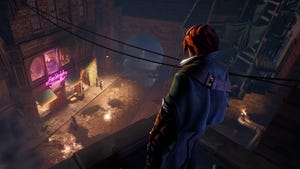
Nightshade is a strange one. At first impression, it’s very much like The Secret of Monkey Island, Leisure Suit Larry, King’s Quest and other adventure games of the ’80s, as it features a wry, semi-competent hero pointing and clicking his way through a joke-strewn world. Yet Nightshade is a little more than that. It’s also a popularity contest, a primitive fighting game, and a stunted attempt at creating a franchise.
It began as a simple idea: the higher-ups at Australia’s Beam Software wanted a “graphic adventure game that would be a whodunit,” according to Paul Kidd, Nightshade’s director, writer and lead designer. With vague orders to “fill in the details,” Kidd and the rest of the Nightshade team devised an offbeat superhero tale bearing a certain resemblance to later satires like The Tick or Mystery Men.
Not that it’s entirely cute. Nightshade’s prologue tells us that Metro City’s leading costumed hero, Vortex, was brutally murdered by a dog-headed crime lord named Sutekh, who’s since used all the local mobsters to conquer the entire region. Nightshade, an up-and-coming defender of justice, steps into this heroic vacuum with little more than a trench coat, a fedora, and a few caustic observations.
Metro City minus Mayor Haggar
Like many an adventure game lead, Nightshade’s unassuming and accident-prone. In fact, he starts his quest tied up next to a sparking bomb. Yet he’s not without defenses. Shortly after he gets free, he runs into what appears to be a bloated, hat-wearing British policeman, and the game reveals its biggest surprise: actual combat. The fast-paced fights, which crop up whenever Nightshade walks into a foe, are basic and strictly two-dimensional, but they’re also fair, never hitting Nightshade with anything that the game’s punch-and-jump setup can’t handle.
Punching is, of course, only one part of Nightshade’s quest. Explore the city, and you’ll find not only slinking female ninja and huge-headed thugs to battle, but also talking seagulls, hot-nut vendors, and legions of helpless citizens. This leads to Nightshade’s second innovation: a popularity meter. Good deeds, violent or not, boost the meter and earn our hero the respect of many. They also advance the game; an old man won’t tell Nightshade any secrets until he’s proved himself a hero, and a stuck-up clerk kicks him out of the newspaper archives if he isn’t sufficiently beloved by the populace.
Right game, wrong platform
Its fistfights and public relations aside, Nightshade progresses just as traditional adventure games usually did. Getting through it is a matter of finding the right items and talking to the right people, with occasional forays into jumping, bribing, or examining.
Nightshade’s options are many, though they’re a little hard to navigate with a stock NES controller. The genre was birthed through PC keyboards and mice, and Nightshade went against the grain in Beam’s choice of system.
“Nightshade was only done for the NES,” Kidd explains. “At that stage, Beam was basically only for the home game platforms. PC games had been abandoned by management as clearly being a dying art form.”
Every game needs Blood Snakes
Adventure games frequently lived by personality alone, and if Nightshade isn’t quite as winning as Grim Fandango or Sam and Max Hit the Road, it’s thoroughly enjoyable. The conversations are frequently amusing, and even the mundane sections benefit from the game’s cartoonish appeal. Despite the dark backgrounds and somewhat grim ancient Egyptian décor, Nightshade is very much a comedy. Yet it wasn’t easy to keep it that way during development.
“Typically, I would come into work to find that the über-boss had been pressuring my workers in the dark of night, and wild idiotic ideas had sprung into life,” Kidd recalls. “Ideas such as enemies whose heads could be severed, allowing giant blood snakes to form out of the blood hosing from their carotid arteries. So these sorts of things were eased onto the 'back burner' pile, and then the burners were turned on, incinerating these concepts for the good of all humanity.”
Co-designer: Snidely Whiplash
While Kidd and his team were able to ditch most of the bad ideas tossed their way, one setback couldn’t be avoided.
“We weren't allowed to have any battery-backed ROM,” Kidd says. “So if you died in the game, there were no save points!”
Lacking any save feature or password system, the development team devised an inventive continue system. Upon dying, Nightshade’s stuck in some convoluted death trap, and the game is truly over unless he figures out how to stop a conveyor, untie himself, or elude some other silent-movie fate. Die five times, however, and there’s no last-minute escape. Though novel, it all makes Nightshade a bit too demanding, recalling the rigid and deadly King’s Quest series instead of the smoother, friendlier LucasArts games.
Whoops
In the market, Nightshade’s luck was no better than its downtrodden hero’s. It arrived in January of 1992 as one of the last NES titles released on Konami’s Ultra Games label.
“The timing was exactly wrong,” Kidd says. “The SNES and Genesis came out as we were finishing up the game, and the NES died literally overnight!”
It put an end to a very ambitious plan. Nightshade was dubbed “Part 1: The Claws of Sutekh,” and, during its early stages, Beam intended to make it a major property. Later in development, however, inter-office tensions led to “deep reluctance amongst Beam to make too much of the game,” Kidd describes. Such drama also squashed any hope for similar NES adventure games that might’ve been in the works.
Yet Nightshade did get a sequel, if only in the spiritual sense. After wrapping up the game, the team was put to work on a Super NES adaptation of Beam’s newest license: the tabletop role-playing game Shadowrun.
From Metro City to Cyberpunk Seattle
According to Kidd, the deadline for Shadowrun was extremely tight, and he and the other staffers had about six months to assemble the game.
“That meant using the guts of Nightshade as the basis for Shadowrun,” he explains. “We made improvements and changes, but the basic concepts were pretty much the same.”
It’s not hard to see Nightshade’s influence in Shadowrun’s dark cityscapes, dialogue-heavy exchanges, and touches of humor. And it was the last of these that would fuel yet more discord between Beam’s management and its programmers. By Kidd's account, he and artist Jeff Kamenek took Shadowrun’s initially “serious” build and made some comedic alterations to the script and the artwork. When presented with both versions, the game’s distributor chose the humorous one, sparking ire among the Beam overlords who’d preferred the straight-laced Shadowrun.
Time enough for Nightshade
Kidd left the company to pursue a writing career shortly thereafter, and remembers that Beam quickly lost “most of the people who would have been their core adventure game designers.” The company’s work with the genre faded, and though its strategy series Krush, Kill ‘n’ Destroy was a hit in the late ‘90s, Beam never touched point-and-click adventures again.
If their efforts ran afoul of Beam’s business side, Kidd, Kamenek and the rest of Shadowrun’s staff have since been vindicated. Critically lauded in its day, the game’s now a cult classic among 16-bit RPGs.
Nightshade isn’t quite so popular, though it’s almost as fun. Despite some flaws, it carries itself with undeniable style, and comes off better than a lot of NES-based adventure games. It may have been doomed by corporate infighting and bad timing, yet there’s no denying that, in better circumstances, Nightshade could’ve gone on to greater things.
[Todd Ciolek is a magazine editor in New York City.]

Having
So most of the time, on the 'new' GameSetWatch, I'll be doing the multiple-link thing to lots of interesting external sites. But from time to time, we'll want to highlight an individual story that really makes a difference - and in this case,
I developed my enthusiasm for video games a little bit later than most. Although the arcade and microcomputer scene fired my imagination in the late seventies and early eighties, most of my young adult-hood was concerned with other things. I have no sugary nostalgia for Nintendo and Saturday morning cereal bowls. The Atari 2600 was something that other kids got for Christmas and were already bored with by the time I came to visit.
Formed out of black plastic, the Genesis model 1 looked modern and high-tech, comfortably taking up residence next to the VCR and stereo equipment. It came with a headphone mini-jack and volume slider as well as coaxial RF and composite video outs. The machine was also fitted with an expansion slot and a 9-pin EXT port. In Japan, a modem was available that utilized the port but it was not a success and the hardware was soon revised, removing the EXT socket.
The Genesis model 2 was a complete redesign released in 1994. Sega discarded the headphone jack and volume slider and simplified the video outs to a single 8-pin DIN port that allowed for RF or composite video. Other changes included a new power adapter (its yellow tip connector will not fit the model 1) and a 6-button controller.
In 1997, well after the Genesis’ glory days had passed, Majesco manufactured a low-cost version called the Genesis 3. Radically redesigned to be slightly larger than a game cartridge, the Genesis 3 had the model 2’s DIN video output but lacked an expansion slot, making it incompatible with the Sega CD. A revised chip layout inside also made the unit incompatible with the 32X and Power Base Converter as well.
First of many hardware add-ons that Sega produced for its Genesis console, the bulky Power Base Converter looked somewhat like an Aztec pyramid plugged into the top of the console and enabled Genesis owners to play most of Sega’s 8-bit Master System cartridges and chip cards. The device was really only useful for playing Phantasy Star which was commonly found in bargain bins at the same time. If your interest in Master System games extends beyond just Phantasy Star, it might be wiser to acquire a complete Master System because several games are incompatible with the Power Base Converter.
The Sega CD was a single-speed CD-ROM drive released for the Genesis in 1992 and represented the company’s first steps down a long road of hardware incoherency. Sega’s marketing promised a new dawn of lush graphics and deep game play, but the reality was pixilated, low frame-rate FMV and heaps of movie-licensed shovelware. The Sega CD was also incredibly expensive, costing more than the Genesis itself, and consumers were reluctant to invest.
Like the Genesis, the Sega CD was produced in two different versions. The first was designed to sit beneath the model 1 Genesis and had a motorized front-loading CD tray. The second version was redesigned to cut manufacturing costs and featured a top-loading drive sitting on a tray next to the model 2 Genesis. It could also fit a model 1 with the help of a snap on extender. Both versions had RCA audio outs and a small amount of on-board memory for saving games. Sega also produced a Memory Card that plugged into the Genesis’ cartridge slot.
The CD-X was a deluxe item that condensed a Genesis and a Sega CD into a single, portable unit. Enjoying a very short production run in 1994, the CD-X could operate as an audio CD player using 2 AA batteries but required a power adapter to operate as a game console.
Sega maintained an irrational commitment to its Sega CD format over the years and even licensed the technology to other manufacturers in hopes of growing the market. JVC created a device called the X’Eye that combined a Genesis and Sega CD into one elegantly designed unit that had microphone inputs for karaoke and a MIDI port that allowed connection to a music keyboard.
Pioneer produced a hybrid LaserDisc player in 1993 called the LaserActive CLD-A100, which had an optional module available that allowed the machine to play Sega CDs and Genesis cartridges, along with a small selection of LaserDisc formatted games called Mega LDs. For the truly obsessed collector, a TurboGrafx module was also produced. The LaserActive along with its game modules was astronomically expensive, ensuring that very few of the units were sold.
Released late in 1994, the 32X was a hardware add-on for the Genesis that would upgrade the aging console into a 32-bit machine. Considering that the Saturn would be released less than a year later, the 32X was dead at birth. By the end of 1995, Sega dropped the accessory and stopped making games for it. Not that anyone cared. In the history of consoles, even the most hangdog machine will have one or two games worth playing. The 32X is unique in that there is not even one game to recommend for it.
A hand-held version of the Genesis released in 1995, the Nomad was a good idea that did not work out so well in practice. With a cartridge sticking out of the top and a battery pack attached to the back, the Nomad was about the size of a shoebox. And while the 3-inch backlit LCD screen was luxurious, the Nomad’s voracious appetite for batteries would chew through six alkalines in less than an hour. An optional (and expensive) rechargeable battery pack did little to improve the machine’s portability.
The Neptune was a piece of one-off concept hardware created by Sega engineers that combined a Genesis and a 32X into one unit. Never seriously considered for production, the Neptune lingers in the minds of video game collectors like a mythical unicorn. Every few years rumors are passed about a forgotten warehouse somewhere on the Yokohama Bayfront, stacked high with dust covered boxes of Neptune systems waiting to fill orders that will never come.
The first time you see a Genesis “boat” it shakes you a little. Combine a Genesis Model 1 sitting on top of a Sega CD Model 2 with tray extender and top it off with a 32X unit. With a tangled nest of cords dangling off the back and three power adapters dragging behind it, the resulting mess is a shocking testament to failed dreams and misplaced loyalty.
So, I've been trying out Backbone and Konami's
Brooktown High is also well-scripted, in a knowing, slightly trashy Laguna Beach-esque way. And it plays like real life _generally_ is - if you're lead geek of astronomy class, then the head cheerleader is going to require extra convincing to actually dig you. That makes you more self-conscious and careful about who you approach. And you actually care about changing your clothes in-game (so girls notice) and targeting specific people who seem to like you for who you are.
What does that say about me, or the gaming medium? I'm not sure. And it's unfortunate that the actual mechanics of Brooktown High will prohibit many players from getting much pleasure from it - as GameSpy notes: "You only get a few minutes each school week to fraternize before rushing to class, which limits the amount of time you can dedicate to meeting other students or setting up dates."
Anyhow, there was a question, as you can see from the title of this post, and I'm still going to ask it. I'm aware that Match.com is a dating game, but Brooktown High offers an even greater opportunity to represent somebody who isn't yourself with no repercussions. So - can there ever be a successful Western dating game? Or is it just too niche, too odd, too taboo, and not something people want to be doing on their own, without real people?
We really are pumping out a good deal of original content at Gamasutra, Game Career Guide, GamesOnDeck, and our various other sites and events of late (ah yeah, and
Well, it has to be said that the reaction to the first couple of longer posts on the 'new' GSW have been excellent, with almost 40 comments between the
So, we at the CMP Game Group have just published the June-July 2007 issue of
So, still trying to work out whether this redesigned, 'cut down' GameSetWatch is actually taking me more time than the old one, heh. It's certainly more, fun, though, and judging by the enthusiastic response to a couple of the opinion pieces I posted, people seem to dig it. Onward and upward with a nice smattering of random links:
Just like with sex, the visual component’s a huge part of gaming. However, the text-only interactive fiction community’s
The other evening, I was happily playing along in Medium mode on
So I guess what I'm saying is that everyone has a certain combination of gameplay styles, visuals, music, effects, and personal loves that can come together in a special moment. And it's not quite the same as other creative media, because you're interacting with the game and affecting the outcome.
OK, the
Aha, time for the new-style GameSetWatch 'concatenate lots of random links into one place' concept - and there's everything from Crecente Winfrey's Game Club to fractal fighting action in this particular bouquet of goodness:
So, I was watching Julien Temple's excellent documentary
Something else I'll be doing more of is rounding up original reporting on the CMP Game Group's edit sites - which includes big sister
So, I'm delighted to announce that we've just set up a new website for
Jason Kottke has
Been trying to think a little bit about what GameSetWatch means to me, my employer, and the game biz, and so we're trying something new for a little bit.
Of course, U.S. arcade firm
At his Game Tycoon blog, Xbox Live Arcade portfolio planner David Edery has been